Home
» Android
»
Why the Galaxy S27 Ultra’s Rumored Battery Life Could Crush the Competition—If Samsung Gets the Efficiency Right
Why the Galaxy S27 Ultra’s Rumored Battery Life Could Crush the Competition—If Samsung Gets the Efficiency Right
The short answer: a bigger battery could matter, but endurance—not mAh—is what would make the S27 Ultra dangerous
The most important point is also the easiest one to miss: the Galaxy S27 Ultra does not need the biggest battery number in the market to become a battery-life leader. It needs a meaningful capacity increase paired with better power efficiency, strong thermal control, and charging that does not force users to plan their day around an outlet.
As of September 14, 2026, Samsung has not announced the Galaxy S27 Ultra or confirmed its battery capacity, chemistry, charging speed, or endurance. Recent reporting has circulated battery figures around 5,700mAh, with other numbers appearing at different points in the rumor cycle. Because none of those figures comes from Samsung, this article treats 5,700mAh only as an illustrative rumor scenario—not as a specification.
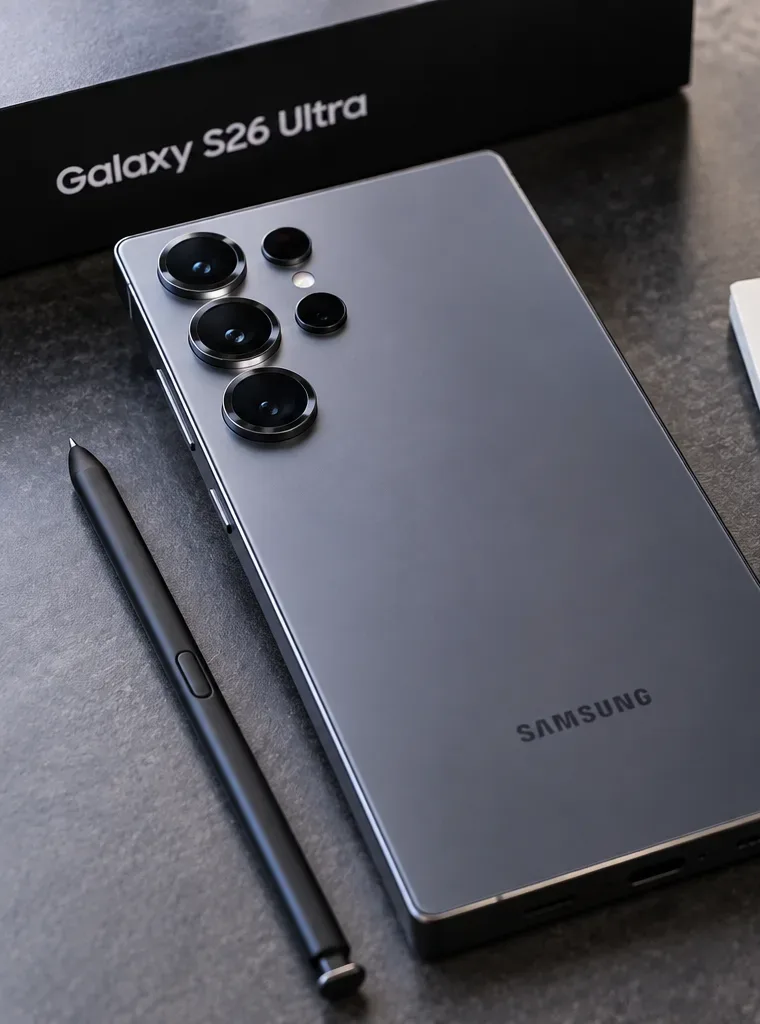
That distinction matters. Samsung currently lists the Galaxy S26 Ultra with a 5,000mAh typical battery, up to 31 hours of video playback, and up to 75% charge in around 30 minutes. A hypothetical jump from 5,000mAh to 5,700mAh would represent roughly 14% more nominal capacity before any efficiency gains are counted.
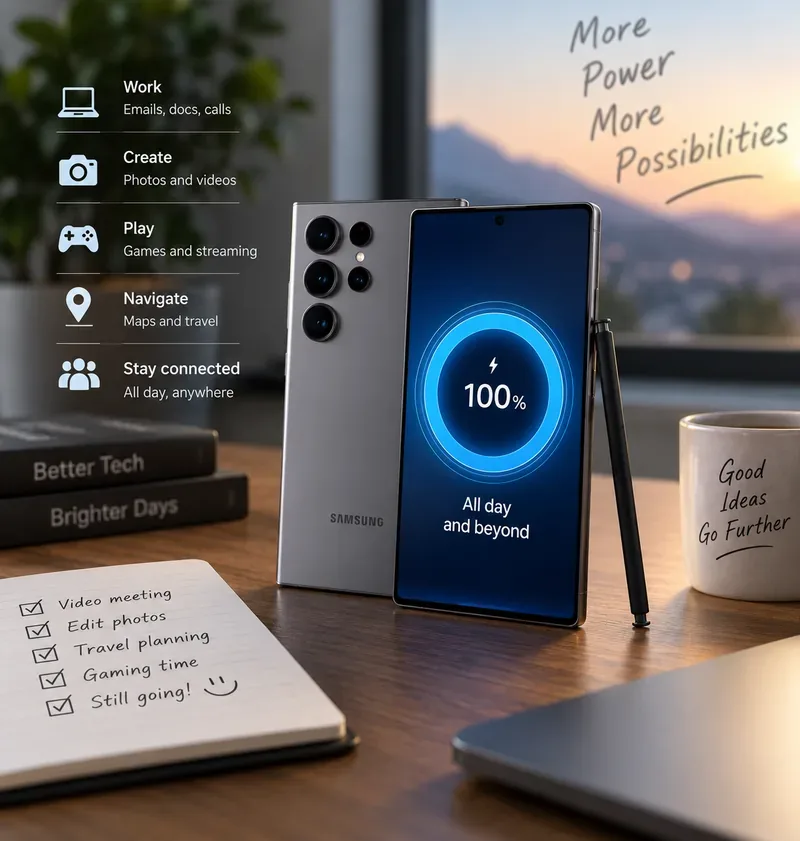
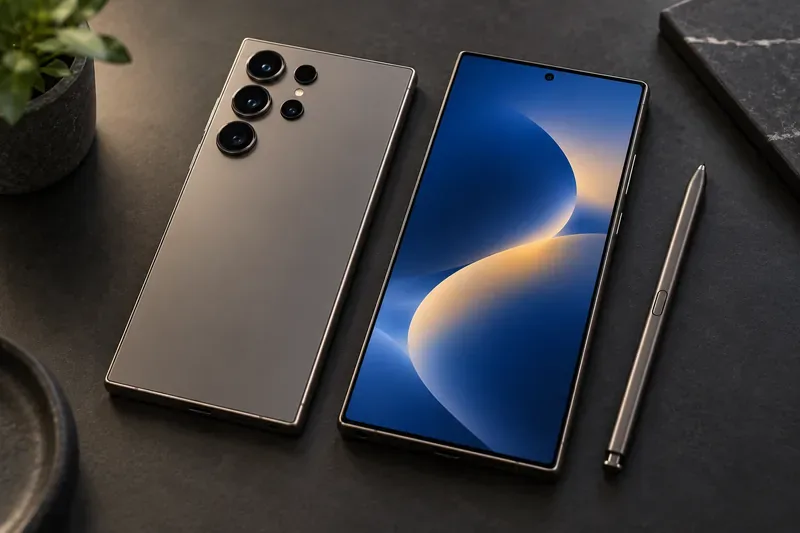
A flagship-phone scene illustrating mixed-use battery demands across work, photography, gaming, navigation, and connectivity. It does not depict confirmed Galaxy S27 Ultra hardware or software.
A hypothetical example: one long day without a charger
Consider a clearly hypothetical user named Jordan. Jordan leaves home at 6:30 a.m. with a fully charged phone, takes a train while streaming music over Bluetooth, uses 5G navigation across town, joins a 40-minute video call, takes photos and 4K clips at lunch, runs a hotspot for a laptop in the afternoon, checks maps repeatedly, and watches video on the ride home. After dinner, Jordan plays a graphics-heavy game for 30 minutes and then scrolls social media before bed.
This is not a battery test and Jordan is not a real reviewer. The scenario is useful because it exposes what “great battery life” actually means. A phone can post an impressive local-video number in a lab and still feel mediocre if camera use, 5G, hotspot activity, high brightness, background syncing, or sustained gaming drain it quickly.
For Jordan, the ideal upgrade is not simply “14% more battery.” It is finishing the same demanding day with enough charge left that battery anxiety disappears. That is the standard the rumored S27 Ultra would need to meet if it wants to feel decisively better than today’s flagships.
What Samsung has already proven—and what is still unconfirmed
Item
Verified today
What remains unknown for S27 Ultra
Battery capacity
Galaxy S26 Ultra: 5,000mAh typical
No official S27 Ultra figure
Video endurance
Galaxy S26 Ultra: up to 31 hours
No official S27 Ultra runtime
Charging
S26 Ultra: up to 75% in around 30 minutes
No confirmed S27 Ultra charging rate
Battery chemistry
Samsung has publicly used silicon-carbon anodes in its 2026 foldable engineering
No confirmation that S27 Ultra will use the same approach
Launch hardware
S26 Ultra is shipping now
S27 Ultra hardware has not been announced
Samsung has at least demonstrated that it is willing to change battery architecture. In an official 2026 engineering interview about the Galaxy Z series, Samsung said it introduced a silicon-carbon anode to improve energy density and redesigned the battery system while preserving a thinner form factor. Samsung also emphasized that the change required system-level work for stability, heat management, and charging—not just swapping one cell chemistry for another. You can read that explanation in Samsung’s engineering interview on the latest Galaxy Z series.
That makes a future silicon-carbon Galaxy S model technically plausible, but it does not make it confirmed. For the S27 Ultra, chemistry should remain in the rumor column until Samsung says otherwise.
Why a 5,700mAh-class battery could be more important than the raw number suggests
1. A 14% capacity increase would give Samsung more room to absorb real-world spikes
Using the illustrative 5,700mAh rumor figure, nominal capacity would rise about 14% over the S26 Ultra’s 5,000mAh battery. If everything else stayed equal, that extra energy budget could help during the activities that punish a phone most: prolonged camera use, bright outdoor viewing, 5G upload, hotspot service, navigation, and sustained gaming.
In Jordan’s hypothetical day, that extra headroom could be the difference between turning on power saving before dinner and simply continuing as normal. This is the kind of improvement users actually notice.
However, “if everything else stayed equal” is a major condition. Screen brightness, display refresh behavior, modem efficiency, processor load, thermal throttling, app behavior, and software scheduling can erase or amplify the benefit of a larger cell.
2. Efficiency can turn a moderate capacity gain into a large experience gain
A phone does not consume power at one fixed rate. Modern flagships constantly move among low-power idle states, short CPU bursts, GPU-heavy tasks, NPU workloads, camera processing, modem activity, and high-brightness display use. Better efficiency in any of those areas can compound the benefit of a larger battery.
This is why the strongest S27 Ultra outcome would be “bigger battery plus lower average drain,” not just “bigger battery.” If Samsung can reduce standby drain, modem power, background AI cost, and sustained display power at the same time, the real-world gain could exceed the percentage increase in nominal capacity.
3. Thermal management matters because wasted heat is wasted energy
Heat is not just a comfort problem. When a phone gets hot, performance and charging behavior may be constrained to protect the device. A larger battery paired with poor thermal management can still produce an inconsistent experience.
In the Jordan example, the hardest part of the day is not checking email. It is the sequence of camera recording, hotspot use, navigation, and gaming. Those are sustained workloads. If the S27 Ultra handles those workloads at lower power and lower temperature, battery life can improve while performance feels more stable.
How the current competition sets the bar
Official manufacturer claims are useful for context, but they are not a standardized cross-platform benchmark. Apple, Google, and Samsung use different test methods, software conditions, network assumptions, and definitions. The numbers below should therefore be read as each company’s own published claim, not as a direct laboratory ranking.
Phone
Official battery claim
Why it matters to the S27 Ultra
Galaxy S26 Ultra
5,000mAh; up to 31 hours video playback
This is the baseline Samsung must clearly beat
iPhone 17 Pro Max
Up to 37 hours video playback
Shows how high the mainstream flagship endurance bar already is
Pixel 10 Pro XL
5,200mAh; “24+ hour” battery life; up to 70% in about 30 minutes
Shows that capacity, charging, and software claims are already central selling points
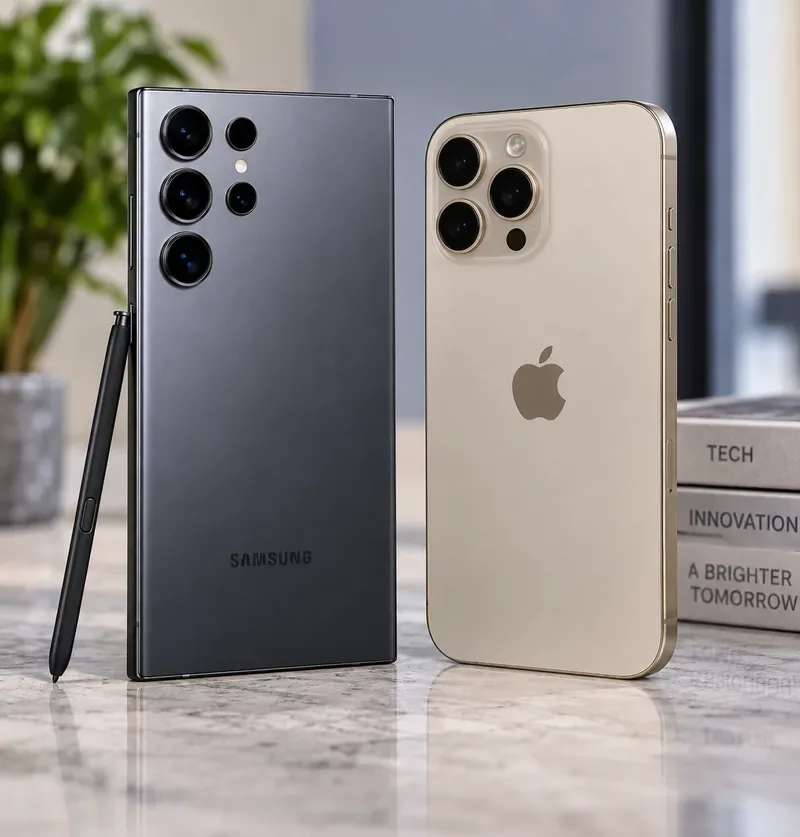
Apple lists the iPhone 17 Pro Max at up to 37 hours of video playback. Google lists the Pixel 10 Pro XL with a 5,200mAh typical battery, more than 24 hours of battery life, and up to 70% charge in about 30 minutes with the specified charger.
If the S27 Ultra launches with a battery around 5,700mAh, Samsung would have a larger nominal cell than the current Pixel 10 Pro XL. That alone would not prove better endurance. What would matter is whether Samsung converts the extra capacity into longer mixed-use runtime without adding unacceptable weight, thickness, heat, or charging time.
Where “crush the competition” is realistic—and where it is not
The phrase makes sense only under specific conditions. The S27 Ultra could create a major advantage over mainstream premium rivals if it delivers a clearly longer mixed-use day while keeping its camera, display, S Pen, and performance strengths intact. It would be especially compelling if heavy users could stop carrying a power bank for ordinary workdays or travel days.
But a 5,700mAh-class battery would not automatically dominate every Android phone. Some devices prioritize very large batteries, thicker bodies, lower-power processors, or different charging trade-offs. Battery leadership has to be defined by the target user and by comparable testing.
For Jordan, “crushing the competition” would mean something concrete: leave home at 6:30 a.m., use the phone hard across 5G, camera, hotspot, navigation, and entertainment, and still reach bedtime with a comfortable reserve. For a light user who already ends the day at 50%, the same upgrade may be less meaningful than a better camera, lower weight, or longer software support.
The four conditions Samsung would need to satisfy
Deliver a real capacity increase. A move from 5,000mAh to roughly 5,700mAh would be large enough to matter on paper. A much smaller increase would put more pressure on efficiency improvements.
Improve efficiency at the same time. Display, modem, processor, AI, and background-task power need to move in the right direction, especially under mixed 5G use.
Keep heat under control. Endurance should remain strong during camera recording, hotspot use, navigation, and gaming—not only in low-load playback tests.
Preserve ergonomics and long-term health. A battery upgrade is less attractive if it makes the phone substantially heavier, thicker, or more difficult to cool. Charging speed also needs to be balanced with battery longevity and temperature management.
What to check when Samsung finally announces the S27 Ultra
Do not judge the phone from one battery-capacity number. Use this checklist instead:
Typical and rated battery capacity
Samsung’s official video-playback or usage claim
Wired and wireless charging specifications
Whether Samsung explicitly confirms silicon-carbon or another chemistry change
Phone weight and thickness versus S26 Ultra
Any thermal-system changes
Battery-protection and charging-management features
Independent mixed-use tests using 5G, camera, navigation, standby, and gaming
That last item is essential. Manufacturer endurance claims are useful, but the most meaningful comparison will come from controlled third-party testing after retail hardware and final software are available.
Bottom line
The Galaxy S27 Ultra’s rumored battery story is exciting because Samsung has room to make a genuinely visible improvement. The S26 Ultra’s official 5,000mAh capacity and 31-hour video claim give Samsung a clear baseline, while rivals such as the iPhone 17 Pro Max and Pixel 10 Pro XL show that endurance remains a major premium-phone battleground.
If the rumored roughly 5,700mAh class capacity becomes real—and if Samsung combines it with lower power consumption, better thermals, and sensible charging—the result could be far more important than a spec-sheet bump. It could turn the Ultra from a phone that lasts a long day into one that makes users stop thinking about battery at all.
Return to Jordan’s hypothetical day: the real win is not seeing a bigger number in Settings. It is reaching bedtime after navigation, video calls, photos, hotspot work, gaming, and streaming without once hunting for a charger. If the S27 Ultra can deliver that consistently, then “battery life advantage” stops being rumor-cycle hype and becomes a reason to buy.