Home
» Android
»
Galaxy S27 Ultra Charging Speeds: Is Samsung Finally Catching Up?
Galaxy S27 Ultra Charging Speeds: Is Samsung Finally Catching Up?
You are about to leave the house with 18% battery, you have 20 minutes near an outlet, and you want enough power to make it through the evening. That is the real test of fast charging—not whether a phone can display the biggest wattage number on a specification sheet.
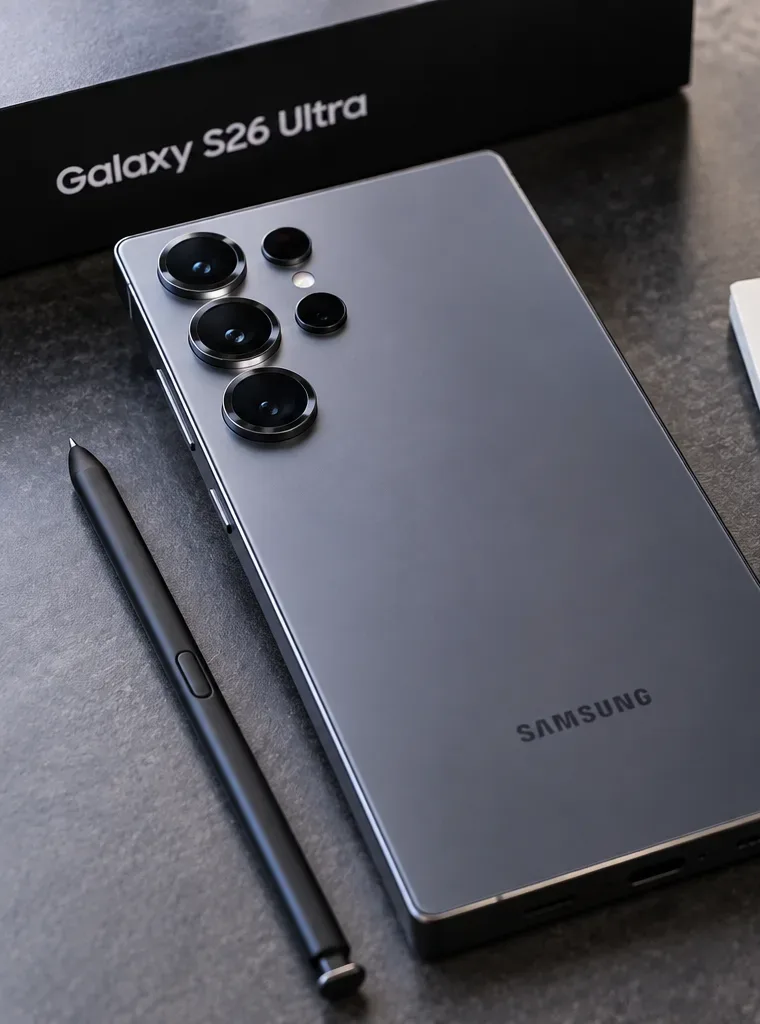
For Galaxy Ultra buyers, Samsung has already made one meaningful change. The Galaxy S26 Ultra officially supports up to 60W wired charging, up from the 45W ceiling used by earlier Ultra generations. Samsung says the S26 Ultra can reach up to 75% in around 30 minutes under its test conditions. The question now is whether the Galaxy S27 Ultra will push farther.
As of September 14, 2026, the answer appears to be no. Samsung has not announced the Galaxy S27 Ultra, but a reported China 3C certification entry associated with model SM-S9580 lists charging profiles that top out at 20V and 3A—60W. If that listing accurately corresponds to the retail S27 Ultra, Samsung is likely to keep the same maximum wired charging power as the S26 Ultra rather than move to 80W, 90W, or 100W.
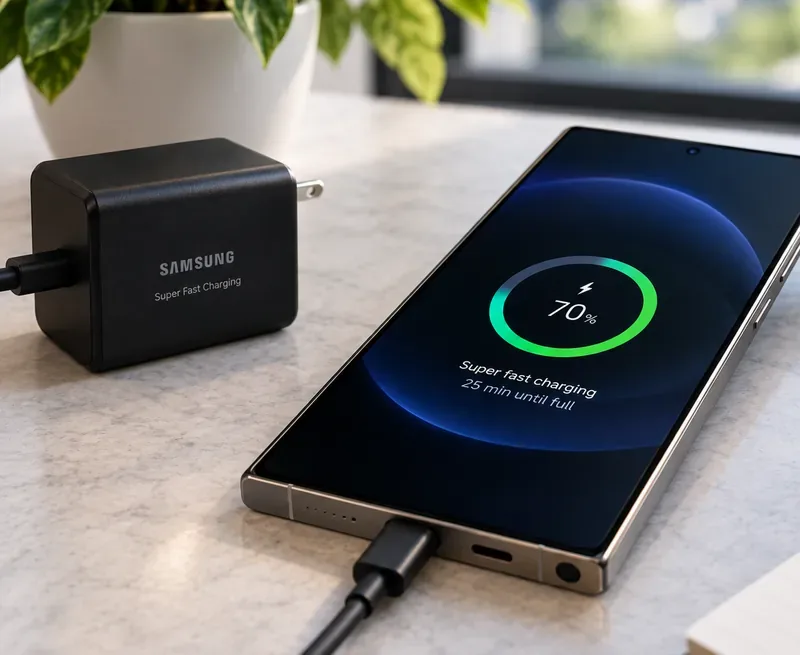
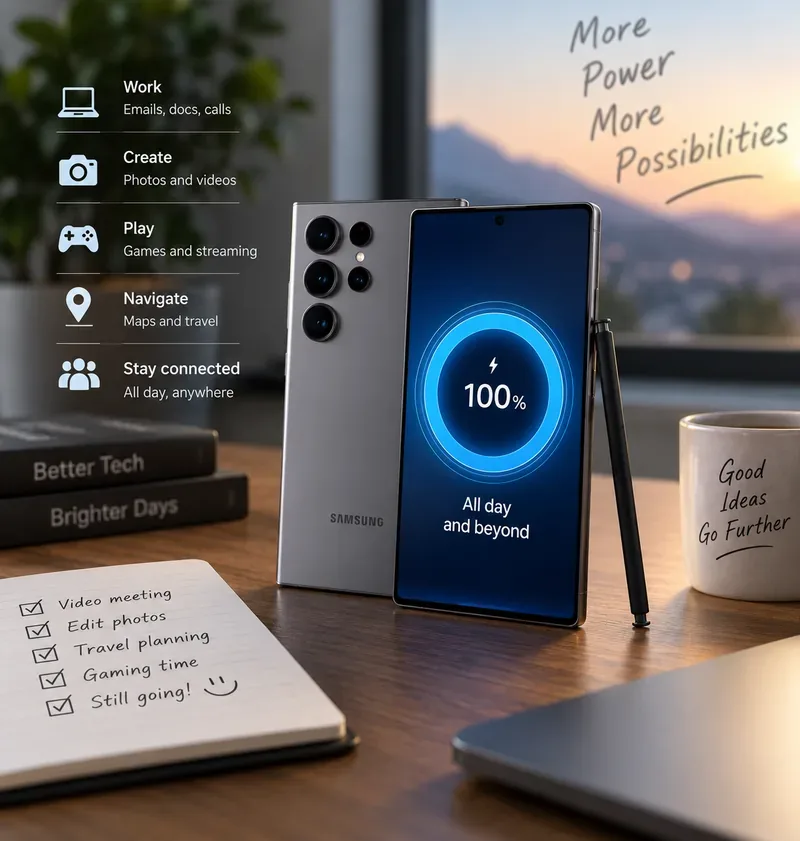
A Galaxy-style phone connected to a fast USB-C charger. The percentage and time shown on the screen are illustrative and are not measured Galaxy S27 Ultra charging results.
So, is the Galaxy S27 Ultra really limited to 60W?
That is the best-supported expectation today, but it is not yet an official Samsung specification. The reported certification data is more useful than an anonymous social-media claim because electrical input profiles are the kind of information regulators collect before devices reach the market. Still, Samsung has not publicly confirmed that SM-S9580 is the final Galaxy S27 Ultra sold worldwide, and I could not independently retrieve the underlying certificate from the regulator’s public database.
That means 60W should be treated as a strong pre-launch signal, not a finished specification.
The confirmed baseline is the Galaxy S26 Ultra. Samsung’s U.S. launch material lists Super Fast Charging 3.0 at up to 60W, up to 75% charge in around 30 minutes, and up to 25W wireless charging. The company also notes that actual charging speed depends on factors such as battery level. You can check the current figures in Samsung’s official Galaxy S26 series announcement.
Why does 60W not mean the phone pulls 60W all the way to 100%?
Because modern phones use a charging curve rather than a fixed power level. The highest power is normally available only during part of the session. As battery state of charge rises, temperature changes, or the battery management system approaches its upper voltage limits, the phone reduces charging power.
This is why the first 20 or 30 minutes matter more than the theoretical time implied by simple arithmetic. A 5,000mAh battery does not charge like an empty bucket being filled at a constant rate. The phone is continuously balancing speed, temperature, battery voltage, and longevity.
Samsung’s official result for the S26 Ultra—up to 75% in around 30 minutes—is therefore more useful than assuming that “60W” automatically means a particular zero-to-100% time.
What charger would you need to get the full speed?
If the S27 Ultra keeps Samsung’s current 60W implementation, the easiest path is a USB-C charger that supports the required USB Power Delivery and PPS profiles, plus a cable rated for the necessary current and power.
Samsung’s official 60W adapter supports USB Power Delivery 3.1, with both PDO and PPS output up to 60W. Samsung lists fixed 9V, 15V, and 20V profiles and PPS from 5V to 20V. The company’s 60W PD Power Adapter is the clearest reference for the current Galaxy charging system.
The broader USB standard is important here. The USB Implementers Forum explains that USB Power Delivery lets devices negotiate power over USB-C and supports programmable power behavior through the PD ecosystem. See the USB-IF Power Delivery overview for the standard itself.
In practice, a charger with a large number printed on it is not enough. A 100W laptop charger can still charge a phone more slowly if it does not expose the voltage/current profile the phone expects. The phone, charger, cable, battery temperature, and battery level all participate in the result.
How should you troubleshoot slow charging, from easiest to harder?
If your Galaxy does not seem to be charging as quickly as expected, start with the simple causes before blaming the phone.
Use a wall outlet. Charging from a laptop, monitor, hub, or low-power USB port can limit available power.
Check the adapter. Make sure it supports the phone’s required USB PD/PPS output rather than judging it only by the total wattage printed on the case.
Check the cable. A damaged, low-current, or incorrectly rated cable can prevent the charger and phone from reaching the intended profile.
Check the charging setting. On current Galaxy devices, Samsung places fast-charging controls under Settings > Battery > Charging settings.
Lower the phone’s temperature. Fast charging can slow when the device is hot from gaming, navigation, camera use, direct sunlight, or a warm environment.
Retest at a lower battery percentage. A phone starting at 70% or 80% should not be expected to hold its peak charging power for long.
So if “catching up” means matching the fastest advertised number, Samsung still appears conservative.
But is 60W actually enough for daily use?
For many people, yes. The S26 Ultra’s official up-to-75%-in-30-minutes figure already covers the scenario that matters most: a meaningful top-up during breakfast, a shower, an airport stop, or a short break before going out.
The gain from 60W to 100W is also not proportional across an entire charging session. Faster systems may spend more time at higher power early in the curve, but they still reduce power as the battery fills. Battery capacity also changes the comparison: a phone with a larger battery can accept more power yet still take a similar amount of time to reach the same percentage.
That is why a good charging comparison should include at least three measurements: 10-minute gain from a low starting percentage, 30-minute percentage, and full-charge time under controlled temperature. Peak wattage alone cannot answer all three.
Where Samsung may be catching up: standardization
Samsung’s charging strategy is less dramatic than some proprietary fast-charging systems, but it has a practical strength: its 60W adapter uses USB PD 3.1 and PPS. That makes it easier to use one capable USB-C charger across a phone, tablet, power bank, or laptop, provided the charger supports the correct profiles.
Some rivals reach their maximum speed only with the brand’s own charging protocol and compatible hardware. OPPO, for example, lists 80W SUPERVOOC but lower limits for third-party PPS and standard PD on the Find X9 Pro. That does not make one approach universally better; it is a tradeoff between maximum speed and cross-device flexibility.
If you travel with one charger for several devices, a standardized 60W implementation can be more useful than a higher proprietary peak that falls sharply with a generic adapter.
What about wireless charging on the S27 Ultra?
There is not enough reliable information yet to claim an S27 Ultra wireless-charging upgrade. The current S26 Ultra officially supports up to 25W Super Fast Wireless Charging. Samsung also sells a 25W Qi2 wireless magnet charger and magnet cases for the S26 family through its official Galaxy S26 accessories guide.
Until Samsung announces the S27 Ultra or a trustworthy certification exposes its wireless power profile, assume nothing beyond the current generation. Claims of 30W, 45W, or 50W wireless charging should remain speculation for now.
Could Samsung improve charging without increasing the 60W ceiling?
Absolutely. Two phones with the same peak wattage can produce different real-world charging times.
Samsung could hold 60W for longer, improve thermal management, change the battery’s charging curve, reduce conversion losses, or improve the transition between high-power and tapering phases. Any of those changes could make the S27 Ultra charge faster in practice even if the box still says 60W.
This is the key limitation of the current leak: a certification can reveal allowed electrical input profiles, but it does not tell us the complete charging curve. We will need production hardware and controlled tests to know whether the S27 Ultra actually gains more percentage in 10 or 30 minutes than the S26 Ultra.
How to tell whether your phone is charging as expected
When the S27 Ultra eventually ships, do not test it by staring at an instantaneous wattage reading for a few seconds. Use a repeatable check:
Start around 5% to 15% battery.
Let the phone cool to room temperature first.
Use the same known-compatible charger, cable, and wall outlet for every test.
Turn off heavy gaming, navigation, hotspot use, and camera recording during the test.
Record battery percentage after 10 minutes and 30 minutes.
Repeat the test at least twice before drawing a conclusion.
If the phone is dramatically slower than Samsung’s official claim under similar conditions, swap the cable first, then the adapter. If the result improves, the accessory was probably the bottleneck. If it does not, check temperature, charging settings, port condition, and software updates before considering service.
Bottom line: is Samsung finally catching up?
The Galaxy S27 Ultra does not currently look like Samsung’s big leap into 80W or 100W charging. The strongest pre-launch evidence points to 60W wired charging, the same ceiling introduced on the Galaxy S26 Ultra.
That means Samsung is still behind several Android rivals in headline wattage. But it is much closer than it was in the 45W era, and its USB PD/PPS approach gives the charging system useful compatibility advantages.
The verdict should ultimately depend on real charging time, not the 60W label. If the S27 Ultra can gain more battery in the first 10 to 30 minutes while staying cool and working well with standard high-quality USB-C chargers, that would be a meaningful improvement even without a higher peak number. Until Samsung publishes the final specifications, treat 60W as the best-supported expectation—not a confirmed retail guarantee.