Home
» Android
»
Galaxy S27 Ultra Titanium Frame: Thinner, Lighter, and Stronger? What We Actually Know
Galaxy S27 Ultra Titanium Frame: Thinner, Lighter, and Stronger? What We Actually Know
Updated September 14, 2026: There is no official Samsung announcement confirming that the Galaxy S27 Ultra will use a titanium frame. In fact, the latest Ultra model points in the opposite direction. Samsung’s current Galaxy S26 Ultra uses an Armor Aluminum frame, after the Galaxy S24 Ultra and Galaxy S25 Ultra used titanium.
That makes the question more interesting than a simple “titanium is better” argument. Samsung has already shown that it can make an Ultra phone thinner and lighter by changing the frame material while still positioning the device as durable. If titanium returns on the S27 Ultra, the important question will not be whether the metal sounds more premium. It will be whether Samsung can use it to improve the complete structural design without giving back the weight and thickness gains achieved by the S26 Ultra.
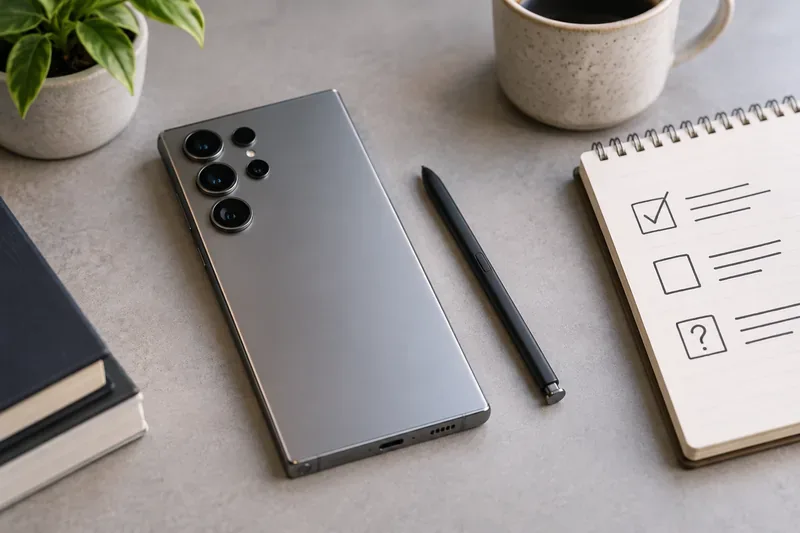
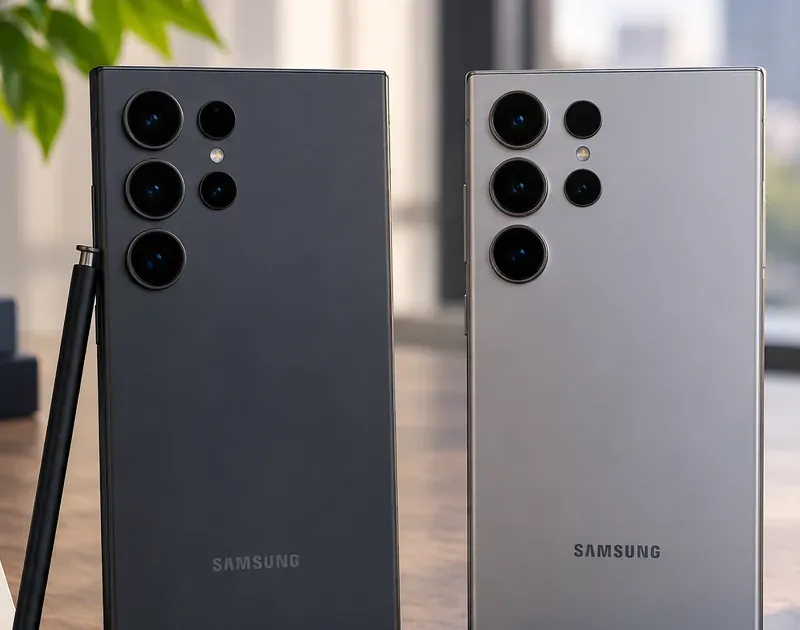
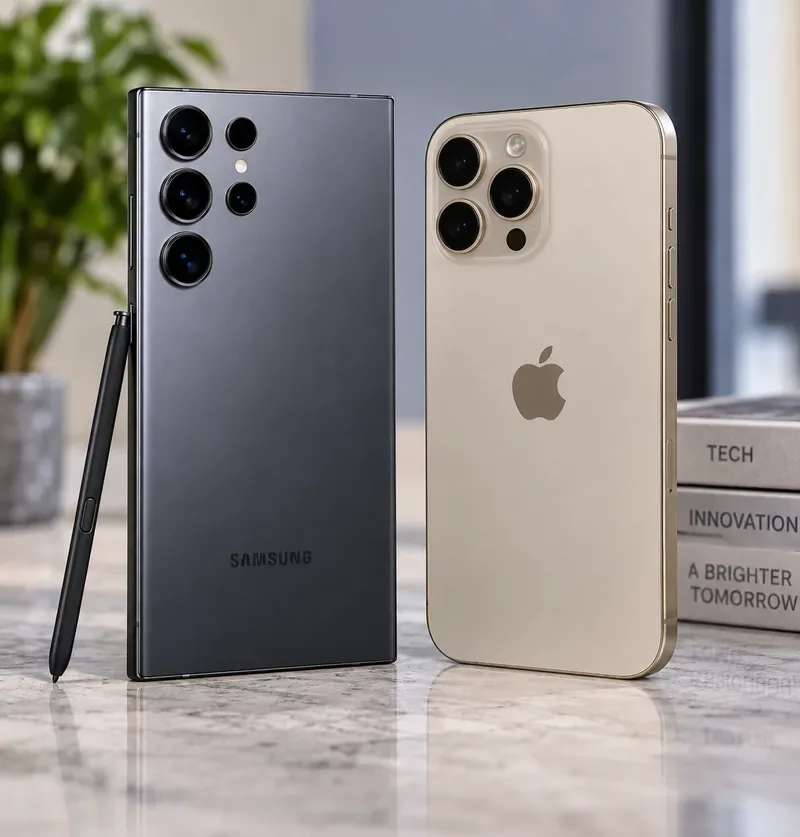
A current-style Galaxy flagship illustrates the frame-focused design question. Samsung has not revealed the Galaxy S27 Ultra’s final materials or industrial design.
The verified change: S26 Ultra moved away from titanium
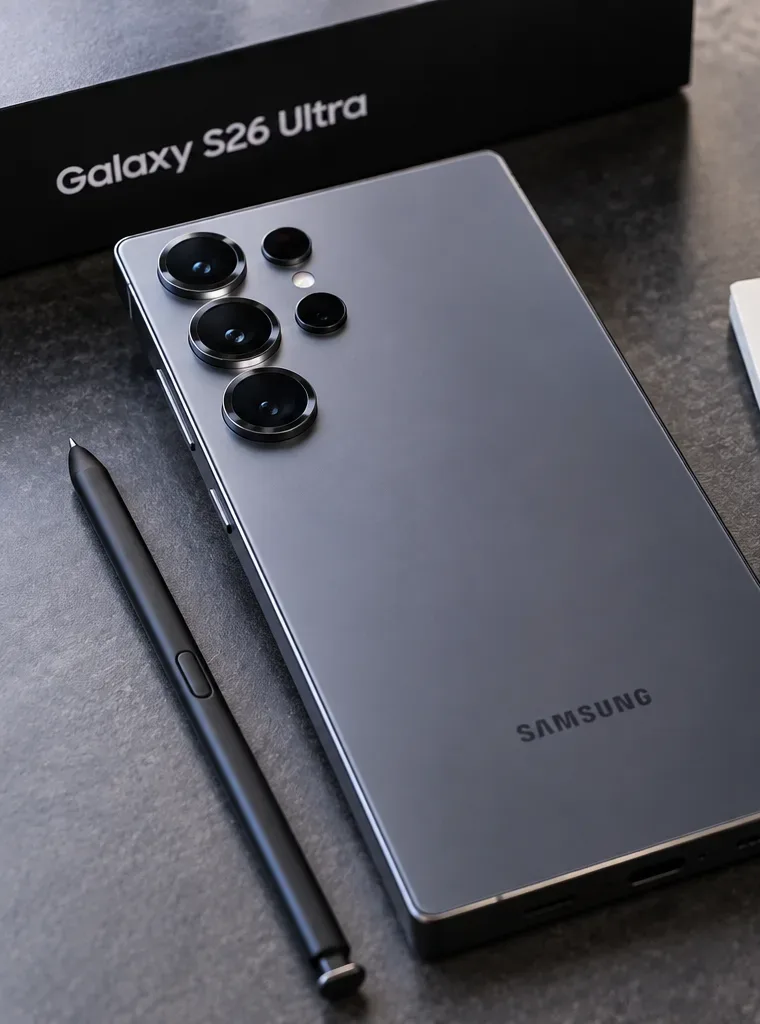
Samsung’s own product information identifies the Galaxy S26 Ultra as using an Armor Aluminum frame. The company lists the phone at 7.9 mm thick and 214 g. You can verify the current design description on the official Galaxy S26 Ultra product page.
That is notable because Samsung promoted titanium heavily on the two previous Ultra generations. The Galaxy S24 Ultra specification page lists a titanium exterior, 8.6 mm thickness, and 232 g weight. The Galaxy S25 Ultra specification page lists a titanium frame, 8.2 mm thickness, and 218 g weight.
Model
Official frame material
Thickness
Weight
Galaxy S24 Ultra
Titanium
8.6 mm
232 g
Galaxy S25 Ultra
Titanium
8.2 mm
218 g
Galaxy S26 Ultra
Armor Aluminum
7.9 mm
214 g
Galaxy S27 Ultra
Not announced
Not announced
Not announced
The trend is clear: Samsung has reduced both thickness and weight across recent Ultra generations, but the latest improvement happened alongside a switch from titanium to aluminum. That does not prove aluminum caused the entire reduction. Internal packaging, display construction, camera modules, battery design, cooling hardware, glass, and chassis geometry all contribute. It does prove one important point: a titanium frame is not required for an Ultra phone to become thinner or lighter.
Could titanium make the S27 Ultra stronger?
Potentially, but “stronger” needs a definition. Titanium has an excellent strength-to-weight ratio and high corrosion resistance. The U.S. Geological Survey notes that titanium is roughly twice as strong as aluminum while being about 60% heavier by volume. The material overview is available in the USGS titanium fact sheet.
Those properties make titanium attractive when engineers need high strength in a relatively compact section. In theory, a stronger material can allow a designer to use less of it. That is why a titanium component can sometimes be lighter than an aluminum component designed to carry the same load, even though titanium itself is denser.
But that conclusion cannot be transferred directly to a smartphone. A phone frame is not a simple bar of metal. Its stiffness and durability depend on wall thickness, internal ribs, cutouts for antennas and buttons, attachment points, manufacturing processes, adhesive interfaces, and how the frame interacts with the front and rear glass.
What would count as a real improvement: Samsung would need to show that a new frame resists bending, twisting, impact damage, or long-term deformation better at the same or lower device weight. A material name alone cannot establish that.
Could a titanium S27 Ultra be thinner?
Yes in principle, but there is no official evidence that this is Samsung’s plan. A higher-strength material can allow certain structural sections to become thinner. However, the outside thickness of an Ultra phone is constrained by much more than its frame.
The camera stack is one of the biggest constraints. Larger image sensors, folded telephoto optics, stabilization systems, and lens assemblies occupy significant depth. Battery thickness, vapor-chamber cooling, wireless charging hardware, display layers, the S Pen silo, and internal shielding also compete for space.
This is why a hypothetical switch back to titanium should not automatically be interpreted as a thinner S27 Ultra. Samsung could use any saved structural volume to reinforce the chassis, enlarge another component, change camera hardware, or simply preserve durability while reducing weight.
What to watch when Samsung announces the phone: Compare the official body thickness, camera protrusion, weight, battery capacity, and internal design claims together. A 0.2 mm thinner body is less meaningful if the camera assembly becomes substantially thicker or if the reduction comes with another trade-off you care about.
Could titanium make it lighter?
This is the most counterintuitive part of the discussion. Titanium is stronger than aluminum, but it is also denser. USGS describes titanium as about 60% heavier than aluminum for the same volume. That means simply replacing an aluminum part with an identically shaped titanium part would normally increase weight, not reduce it.
The engineering opportunity comes from geometry. If titanium allows the frame to use thinner sections while maintaining the required structural performance, the final part could offset some or all of that density penalty. Whether that happens depends on the exact alloy, manufacturing method, frame architecture, and load requirements.
The S26 Ultra provides a useful real-world baseline. At 214 g, it is already 4 g lighter than the titanium-framed S25 Ultra and 18 g lighter than the titanium-framed S24 Ultra. Samsung’s own S26 Ultra page highlights this progression. A future titanium model would therefore need to beat a fairly aggressive aluminum benchmark if “lighter” is going to be part of the story.
A useful rule for buyers
Ignore claims that frame material alone determines phone weight. Look at the complete device weight published by Samsung. If an S27 Ultra arrives at 214 g or below while adding new hardware, that would be meaningful. If it becomes heavier, titanium might still offer structural advantages, but it would not support the “lighter” part of the claim.
Does titanium automatically mean better drop durability?
No. Drop durability is a system property, not a frame-only property. On the Galaxy S25 Ultra, Samsung paired a titanium frame with Corning Gorilla Armor 2. Samsung described that combination as part of its durability strategy in the official Galaxy S25 series announcement.
The Galaxy S26 Ultra, meanwhile, uses Armor Aluminum and continues to rely on protective glass and water resistance as part of the overall durability package. Samsung’s current S26 Ultra product page states that Gorilla Armor 2 is used on the front and Gorilla Glass Victus 2 on the back, alongside an IP68 rating.
A harder or stronger frame may reduce deformation in some impacts, but glass can still crack, coatings can scratch, and energy can be transferred into other components. A very rigid structure is not automatically the best structure for every type of impact. Manufacturers tune the entire enclosure, including how materials flex and distribute loads.
What to look for: When independent durability testing appears after launch, pay attention to bending resistance, repeated drop behavior, frame denting, glass breakage, and whether structural damage affects camera alignment or water sealing. One dramatic drop test should not be treated as a complete durability verdict.
Why Samsung may prefer Armor Aluminum right now
Samsung has not publicly explained every engineering reason for the S26 Ultra material change, so it would be wrong to assign a single motive. Still, aluminum offers obvious design advantages: it is less dense than titanium, widely used in electronics, relatively straightforward to machine and form, and can support a lightweight chassis when paired with the right geometry.
The verified outcome matters more than speculation about motive. The S26 Ultra is thinner and lighter than the S25 Ultra while retaining Samsung’s Ultra positioning, S Pen integration, large display, 5,000 mAh battery, advanced camera system, and IP68 rating. That makes Armor Aluminum a credible baseline rather than a downgrade that must automatically be reversed.
What would make a titanium S27 Ultra genuinely impressive?
If Samsung does return to titanium, three measurable outcomes would justify the change:
Lower or equal total weight: ideally 214 g or less, despite the denser frame material.
Equal or lower body thickness: 7.9 mm or less without compromising battery, cooling, cameras, or structural integrity.
Demonstrably better structural performance: stronger resistance to bending or impact in repeatable testing, not just a premium material label.
A fourth benefit would be improved ergonomics. Weight distribution matters almost as much as total weight. A phone can feel lighter if its center of mass is better balanced and the edges are easier to grip. Samsung’s S25 Ultra design work already showed that geometry can meaningfully change how a large phone feels in the hand.
What is still unknown about the S27 Ultra
As of September 14, 2026, Samsung has not published official S27 Ultra specifications covering the frame material, dimensions, weight, glass, battery, camera housing, or structural design. Any claim that the phone definitely has a titanium frame, is thinner than 7.9 mm, weighs less than 214 g, or is stronger than the S26 Ultra should therefore be treated as unconfirmed unless Samsung provides those details.
This is especially important because the material history is not moving in a simple direction. Samsung used titanium on the S24 Ultra and S25 Ultra, then switched the S26 Ultra to Armor Aluminum while continuing to reduce thickness and weight. A future design could use titanium again, stay with aluminum, use a hybrid structure, or change construction in another way entirely.
Bottom line
The idea of a thinner, lighter, stronger Galaxy S27 Ultra with a titanium frame is technically plausible, but it is not an announced Samsung product specification. The latest verified evidence actually shows Samsung achieving its thinnest and lightest recent Ultra design with Armor Aluminum, not titanium.
Titanium has real engineering advantages, especially its high strength-to-weight ratio and corrosion resistance. It also has a density penalty compared with aluminum. Whether it improves a smartphone depends on how intelligently Samsung uses the material across the entire chassis.
When the Galaxy S27 Ultra is officially announced, the right questions will be simple: What does it weigh? How thick is it? What material is actually used? What other hardware changed? And does independent testing show a meaningful durability gain? Until those answers exist, “titanium” is a possibility to evaluate, not a confirmed upgrade.