Home
» Android
»
Samsung Galaxy S27 Ultra Design Rumors: Are We Getting a Completely Flat Display?
Samsung Galaxy S27 Ultra Design Rumors: Are We Getting a Completely Flat Display?
Updated September 14, 2026: Samsung has not announced the Galaxy S27 Ultra, so there is no official S27 Ultra display specification yet. The most useful way to read the current design rumors is to separate what leaked CAD-based images appear to show from what Samsung has already confirmed about its existing Ultra phones.
The short answer: a flat Galaxy S27 Ultra display looks more likely than a return to a curved-edge screen. But that would be continuity, not a dramatic new direction. Samsung officially described the Galaxy S25 Ultra as having a flat display, and the Galaxy S26 Ultra continues the newer rounded-corner, slimmed-down Ultra design language. The unresolved part is whether every layer around the S27 Ultra screen — cover glass, edge transition, and metal frame — will look and feel completely planar.
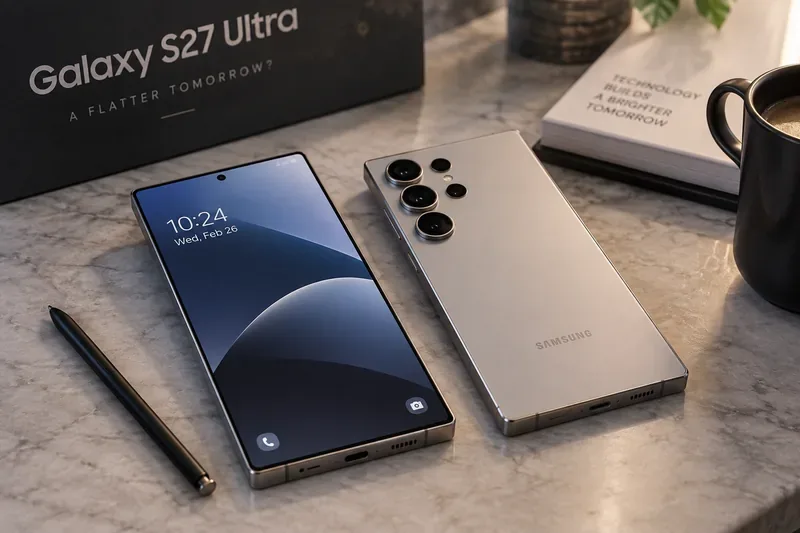
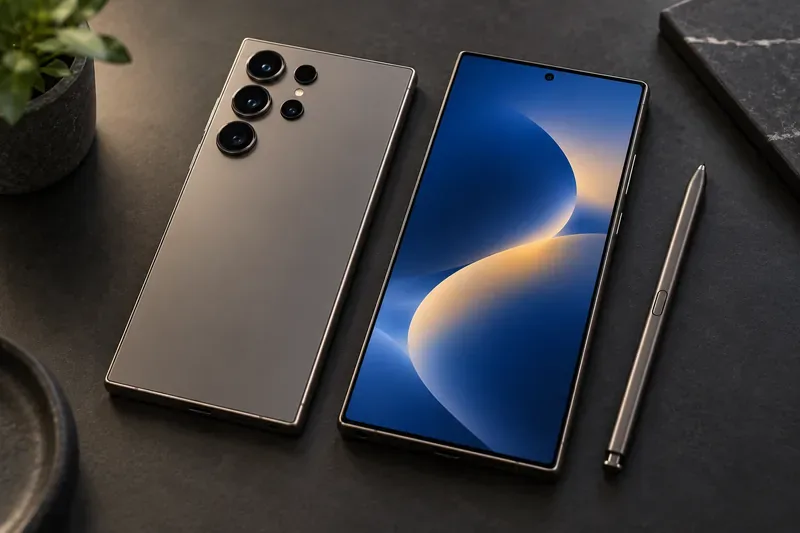
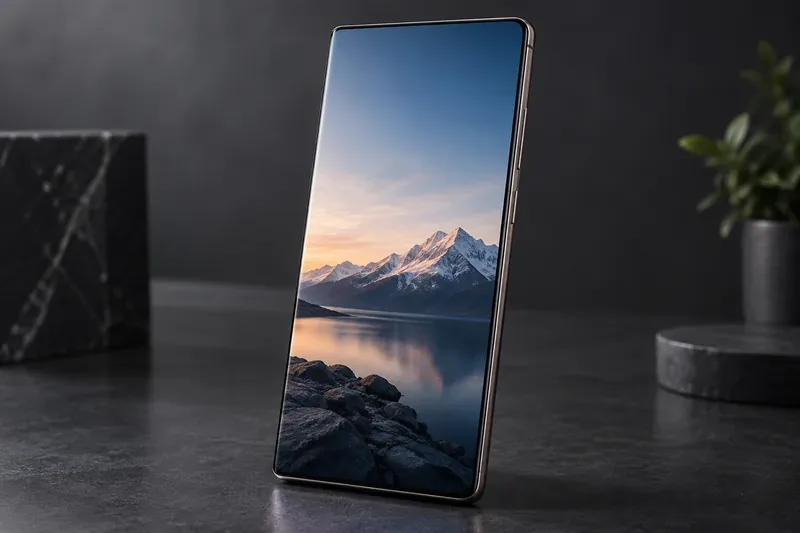
A concept-style view used to illustrate the difference between a flat display surface and the surrounding frame geometry. Samsung has not announced the Galaxy S27 Ultra or confirmed its final industrial design.
Quick Reference: What Is Actually Known?
Design point
Status as of Sept. 14, 2026
What it means
Galaxy S27 Ultra exists as an announced product
Not confirmed
Samsung has not published an official S27 Ultra product page or specification sheet.
Flat front display
Likely, but not official
Recent CAD-based leak imagery depicts a flat front, and Samsung has already used a flat display on recent Ultra generations.
Rounded outer corners
Likely
This follows Samsung’s current design direction, but the exact S27 radius is unconfirmed.
Perfectly flat metal side rails
Unclear
A flat screen does not automatically mean the frame has no bevel or curvature.
Horizontal rear camera plateau
Rumored
This is one of the most visible changes in late-August CAD leaks, but it does not confirm the display specification.
Wait for Samsung’s official technical specifications.
First, What Does “Completely Flat Display” Mean?
Phone discussions often use “flat display” to describe several different parts at once. That can make rumors sound more dramatic than they are.
1. The display panel
This is the OLED layer that produces the image. A flat panel does not bend downward at the left and right edges the way older curved Galaxy Ultra screens did.
2. The cover glass
This is the transparent protective surface you touch. Even when the active display is flat, the cover glass can have a subtle edge treatment where it meets the frame. That small transition does not necessarily make it a “curved display” in the traditional Galaxy sense.
3. The frame
The metal rail around the phone can be flat, rounded, chamfered, or slightly beveled. “Chamfered” means an angled transition between two surfaces. A phone can therefore have a flat display while still feeling softer at the edges in your hand.
This distinction matters because current S27 Ultra rumors appear to support a flat viewing surface, while details about the exact frame and glass transition remain less certain.
Why a Flat S27 Ultra Would Not Be a New Direction
Samsung already made the key transition before the S27 generation. In its official Galaxy S25 design story, Samsung said the Galaxy S25 Ultra introduced a new shape with a flat display and rounded corners, with the change intended to improve grip and usability. You can read Samsung’s own design explanation on the Galaxy S25 Series Design Story.
The Galaxy S26 generation then pushed the family resemblance further. Samsung’s designers explained that the S26, S26+, and S26 Ultra share the same corner radius, and that the company intentionally refined the transition between front and back surfaces to make the phones feel slimmer and more comfortable. Samsung also notes that the Ultra’s pen structure and internal layout affect what is physically possible. The full discussion is available in the Galaxy S26 Series Design Story.
That history is important. If the S27 Ultra launches with a flat front panel, it would be the continuation of Samsung’s current industrial-design path rather than a sudden abandonment of curved screens in 2027.
What the Current S27 Ultra Design Rumors Suggest
Late-August 2026 CAD-based render leaks depict an S27 Ultra with a front surface that remains visually flat. “CAD” stands for computer-aided design: a digital model used to define dimensions and geometry. CAD-derived renders can be more informative than a fan-made concept because they may reflect manufacturing or accessory-development measurements, but they are still not official Samsung product images.
The bigger rumored change is actually on the back. The circulating renders show a much wider camera area rather than the familiar individually separated camera rings. They also suggest rounded corners and an S Pen slot. None of those details proves the final display stack, however.
For practical purposes, the current rumor signal can be summarized this way: there is no credible sign that Samsung is preparing to bring back the old waterfall-style curved display on the S27 Ultra. What remains unknown is how flat the cover glass will look at extreme angles and how sharply or softly the metal frame will transition around it.
What Samsung’s Current S26 Ultra Tells Us
The present Galaxy S26 Ultra is the best official baseline. Samsung lists a 6.9-inch display, 7.9 mm thickness, 214 g weight, rounded ergonomic corners, and a built-in Privacy Display on its Galaxy S26 Ultra product page.
Privacy Display is worth separating from the physical screen shape. It is a viewing-privacy technology that reduces what people beside you can see when enabled; it does not mean the panel itself is curved. Samsung describes how it works in its official Privacy Display overview.
So when future rumors mention a new S27 display, check whether the claim refers to the panel shape, privacy technology, cover glass, bezels, brightness, or another display characteristic. Those are separate design decisions.
Why Flat Displays Matter in Everyday Use
Screen protectors are simpler
A truly flat front surface generally makes alignment easier for rigid tempered-glass protectors. Curved edges can require more specialized adhesives or leave lifting points near the sides. If this is your main reason for waiting for the S27 Ultra, remember that Samsung already moved the Ultra family toward flat screens before this generation.
S Pen use can feel more consistent near the edges
A flat writing surface gives the stylus a more uniform physical area near the left and right edges. That does not automatically change digitizer performance, but it avoids the sensation of writing onto a downward-sloping piece of glass.
Accidental edge touches are less of a design issue
Older strongly curved screens could place interactive content close to a sloped edge. Modern software can compensate for accidental touches, but a flat surface is inherently easier to treat as a conventional rectangular workspace.
Case and frame feel still matter
Do not assume a flat display guarantees a comfortable phone. Samsung’s S26 design team specifically emphasized corner radius and subtle exterior curvature because a very thin device with abrupt edges can feel sharp. The S27 Ultra’s comfort will depend on the total body geometry, not just its display.
Practical Checklist Before Believing a New S27 Ultra “Flat Screen” Leak
Check whether Samsung has announced the phone. If not, treat dimensions and materials as provisional.
Look for a true side profile. A front-on image cannot reveal subtle cover-glass or frame transitions.
Separate display flatness from frame flatness. They are not the same specification.
Do not infer bezel measurements from a render. Rendering perspective can make bezels look thinner than they are.
Do not use the rear camera redesign as proof of screen changes. The two parts can evolve independently.
Wait for Samsung’s specification page for exact materials. Glass generation, resolution, brightness, and dimensions need official confirmation.
Should You Wait for the S27 Ultra Just for a Flat Display?
If you use an older curved-screen Galaxy Ultra: you do not necessarily need to wait. Samsung has already documented the flat-display move on the S25 Ultra, and the S26 Ultra continues the current, flatter design direction. Compare the current phones in person before assuming the S27 is required to get away from curved edges.
If you own an S25 Ultra or S26 Ultra: display flatness alone is not a compelling reason to upgrade. Your decision should depend on confirmed changes in camera hardware, battery, processor, display quality, S Pen features, weight, and software support once Samsung publishes them.
If you care most about screen protectors and edge usability: prioritize the physical geometry you can verify in a store rather than waiting on rumor terminology. A small bevel at the glass-to-frame transition may still be perfectly compatible with conventional protectors even if someone online describes the phone as “not completely flat.”
What to Watch for Next
The most useful confirmation will not be another render. Watch for Samsung’s official Galaxy announcement, the detailed product specification page, and the company’s design story. Those sources should settle four questions that rumors cannot answer reliably:
Is the S27 Ultra active display panel fully flat?
Does the cover glass stay planar all the way to the bezel?
How are the side rails and corner transitions shaped?
What are the exact display size, resolution, brightness, coating, and privacy features?
Bottom Line
Based on Samsung’s documented design evolution and the current S27 Ultra CAD-rumor cycle, a flat display is the most plausible outcome. But the headline “Samsung is finally going completely flat” would be misleading: Samsung already officially described the S25 Ultra as having a flat display, and the S26 generation further refined the rounded-corner, unified Galaxy S shape.
The real S27 Ultra design question is more specific: how flat will the cover glass and frame transition be, and what will Samsung change around that already-flat viewing surface? As of September 14, 2026, that remains unconfirmed. Treat the leaked renders as a useful preview of direction, not a final specification sheet.