Home
» Android
»
Will the Samsung Galaxy S27 Ultra Finally Ditch Snapdragon? What the Exynos 2700 Rumors Really Mean
Will the Samsung Galaxy S27 Ultra Finally Ditch Snapdragon? What the Exynos 2700 Rumors Really Mean
Updated September 14, 2026: There is still no official Samsung confirmation that the Galaxy S27 Ultra will abandon Qualcomm Snapdragon. In fact, the most credible interpretation of the current leak cycle is almost the opposite: Samsung appears to be keeping multiple processor options open while it evaluates whether its next Exynos platform is good enough for an Ultra-class phone.
That matters because the useful question is not simply “Snapdragon or Exynos?” The useful question is whether an eventual Galaxy S27 Ultra delivers the same—or better—real-world results in sustained speed, battery life, thermals, modem behavior, camera processing, and AI workloads regardless of the chip inside. Until those outcomes can be measured, a processor name alone does not tell you whether the phone is an upgrade.
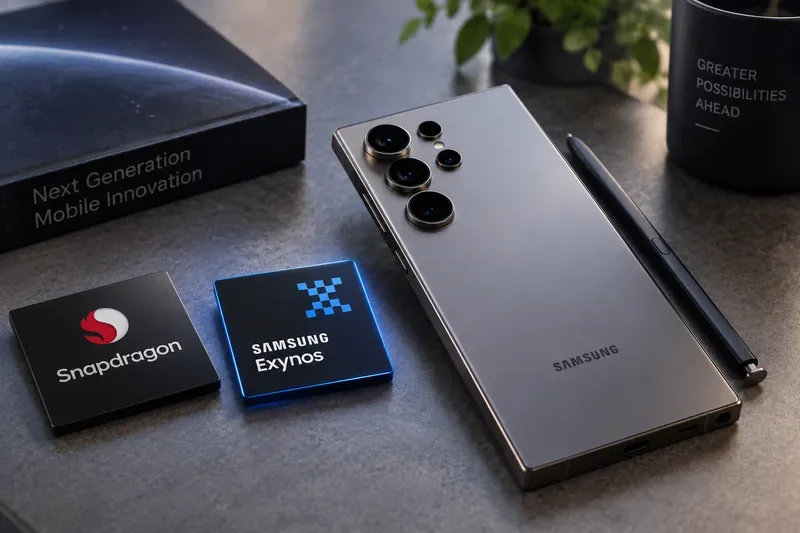
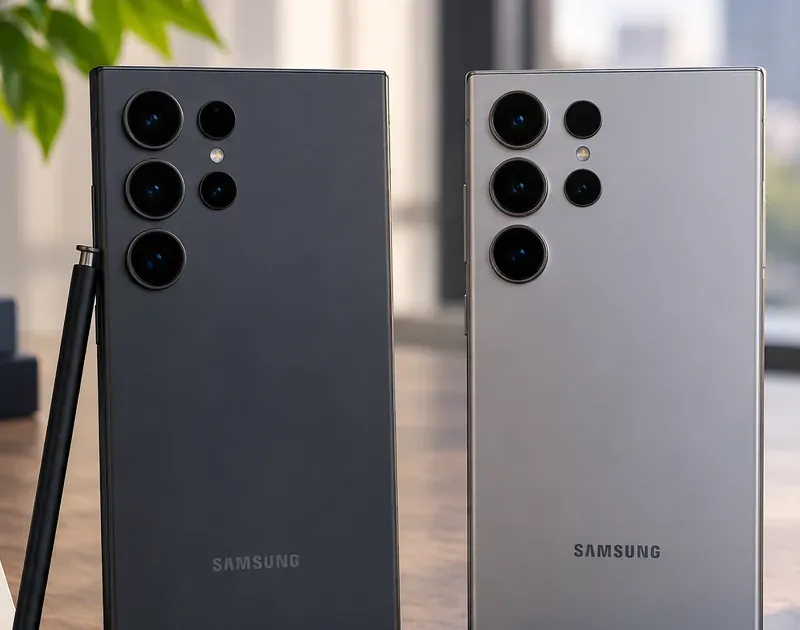
A conceptual comparison scene showing an Ultra-style Galaxy phone beside Snapdragon and Exynos chip options. Samsung has not announced the Galaxy S27 Ultra or confirmed its processor configuration.
Short answer: probably not a complete Snapdragon exit
As of September 14, Samsung has not announced the Galaxy S27 Ultra, the Exynos 2700, or a final processor strategy for the 2027 Galaxy S family. Recent industry reporting has claimed that Samsung is developing an Exynos 2700 version of the S27 Ultra for at least some markets while continuing Snapdragon development in parallel. Other leaks still point to Snapdragon-equipped S27 hardware.
Taken together, those reports do not support the idea that Samsung has decided to remove Snapdragon from the Ultra line worldwide. They support a narrower possibility: Samsung may return to a regional or dual-source strategy in which some S27 Ultra models use Exynos and others use Qualcomm silicon.
That is a meaningful change if it happens, but it is different from “ditching Snapdragon.” The distinction matters for buyers because regional chip splits can create different battery, thermal, modem, gaming, and camera-processing behavior between versions of what is sold under the same phone name.
What Samsung has actually confirmed so far
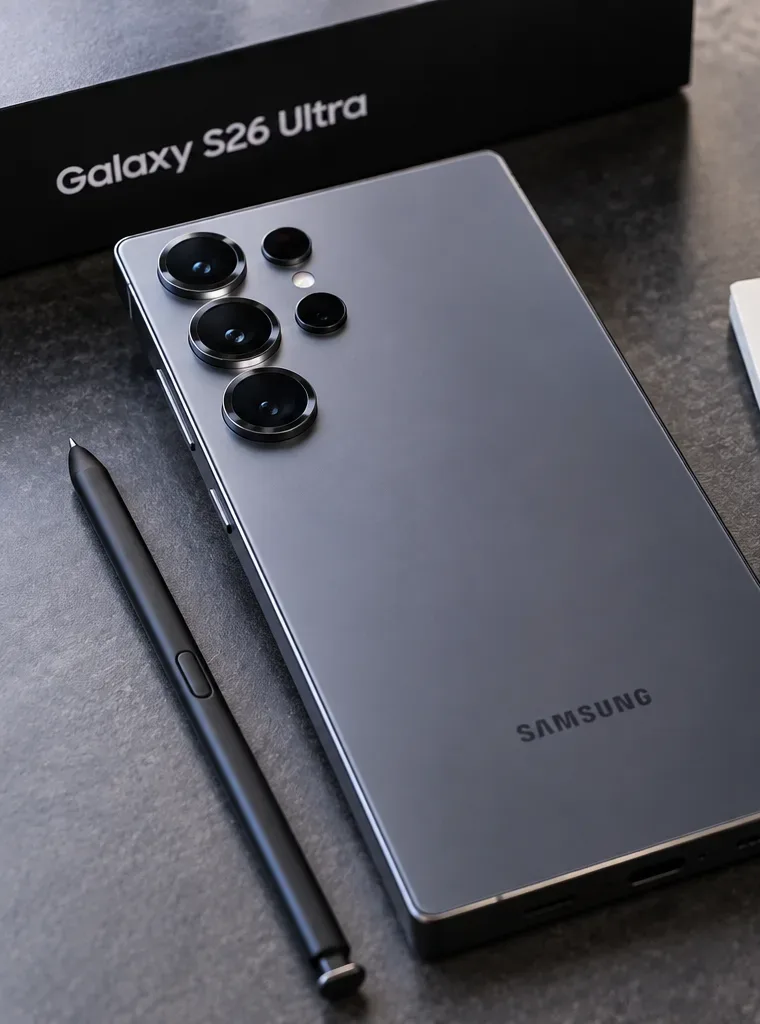
The current Galaxy S26 Ultra provides the clearest verified baseline. Samsung says the phone uses the customized Snapdragon 8 Elite Gen 5 Mobile Platform for Galaxy. The company describes gains across CPU, GPU, and NPU performance and positions the chip as part of the S26 Ultra’s sustained-performance and AI strategy. Those details are published in Samsung’s official Galaxy S26 series announcement.
Samsung has also demonstrated that it is serious about rebuilding its own flagship silicon. The company’s current Exynos 2600 product page describes a 2nm GAA processor with a 10-core CPU, Xclipse 960 graphics, a substantially upgraded NPU, new image-processing features, and efficiency-focused packaging. Samsung’s performance percentages on that page are based on internal comparisons with the Exynos 2500, so they should not be treated as a direct comparison with Qualcomm’s latest flagship silicon.
Samsung Foundry also lists 2nm GAA technology in its current process portfolio, reinforcing that advanced-node manufacturing is central to Samsung’s roadmap. The company explains the process direction on its official Foundry process technology page.
Why the Exynos 2700 rumor is more plausible than it would have been a few years ago
The rumor is plausible because Samsung now has a recent flagship Exynos platform that is technically ambitious and already being used in the Galaxy S26 and S26+ in some markets. That gives Samsung more reason to test whether a next-generation Exynos part can move further up the product stack.
But plausibility is not proof. The “Exynos 2700” name, its final CPU and GPU configuration, its modem arrangement, and its placement in the S27 Ultra remain unconfirmed by Samsung. Leaked motherboard orders or prototype references can show that a configuration is under evaluation without proving that it will reach retail production.
The right reading, therefore, is: Samsung may be qualifying an Exynos-powered S27 Ultra, but there is not enough evidence to conclude that Snapdragon is gone.
What result should buyers actually want?
If Samsung does ship both Exynos and Snapdragon versions, the goal should not be “Exynos wins a benchmark.” The goal should be that buyers can choose an S27 Ultra in any region without worrying that one version is materially worse in everyday use.
Area to judge
What a good result looks like
Warning sign
Sustained performance
Long gaming, camera, and productivity sessions remain smooth without steep performance drops.
Strong first-minute benchmark scores followed by aggressive throttling.
Battery efficiency
Comparable screen-on time and standby drain under matched settings and network conditions.
A consistent multi-hour battery gap between regional variants.
Thermals
Comfortable surface temperatures and stable clocks during demanding workloads.
One chip runs noticeably hotter or reduces performance sooner.
Modem and connectivity
Reliable 5G, Wi-Fi, GPS, and handoff behavior with competitive power use.
More dropped connections, weak-signal drain, or inconsistent regional support.
Camera processing
Similar autofocus, HDR, low-light quality, video stability, and capture speed.
Visible differences in image quality or processing latency between chip versions.
On-device AI
Comparable latency, privacy behavior, supported features, and efficiency.
Feature availability or response speed differs depending on the processor.
Software support
The same update cadence and feature set across variants.
One model receives fixes or capabilities later because of platform-specific work.
When should you change your view of the rumor?
Signal 1: Samsung officially names the S27 Ultra processor
This is the strongest evidence. An Unpacked announcement, Samsung product page, official specification sheet, or regulatory filing tied clearly to a retail model should outweigh months of leak coverage. Until then, processor assignments are provisional.
Signal 2: Samsung announces the Exynos 2700 itself
Samsung’s Semiconductor site currently highlights the Exynos 2600 as its latest flagship mobile processor. A formal Exynos 2700 announcement would let buyers evaluate Samsung’s own claims about architecture, manufacturing process, GPU, NPU, imaging, modem support, and efficiency instead of relying on leaked specifications.
Signal 3: Qualcomm reveals its next flagship platform
Qualcomm has officially scheduled Snapdragon Summit for September 22–24, 2026. That event is important because Qualcomm is expected to discuss its next generation of premium mobile silicon, although Qualcomm has not officially tied any unreleased chip to the Galaxy S27 Ultra as of this update. The current schedule is listed on Qualcomm’s official events page.
If Samsung is developing both platforms, Qualcomm’s announcement will establish one side of the comparison. It still will not tell us which markets receive which Galaxy S27 Ultra variant.
Signal 4: independent retail-unit testing appears
This is when the processor debate becomes genuinely useful. Pre-release benchmark leaks can be misleading because firmware, cooling policies, clocks, and power limits may not be final. Retail devices tested under the same conditions reveal much more.
For a meaningful comparison, look for repeated tests across multiple runs, matched display brightness, the same network mode, equivalent software versions, and similar ambient temperature. One benchmark screenshot is not enough to determine battery efficiency or sustained performance.
Would an Exynos 2700 automatically be worse than Snapdragon?
No. That conclusion would be just as unsupported as assuming a future Exynos chip must be better because it uses a newer manufacturing process.
Chip quality depends on the complete implementation: CPU architecture, GPU behavior, NPU throughput, memory subsystem, modem efficiency, ISP, packaging, software drivers, thermal design, and Samsung’s device-level tuning. Manufacturing node labels matter, but they are only one part of the result.
The Exynos 2600 is relevant because it shows Samsung has continued investing in leading-edge mobile silicon. Samsung says the chip uses its first 2nm GAA mobile process and includes major CPU, GPU, AI, imaging, and power-efficiency changes. Those are encouraging technical signals. They are not evidence that an unannounced Exynos 2700 will beat Qualcomm in an S27 Ultra.
Would a regional chip split be a problem?
Not necessarily. It becomes a problem only if the user experience differs enough that buyers in one market receive a clearly inferior version at the same product tier.
A successful dual-chip strategy would make the distinction largely irrelevant to most owners. Both versions would need to meet the same practical bar for battery life, camera output, heat, responsiveness, network reliability, AI features, and software support.
If those results are close, Samsung gains supply flexibility and may reduce dependence on a single chip vendor without meaningfully hurting customers. If they are not close, the processor split becomes a purchasing issue—especially for people importing phones or comparing models across regions.
Should you wait for a Snapdragon S27 Ultra specifically?
It is too early to make that decision. Right now, neither the Exynos 2700 nor the next Snapdragon platform has been officially assigned to the S27 Ultra. Waiting for one chip name based only on brand history can lead you to ignore the metrics that actually affect ownership.
A better approach is to wait for three pieces of evidence: Samsung’s final regional specifications, independent battery and sustained-performance testing, and modem/camera comparisons between any variants that actually ship.
If those results show a meaningful gap, then choosing a specific regional model may make sense. If the gap is small, processor branding should carry much less weight than price, warranty coverage, local bands, storage, and trade-in value.
The current verdict
The Samsung Galaxy S27 Ultra is not currently confirmed to ditch Snapdragon. The strongest recent rumors suggest Samsung may be willing to put a next-generation Exynos chip into at least some Ultra variants, while Snapdragon development continues in parallel. That points toward possible dual sourcing, not a clean break with Qualcomm.
For buyers, the standard should be simple: do not judge the S27 Ultra by the chip logo. Judge whether Samsung can deliver equivalent flagship-level results in battery life, sustained speed, temperature, connectivity, camera processing, and AI features. If Samsung can do that with Exynos, the return of its in-house processor could be a non-issue—or even a competitive advantage. If it cannot, the regional processor split will matter far more than the headline.
Until Samsung publishes final S27 Ultra specifications, that outcome remains unknown.