Home
» News
»
How the UK Personal Allowance Works in 2026/27 — and What It Means for Your Tax
How the UK Personal Allowance Works in 2026/27 — and What It Means for Your Tax
The UK Personal Allowance is often described as the amount you can earn “tax-free,” but that shorthand can cause confusion. For the current 2026/27 tax year, which runs from 6 April 2026 to 5 April 2027, the standard Personal Allowance is £12,570. In simple cases, that means the first £12,570 of your taxable income is not subject to Income Tax. It does not mean HM Revenue & Customs gives you £12,570, and it does not mean every person automatically has exactly the same tax-free amount.
The key is to separate three ideas: your Personal Allowance, your taxable income after allowances, and the tax rates that apply to the remaining income. HMRC’s current 2026/27 figures are published on GOV.UK’s Income Tax rates and Personal Allowances page. If your circumstances are straightforward, the standard allowance applies. If your adjusted net income is above £100,000, however, the allowance begins to shrink.
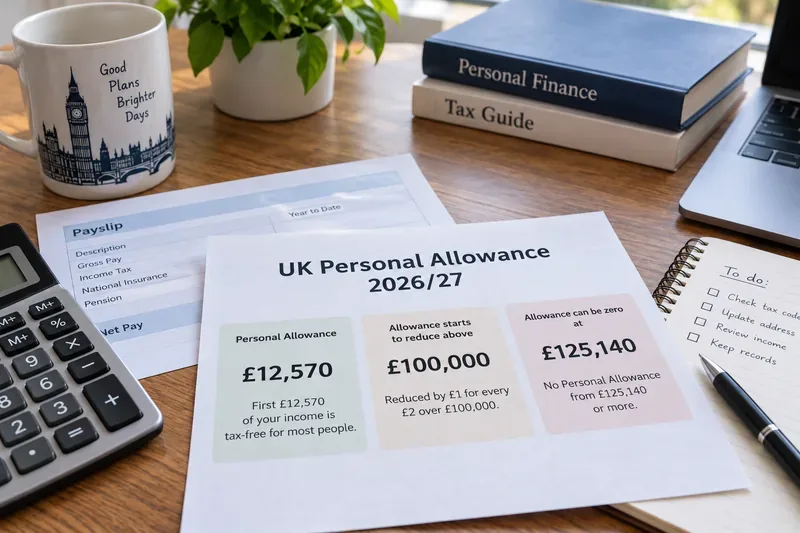
A practical tax-planning desk showing the three figures that matter most for the 2026/27 Personal Allowance: £12,570, the £100,000 taper point and £125,140 where the standard allowance can fall to zero.
What the Personal Allowance actually does
A common misunderstanding is that the Personal Allowance is a tax credit. It is not. A tax credit reduces the tax bill itself; the Personal Allowance instead reduces the amount of income that is exposed to Income Tax.
For example, suppose you live in England, Wales or Northern Ireland and have £40,000 of ordinary employment income in 2026/27 with no special adjustments. With a £12,570 Personal Allowance, £27,430 is left as taxable income. That taxable income then falls into the relevant Income Tax bands. The same principle applies in Scotland, although Scottish rates and bands for non-savings, non-dividend income are different.
Action: when estimating your tax, subtract the Personal Allowance only after identifying your taxable income, then apply the appropriate tax bands to what remains. Do not simply subtract £12,570 from the tax bill.
The verified 2026/27 figures at a glance
Item
2026/27 position
What it means
Standard Personal Allowance
£12,570
Income covered by the standard allowance before Income Tax is charged, subject to eligibility and tapering.
Taper starts
Adjusted net income above £100,000
The allowance is reduced by £1 for every £2 above £100,000.
Allowance reaches zero
£125,140 adjusted net income
At or above this level, the standard Personal Allowance is fully withdrawn.
Common PAYE tax code
1257L
Used for many people with one job or pension, but not a guarantee that it is correct for you.
These figures are confirmed by HMRC for 2026/27. HMRC also states that the standard Personal Allowance applies across the UK, although Scotland has its own Income Tax bands for wages, pensions and most other non-savings, non-dividend income. See the official Scottish Income Tax rates if you are a Scottish taxpayer.
What happens when your income exceeds £100,000?
The Personal Allowance is based on adjusted net income, not simply your headline salary. Once adjusted net income exceeds £100,000, the allowance falls by £1 for every £2 above that threshold.
Take someone with adjusted net income of £110,000. They are £10,000 above the threshold. Half of that amount, £5,000, is removed from the standard £12,570 allowance, leaving a Personal Allowance of £7,570. At £125,140, the entire £12,570 has been withdrawn.
This creates a frequently discussed tax effect. For a taxpayer in England, Wales or Northern Ireland who is paying 40% higher-rate Income Tax in this range, each additional £2 can both attract 40% tax and remove £1 of tax-free allowance. That produces an effective Income Tax marginal rate of 60% on income within the taper range, before considering National Insurance, student-loan deductions or other charges. That 60% figure is a mathematical consequence of the allowance withdrawal; it is not a separate statutory tax band.
Action: if your income is near or above £100,000, calculate adjusted net income rather than relying only on gross salary. HMRC explains the calculation in its adjusted net income guidance.
Adjusted net income is not the same as salary
Another common mistake is to look only at annual salary when deciding whether the £100,000 taper applies. HMRC’s adjusted net income calculation begins with taxable income from relevant sources and then makes specific adjustments. Depending on your circumstances, taxable income can include employment income, self-employment profits, pensions, savings interest, dividends, rental income and certain foreign income.
Certain reliefs can reduce adjusted net income. HMRC specifically identifies qualifying pension contributions and Gift Aid donations among the adjustments that may matter. For example, under relief-at-source pension arrangements, the grossed-up pension contribution can reduce adjusted net income. The exact treatment depends on how the contribution was made, so this is an area where payroll figures alone may not tell the whole story.
Action: if you are close to £100,000, gather your income from all taxable sources and check how any pension contributions or Gift Aid donations are treated before deciding whether your allowance is tapered.
Does earning more than £12,570 mean all your income becomes taxable?
No. Crossing the standard Personal Allowance does not suddenly make the whole amount taxable. In a straightforward case, only the portion above the allowance enters the Income Tax bands.
If your taxable income is £13,570 and you receive the full £12,570 allowance, only £1,000 remains taxable. The Personal Allowance therefore works more like a tax-free slice of income than a cliff edge.
Action: focus on the amount above your allowance, not your total income, when making a basic tax estimate.
Does 1257L always mean you have exactly £12,570 tax-free?
Not necessarily. HMRC says 1257L is currently the tax code used for most people who have one job or pension, and the numbers in a tax code generally indicate how much tax-free income an employer or pension provider should give through PAYE. But tax codes can be adjusted for untaxed income, taxable benefits, underpaid tax or other items.
Someone can therefore have a code that differs from 1257L even though the standard Personal Allowance is £12,570. Scottish and Welsh taxpayers can also see prefixes such as S or C in their tax codes.
Action: compare the code on your latest payslip with HMRC’s official tax-code guidance. If the income, benefits or deductions used by HMRC are wrong, update them rather than assuming the payroll calculation will correct itself automatically.
England, Wales, Northern Ireland and Scotland: what changes?
The standard Personal Allowance of £12,570 is UK-wide for 2026/27. The main difference is what happens after that allowance has been used.
For England, Wales and Northern Ireland, the standard bands shown by HMRC for 2026/27 are 20% basic rate, 40% higher rate and 45% additional rate, subject to the published thresholds. Scotland uses separate starter, basic, intermediate, higher, advanced and top rates for wages, pensions and most other non-savings, non-dividend income. Savings and dividend taxation follows UK-wide rules in important respects.
Action: determine your taxpayer status before copying an Income Tax calculation from an online example. A calculation for an employee in London may not reproduce the result for an employee with the same salary who is a Scottish taxpayer.
Personal Allowance and National Insurance are different systems
“Tax-free” can also be misleading because the Personal Allowance concerns Income Tax, not every deduction from pay. National Insurance uses its own thresholds and rules. A person can therefore have income that falls within the Personal Allowance for Income Tax purposes yet still need to consider other deductions or liabilities, depending on the type and level of income.
The same caution applies to student-loan repayments, pension deductions and other payroll items. None of those should be assumed to disappear simply because part of your income is covered by the Personal Allowance.
Action: when checking a payslip, review Income Tax separately from National Insurance and other deductions. Do not use the Personal Allowance as a universal “no deductions below this amount” threshold.
Marriage Allowance is related, but it is not an automatic doubling of your allowance
Marriage Allowance is another area where terminology causes confusion. For 2026/27, the transferable amount is £1,260 under the published rules, but eligibility conditions apply. It does not mean a married couple simply combines two Personal Allowances into one pot or automatically gets an extra £1,260 each.
The lower-income spouse or civil partner may be able to transfer a specified portion of unused Personal Allowance to an eligible partner. The recipient must meet the relevant tax-rate conditions. HMRC publishes the current figure in its official Income Tax allowances material.
Action: treat Marriage Allowance as a separate claim with eligibility rules, not as part of the default £12,570 calculation.
Why your PAYE deductions can still be wrong during the year
PAYE is designed to collect Income Tax through payroll, but it relies on HMRC having reasonable information about your expected income and circumstances. Starting a second job, receiving taxable benefits, changing pension income or moving into the Personal Allowance taper can affect the tax code HMRC uses.
HMRC provides a current-year service that lets taxpayers check their tax code, Personal Allowance, estimated employment and pension income, tax already paid and expected tax for the rest of the year. The service covers the 2026/27 tax year.
The Personal Allowance also feeds into Self Assessment calculations. The principle is the same: relevant taxable income is identified, allowances and reliefs are applied under the rules, and tax rates are then used to calculate the liability.
For people with multiple income sources, self-employment, rental income or other complex tax affairs, the figure that matters may differ materially from salary shown on a P60. The adjusted-net-income test is particularly important for higher-income taxpayers because it affects the Personal Allowance and can also interact with other tax rules.
Action: if Self Assessment applies to you, reconcile all taxable income sources before relying on a PAYE tax code as a complete picture of your annual tax position.
A practical way to check your own position
Identify the tax year. This article uses 2026/27, from 6 April 2026 to 5 April 2027.
Add up relevant taxable income. Include more than salary if you have taxable pensions, interest, dividends, rental income or other taxable sources.
Work out adjusted net income if needed. This is especially important around £100,000 and where pension contributions or Gift Aid may alter the result.
Find the Personal Allowance that actually applies. Do not assume £12,570 if tapering or another adjustment applies.
Apply the correct tax bands. Use the rates for your taxpayer status, especially if you are in Scotland.
Compare the result with PAYE. Check your tax code and HMRC’s current-year estimate if your payslip does not look consistent.
What is verified, what depends on circumstances, and what can change
Verified for 2026/27: the standard Personal Allowance is £12,570; the taper begins above £100,000 of adjusted net income; the allowance is reduced by £1 for every £2 over that level; and it reaches zero at £125,140. HMRC also confirms that 1257L is used for most people with one job or pension.
Depends on your circumstances: your actual Personal Allowance, tax code, taxable income, whether pension or Gift Aid adjustments reduce adjusted net income, whether you qualify for Marriage Allowance, and which tax bands apply to your non-savings income.
Not safe to assume for future years: that these exact thresholds will always remain unchanged. Tax policy can be altered by legislation and future fiscal events. A calculation for 2026/27 should therefore not be reused blindly for a later tax year.
Action: keep the tax year visible on any calculation you save and recheck HMRC’s official rates whenever you use it again.
Bottom line
The UK Personal Allowance is best understood as a tax-free slice of income, not a cash payment or a universal promise that the first £12,570 on every payslip will always be untouched. For 2026/27, £12,570 is the standard figure, but adjusted net income above £100,000 can reduce it and £125,140 can eliminate it entirely.
For most employees, the quickest practical check is to compare the tax code on the payslip with HMRC’s current-year record. For people near the £100,000 taper, with several income sources or with pension and Gift Aid adjustments, calculating adjusted net income is the more important step. That distinction is what turns the Personal Allowance from a headline number into an accurate tax calculation.