Home
» News
»
Senate Blocks Data Center Bill: What It Could Mean for AI Infrastructure
Senate Blocks Data Center Bill: What It Could Mean for AI Infrastructure
If you are trying to understand whether the Senate just stopped America’s AI buildout, the short answer is no. The Senate blocked immediate passage of the Ratepayer Protection Act on September 17, 2026, but the action did not create a moratorium on data centers, cancel approved projects, or change electricity rates overnight. It exposed a deeper policy dispute: who should pay when a very large computing facility requires new generation, transmission lines, substations, and local grid upgrades?
This article explains the event and its practical meaning as of September 18, 2026. The legislative status can change, so the official bill pages linked below should be treated as the final check before making an investment, permitting, or infrastructure decision.
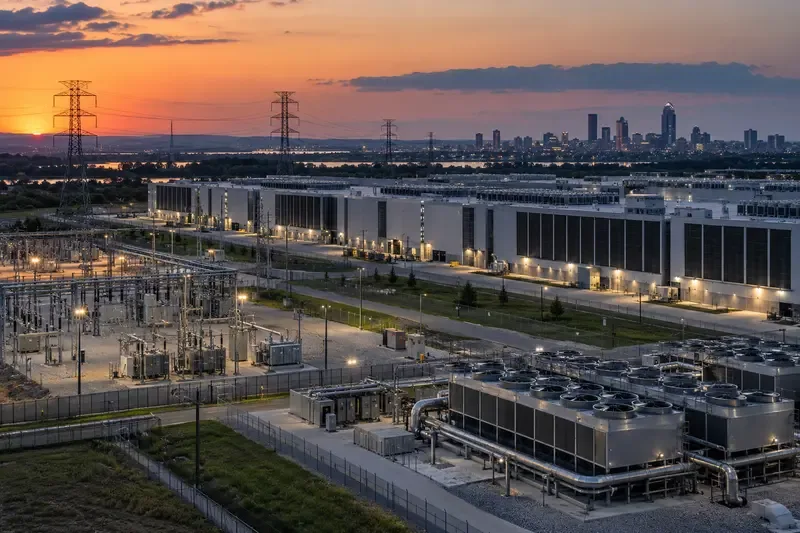
A large data center campus, cooling equipment, substations, and transmission lines illustrate the physical infrastructure at the center of the ratepayer debate.
What happened in the Senate?
The measure is the Ratepayer Protection Act. In the House, it was identified as H.R. 9340 and passed on September 16 by a 417–3 vote. The proposal would establish federal standards that state utility regulators would consider when setting rates for large-load customers, including data centers.
On September 17, Senator Jon Husted, Republican of Ohio, brought the Senate version to the floor and sought passage by unanimous consent. That procedure can move a noncontroversial measure quickly, but any senator can object. According to Senator Husted’s official statement, a Democratic senator objected, so the bill did not pass through that expedited route.
That wording matters. “The Senate blocked the bill” does not necessarily mean senators held a recorded vote and rejected the policy after full debate. It means the unanimous-consent path was stopped. The legislation could still return through regular Senate procedures, negotiation, a committee process, or a revised bill.
What would the bill actually do?
The proposal is narrower than headlines about “stopping AI data centers” may suggest. The Congressional Budget Office describes H.R. 9340 as a measure that would expand what electric utilities consider when establishing rates. A qualifying large-load customer would be a nonresidential customer operating a data center with peak demand of at least 100 megawatts at a single facility.
The intended policy direction is cost allocation: a large customer that triggers incremental upgrades could be charged for those costs through a special rate, an agreement, financial assurances, or another approved mechanism. The House sponsor’s explanation also describes protection against stranded costs if a large customer later reduces operations or leaves the system. The practical goal is to avoid making ordinary households and small businesses absorb infrastructure expenses created mainly for a very large new load.
There is an important limitation. The CBO says state regulatory commissions could adopt or reject the federal standards under current law. In other words, the proposal would not automatically impose one nationwide electricity tariff or guarantee that every data center pays every grid-related cost. It would create a federal framework that states would evaluate.
Question
What is confirmed
What is not yet established
Did the bill become law?
No. The Senate’s expedited passage attempt was blocked.
Whether it will return under another procedure or in revised form.
Does it ban new data centers?
No. The proposal concerns rates and grid-upgrade cost recovery.
Whether future state rules could slow individual projects.
Are all data centers covered?
The CBO describes a 100-MW single-facility threshold for the large-load standard.
How each state would define, aggregate, or administer qualifying loads.
Will household bills fall?
The proposal is designed to reduce cost shifting to ratepayers.
The size or timing of any bill effect; that would depend on state rules, utility planning, and project contracts.
Why are data centers at the center of the fight?
AI infrastructure is unusually dependent on power. Training and serving advanced models require large clusters of servers, networking equipment, cooling systems, backup power, and high-speed connections. A new campus may therefore require more than a simple connection to an existing distribution line. Utilities may need to plan generation, substations, transmission capacity, and reliability measures around a large and often fast-growing customer.
The disagreement is not simply “AI versus consumers.” Utilities want enough revenue and financial certainty to build infrastructure. Technology companies want predictable interconnection timelines and competitive energy costs. State regulators must decide which costs belong to the project, which costs benefit the wider system, and what happens if the customer’s demand forecast does not materialize.
That is why the Senate incident matters even before any law is enacted. It signals that data-center power costs have become a national political issue rather than a technical matter handled only in utility filings. The House vote also shows that consumer-cost concerns can attract bipartisan support, even among lawmakers who support rapid AI development.
What could the Senate setback mean for AI infrastructure?
1. Near term: no automatic construction freeze
There is no confirmed federal pause created by this event. Projects already moving through local zoning, environmental review, utility interconnection, or construction contracts are not automatically canceled. Developers should not treat the Senate action as a new prohibition.
Practical check: if you are tracking a project, read its local permit, utility interconnection agreement, and state commission docket. Do not infer the project’s status from the national headline alone.
2. Financing may place more weight on power-cost risk
This is an analysis, not a confirmed market outcome. If Congress eventually adopts a framework that makes large customers responsible for incremental grid costs, developers may need larger deposits, stronger financial assurances, longer rate agreements, or more detailed power-procurement plans. Those requirements could improve certainty for utilities but raise the upfront cost of a project.
Practical check: separate the project’s server and building budget from its power-delivery budget. Ask which party pays for generation, transmission, substations, backup capacity, and stranded-cost protection, and whether those terms are binding.
3. Site selection could become more important
A data center’s location already depends on land, fiber, cooling, water, tax policy, and reliability. A stronger cost-allocation regime could make available grid capacity and the local utility’s interconnection rules even more decisive. Projects near generation or transmission capacity may face a different cost profile from projects that require major upgrades.
Practical check: compare sites using a full infrastructure checklist, not just advertised electricity prices. Request the utility’s assumptions about peak demand, delivery schedule, upgrade scope, and curtailment or demand-response requirements.
4. AI deployment may spread across more locations
This is a plausible scenario, not a measured result of the Senate action. If a single campus becomes expensive or slow to connect, operators may diversify across regions, use smaller facilities, place some workloads in existing cloud capacity, or rely more on workload scheduling and efficiency improvements. That could change where AI compute is built without reducing total demand.
Practical check: distinguish training, batch inference, and latency-sensitive inference. They have different location and scheduling needs, so a policy shock may affect them differently.
What should readers watch next?
Senate procedure: whether the bill receives a committee hearing, a regular floor motion, or a revised text.
Bill language: whether the 100-MW threshold, financial assurances, and state-regulator discretion remain intact.
State implementation: utility commission orders, large-load tariffs, interconnection rules, and public comments.
Utility filings: projected demand, requested transmission or generation upgrades, and who is contractually responsible if a project is delayed.
Company disclosures: power-purchase agreements, on-site generation, backup systems, workload flexibility, and changes to data-center locations.
Before repeating that the Senate “killed AI infrastructure,” run this five-question check:
Am I describing an objection to unanimous consent, or a recorded Senate vote?
Am I discussing a proposal, an enacted law, or a state rule already in force?
Does the project I care about meet the proposed 100-MW single-facility threshold?
Do I know who is contractually paying for incremental grid upgrades?
Have I checked the latest official bill status and the relevant state utility docket?
The clearest conclusion today is limited but important: the Senate setback leaves the federal cost-allocation question unresolved. It does not stop the AI infrastructure race, but it increases the importance of power economics, utility contracts, state regulation, and financial responsibility in deciding which data-center projects can move forward quickly.