Home
» News
»
Solid-State Batteries Explained: How They Work and What They Could Change
Solid-State Batteries Explained: How They Work and What They Could Change
Solid-state batteries are often described as the next major step beyond today’s lithium-ion batteries. The phrase sounds simple, but it covers several different material systems, and the most exciting claims—more range, faster charging, better safety, and smaller packs—depend on engineering choices that are still being worked out.
This guide builds the subject from the ground up. You will first learn the parts of a rechargeable battery, then see what changes when the electrolyte becomes solid, how charging and discharging work, what advantages are plausible, what technical problems remain, and how to read product announcements without treating development targets as finished specifications.
Start with the one change that defines a solid-state battery
A rechargeable battery needs an electrolyte: a material that allows charged atoms called ions to move between the two electrodes inside the cell. In most conventional lithium-ion cells, that electrolyte is a lithium salt dissolved in an organic liquid and held inside a porous separator.
In an all-solid-state battery, the ion-conducting electrolyte is solid rather than liquid. It may be a ceramic, glass-like material, sulfide, polymer, or a composite. “Solid-state battery” is sometimes used more broadly for designs that still contain a small amount of liquid or gel, so when comparing products, it is worth checking whether the company specifically says all-solid-state.
You do not need electrochemistry training to follow the basic operation. Keep four functions in mind:
Cathode: the positive electrode during discharge. It stores lithium in a host material in many rechargeable designs.
Anode: the negative electrode during discharge. Conventional lithium-ion cells often use graphite; some solid-state designs aim to use lithium metal because it can store more charge per unit mass than graphite.
Electrolyte: the ion-conducting path inside the cell. In a solid-state design, this is a solid material.
External circuit: the path through the device, motor, charger and wiring where electrons travel. The electrolyte should carry ions but block electrons.
The distinction between ions and electrons is the key mental model. Lithium ions move through the electrolyte inside the battery; electrons move through the external circuit. Those two coordinated flows are what make useful electrical current possible.
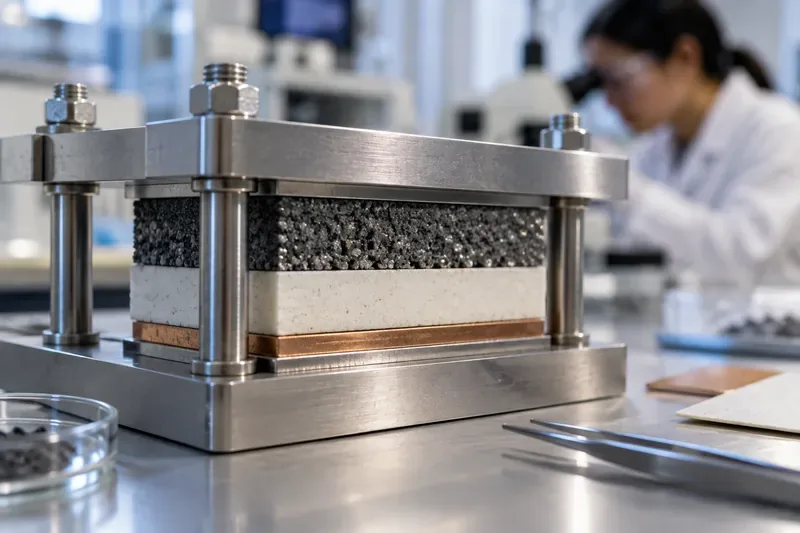
A layered laboratory test stack is held under compression between metal plates. The visible solid layers and clamping fixture help illustrate a central engineering issue in solid-state cells: maintaining close contact across solid-to-solid interfaces.
How charging and discharging work
During charging
A charger pushes electrons toward the anode through the external circuit. At the same time, lithium ions move through the solid electrolyte toward the anode. If the cell uses a lithium-metal anode, lithium can plate onto the metal surface as charging proceeds.
During discharge
The process reverses. Lithium is oxidized at the anode side, lithium ions migrate through the electrolyte toward the cathode, and electrons travel through the external circuit to power a device or vehicle.
In principle, that is not radically different from a conventional lithium-ion battery. The difficult part is making a solid electrolyte that conducts lithium ions quickly, remains chemically stable against both electrodes, can be manufactured as a thin layer, and maintains intimate contact while the electrodes expand, contract and change during cycling.
A widely cited review of interface stability in solid-state batteries explains why the boundaries between active material, electrolyte and conductive additives can create high resistance even after bulk solid electrolytes reach ion conductivities comparable with liquid electrolytes.
Before judging the benefits, prepare a simple claim checklist
Solid-state battery announcements often compress several separate ideas into one headline. Before deciding whether a claim is meaningful, write down five questions:
Is the cell truly all-solid-state, or is it a hybrid with liquid or gel?
What is the anode—graphite, silicon-rich material, lithium metal, or an anode-free design?
Is the quoted number measured at cell level, module level, or full battery-pack level?
What conditions were used for charging, temperature, pressure and cycle-life testing?
Is the figure an independently measured result, a prototype result, or a future target?
This checklist matters because “solid electrolyte” alone does not guarantee a particular range, charging time, lifespan or safety level.
Why researchers expect higher energy density
Energy density means how much energy a battery stores relative to its mass or volume. Solid-state technology can potentially improve it in more than one way.
The most important route is not simply replacing liquid with solid. It is enabling electrode combinations that are difficult to use reliably in conventional cells. Lithium metal is especially attractive because it can serve as a very high-capacity anode. A thinner electrolyte and simplified cell architecture can also reduce inactive material. But every practical cell still needs current collectors, packaging, pressure management, thermal controls and safety systems, so laboratory material numbers should not be confused with pack-level performance.
Reviews in Nature Reviews Materials describe solid electrolytes as a route toward safe, energy-dense batteries while emphasizing that conductivity, mechanical behavior and electrode interfaces must be solved together.
Why safety could improve—but “nonflammable” is not the same as “risk-free”
Many conventional lithium-ion cells use flammable organic liquid electrolytes. Replacing much or all of that liquid with an inorganic solid electrolyte can reduce one important source of flammable material and may allow cells to tolerate different operating conditions.
That does not make every solid-state battery intrinsically safe under every abuse condition. Electrodes can still store large amounts of chemical energy. Internal short circuits can still generate heat. Some solid electrolytes can react with moisture or with electrode materials, and lithium metal brings its own failure modes.
The right conclusion is narrower: solid electrolytes can improve the safety design space, particularly by reducing dependence on volatile liquid electrolyte, but real safety has to be demonstrated at cell and pack level under standardized abuse tests.
The hardest problem is often the interface, not the solid material itself
Two liquids naturally wet each other and conform to irregular surfaces. Two solids do not. If microscopic gaps form between an electrode and a solid electrolyte, lithium ions have fewer pathways across the boundary and local current can become uneven.
This is why solid-state cells may be assembled or operated under stack pressure—mechanical pressure applied across the layered cell to preserve contact. A 2024 review of pressure–electrochemistry coupling notes that pressure can affect conductivity, electrode deformation, cycling and safety. For commercial products, the challenge is to get reliable contact without adding bulky hardware or demanding impractical pressure.
Interfaces can also react chemically. Reaction products may create resistive layers, while repeated charging and discharging can cause cracking, delamination or loss of contact. Those details are why a material that looks excellent in a small laboratory pellet may be much harder to turn into a large, durable automotive cell.
Solid electrolytes are a family, not one material
Electrolyte family
Why it is attractive
Typical engineering challenge
Sulfides
Very high lithium-ion conductivity and relatively soft, formable behavior
Moisture sensitivity, interface chemistry and controlled manufacturing
Oxide ceramics
Chemical and thermal robustness in many compositions
Brittleness, difficult solid-solid contact and high-temperature processing for some materials
Polymers
Flexible, easier to form into thin films
Room-temperature conductivity and high-voltage stability can be limiting
Composite or hybrid solids
Can combine mechanical flexibility with inorganic ion-conducting phases
More interfaces and a more complicated balance of conductivity, strength and processing
There is no universally best solid electrolyte. The optimum material depends on voltage, anode choice, manufacturing process, operating temperature, required pressure, cost and the intended product.
Dendrites do not disappear just because the electrolyte is solid
A dendrite is a filament-like deposit that can grow from lithium during charging. One early hope was that a hard solid electrolyte would mechanically block these structures. Research has shown the reality is more complicated: defects, grain boundaries, local current concentration, interface voids and electrochemical reactions can all contribute to lithium penetration.
A Nature Materials study published in January 2025 observed two dendrite-related mechanisms in a garnet solid electrolyte system: nonuniform lithium plating at the electrode–electrolyte interface and local lithium-ion reduction at electrolyte grain boundaries. The lesson for beginners is simple: a ceramic separator is not an automatic dendrite shield.
If manufacturers can combine thin solid electrolytes, lithium-metal or other high-capacity anodes, fast ion transport and long cycle life at acceptable cost, electric vehicles could benefit in several ways:
More range from a pack of similar mass, or a smaller pack for the same range.
Higher power capability for acceleration and regenerative braking if internal resistance is low.
Faster charging if the electrolyte, interfaces, anode and thermal system can tolerate high current.
Different pack designs because thermal and safety constraints may change.
Those are conditional benefits, not universal specifications. Charging time, for example, depends on the entire cell chemistry and the vehicle’s charger, cooling system and battery-management limits. Energy density at the material level does not automatically become extra driving range because aerodynamics, vehicle mass and auxiliary loads still matter.
What could change for phones, laptops and wearables
Consumer electronics could use higher volumetric energy density to make devices thinner, extend runtime or create room for cameras, cooling hardware and other components. A solid electrolyte could also enable cell shapes or packaging approaches that are difficult with conventional liquid-filled cells.
But the commercial trade-off is different from a car. A phone battery must be extremely inexpensive, thin, manufacturable by the hundreds of millions and able to survive years of everyday charging. A chemistry that works economically in a premium vehicle or specialized device may not immediately make sense for mainstream phones.
What has to happen before mass adoption
To move from a promising laboratory cell to a high-volume product, manufacturers need more than a strong electrochemistry graph. They must repeatedly produce large-area layers with few defects, control moisture and contamination, maintain interface contact, achieve useful cycle life, validate abuse behavior, and keep yield high enough for competitive cost.
Scale also changes the problem. A tiny test cell can use unusually high pressure, excess lithium, thick separators or carefully selected samples. A commercial cell has to work with realistic material loading, thin electrolyte layers, rapid manufacturing and statistically consistent quality.
That is why manufacturing announcements deserve as much attention as record-setting laboratory results.
Where commercialization stood as of September 2026
Solid-state development is beyond the purely academic stage, but future launch dates should still be read as targets. In an October 8, 2025 official announcement, Toyota and Sumitomo Metal Mining said they were collaborating on mass production of cathode materials and that Toyota was aiming for a market launch of battery-electric vehicles with all-solid-state batteries in 2027–2028. The release is available on Toyota’s official global newsroom.
Toyota’s official solid-state development-line disclosure also emphasized the need to stack anode, cathode and solid-electrolyte layers tightly without gaps and to develop high-speed, high-precision production methods. That is a useful reminder that a prototype cell, a pilot line and full-scale mass production are three different milestones.
For readers in 2026, the safest way to interpret any “coming soon” solid-state battery story is to look for the exact cell format, chemistry, test conditions, manufacturing stage and whether the date is a company goal or an actual product launch.
A practical way to evaluate the next solid-state battery headline
When you encounter a new announcement, work through it in this order:
Identify the electrolyte. “Solid-state” alone is too broad; sulfide, oxide, polymer and composite systems have different trade-offs.
Identify the anode. A lithium-metal design has different energy-density potential and interface challenges from a graphite-based design.
Find the measurement level. Separate material, single-layer cell, full cell, module and pack numbers.
Read the test conditions. Look for temperature, pressure, charge rate, discharge rate, cycle count and capacity retention.
Separate demonstrated data from targets. A stated goal for 2028 is not a 2026 production specification.
Look for manufacturing evidence. Pilot-line yield, layer thickness, defect control and production rate can matter as much as a peak laboratory metric.
Common mistakes to avoid
Assuming all solid-state batteries use lithium metal. They do not. The electrolyte and anode are separate design choices.
Assuming “solid” means dendrite-proof. Recent research shows dendrites can still develop through multiple mechanisms.
Comparing cell energy density with pack energy density. A finished pack contains structural, electrical, cooling and safety hardware.
Treating a fast-charge target as a chemistry-wide property. Charge speed depends on the whole battery system and operating conditions.
Reading a company roadmap as a guaranteed release date. Pilot production, qualification and mass production can move on different schedules.
Reducing safety to flammability alone. Solid electrolytes can remove or reduce flammable liquid electrolyte, but short circuits, lithium reactions and stored energy still have to be managed.
The bottom line
A solid-state battery replaces the conventional liquid electrolyte with a solid ion conductor, but the consequences go far beyond swapping one material. The technology can potentially support high-capacity anodes, thinner internal layers, different safety strategies, high power and fast charging. At the same time, it creates demanding solid-to-solid interfaces that must stay chemically stable and physically connected through thousands of cycles.
The most useful beginner’s rule is to resist treating “solid-state” as a single performance label. Ask what the electrolyte is, what the anode is, how the cell was tested and whether the claim is a measured result or a future target. Those four questions make it much easier to separate genuine progress from a headline that skips the engineering details.