Home
» News
»
What the Data Center Bill Could Mean for US Digital Infrastructure
What the Data Center Bill Could Mean for US Digital Infrastructure
What the bill could mean in practical terms: the House-passed Ratepayer Protection Act could push states to make very large data centers bear more of the incremental cost of the generation, transmission, and distribution capacity built to serve them. It would not, by itself, set a national electricity rate, approve a power plant, or guarantee that household bills fall. As of September 19, 2026, the point that can be verified from the official House committee record is that H.R. 9340 passed the House on September 16 by 417–3. The same record describes the measure as a federal recommendation to state utility commissions, not a nationwide tariff that is already in force.
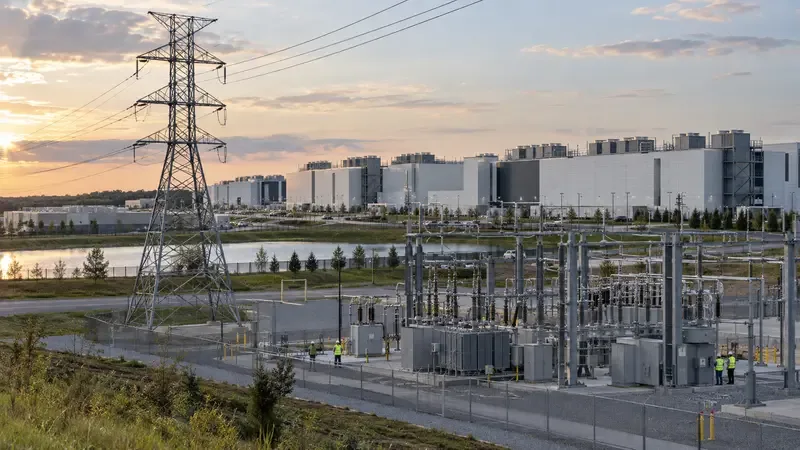
A data center campus sits behind grid equipment in this neutral illustration of the infrastructure question at the center of the debate; it does not depict a specific project or bill hearing.
What has actually been verified?
The House Energy and Commerce Committee says H.R. 9340, the Ratepayer Protection Act, passed the House with a 417–3 vote on September 16, 2026. The committee’s background summary says the bill would have state public utility commissions consider large-load standards for data centers drawing more than 100 megawatts. Those standards would be designed to make the facilities cover the full incremental cost of serving their loads. The summary also says the approach would preserve state authority over electricity markets and rely on existing Public Utility Regulatory Policies Act authority.
That distinction matters. “Passed the House” is not the same as “became law,” and “consider large-load standards” is not the same as “every data center must immediately pay a national surcharge.” The official record reviewed for this article confirms the House action and the proposed policy mechanism. It does not establish that the proposal has been enacted, that every state has adopted a matching tariff, or that a household in any particular utility territory will see a specific bill change.
For the primary description of the measure, read the House Energy and Commerce Committee release on H.R. 9340. Useful test: when you see a headline saying “the data center bill passed,” check whether it identifies the chamber, the bill number, the date, and whether the text became law. If one of those items is missing, treat the headline as incomplete.
Why data centers are being treated as an infrastructure issue
A data center is not only a server building. It is a concentrated electrical load connected to a network that also serves homes, hospitals, factories, schools, and other businesses. The computing equipment needs power, cooling, backup systems, fiber connections, and a reliable path to the grid. A large new campus can therefore affect utility forecasts and construction decisions well beyond its fence line.
Lawrence Berkeley National Laboratory’s data-center energy work illustrates the scale of the underlying question. Its 2024 report estimated U.S. data-center electricity use at about 176 terawatt-hours in 2023, up from 58 terawatt-hours in 2014, and projected a 2028 range of roughly 325 to 580 terawatt-hours depending on growth assumptions. The range is important: it is a scenario estimate, not a promise that demand will reach one exact number. The lab’s current data-center research also focuses on large-load connections, grid planning, procurement, and load flexibility.
Those uncertainties are one reason the bill’s design matters more than a single national forecast. A utility may need to study a proposed facility before it knows whether the project will be built at full size, when its servers will be energized, how quickly its load will grow, or whether the developer will fund dedicated equipment. Useful test: when evaluating an infrastructure claim, look for three separate numbers: the facility’s requested megawatts, its expected operating load, and the cost of the specific grid upgrades. Combining them into one headline number can hide the actual decision.
How the bill could change cost allocation
The core policy question is who pays for the “incremental” infrastructure. That can include a new substation, transmission upgrades, distribution equipment, generation capacity, network studies, or protection and control systems that would not have been needed at the same scale without the large load. Under a large-load standard, a state commission could require the data center customer to provide deposits, minimum-payment commitments, dedicated rates, or other financial protections. The exact design would be decided through state regulation rather than by one federal price posted for the entire country.
For ratepayers, the potential benefit is lower exposure to costs tied to a project that is delayed, downsized, or canceled. For utilities, a clear cost-allocation rule could make it easier to approve needed equipment without asking ordinary customers to absorb speculative demand. For data-center developers, the tradeoff is a larger upfront obligation and potentially less flexibility to leave a partially used connection behind.
“Make data centers pay their own way” should not be read too broadly. A facility would still use a shared grid, and some investments may benefit multiple customers. A regulator would have to decide which costs are truly incremental, how to allocate shared assets, and whether a long-term commitment is sufficient to protect other customers. Useful test: read the utility commission filing for the project, not just the political slogan. The meaningful details are the proposed tariff, minimum load commitment, security or contribution, exit terms, and treatment of shared upgrades.
What it could mean for U.S. digital infrastructure
1. More disciplined site selection
If a proposed campus must account for the cost of new grid capacity, developers may place greater value on locations with available transmission, diverse generation, substations, fiber, and a utility process that can deliver power on a credible schedule. This could favor expansion near existing industrial infrastructure rather than a greenfield site chosen mainly for land or tax incentives. It does not mean new projects would stop; it means the power connection would become a more visible part of the business case.
How to judge the result: compare announced projects with their executed interconnection agreements and construction milestones. A press release about a planned campus is not evidence that power, permits, or financing are secured. Change your assessment if the project moves from a request for service to a binding agreement with a defined energization schedule.
2. Greater pressure for generation and transmission investment
The bill could improve accountability, but it cannot manufacture transformers, transmission corridors, or power plants on its own. If data-center demand continues to grow, the United States will still need generation, transmission, distribution upgrades, storage, and faster interconnection processes. Cost responsibility can determine who finances those assets, while it does not eliminate the engineering work or the permitting timeline.
That is a limit worth stating plainly: a data center may pay for an upgrade and still face a long wait for equipment, environmental review, land rights, or regional reliability studies. How to judge the result: track transformer procurement, interconnection queue position, transmission approvals, and the utility’s expected in-service date. If the money is assigned but the schedule has not improved, the policy has addressed allocation more than delivery.
3. Possible changes to project economics and cloud pricing
Higher connection costs could reduce the number of speculative projects or change the economics of AI training, cloud services, and colocation. Developers might respond with more efficient servers, higher utilization, flexible computing schedules, onsite generation, storage, or contracts for clean power. Those responses could improve infrastructure productivity, but they are not automatic. A company could also pass some costs into enterprise contracts, delay capacity, or choose another region.
There is no verified basis for promising that consumers will see lower cloud prices or that AI services will become more expensive by a fixed amount. The effect depends on the customer’s contract, the region’s power market, technology efficiency, and the final tariff. How to judge the result: watch for changes in published utility tariffs, data-center capital plans, and cloud capacity announcements rather than inferring retail prices from the bill’s vote.
4. More state-by-state variation
Because the House summary preserves state authority, the same federal signal could produce different outcomes in Virginia, Texas, Ohio, Arizona, or another state. One commission may adopt a dedicated large-load tariff; another may use deposits, demand charges, or existing rules; a third may decide that its current framework is sufficient. Local zoning, water permits, tax incentives, noise rules, and environmental reviews would still operate alongside electricity regulation.
This makes national statements easy to overstate. A federal bill can shape incentives without producing one uniform local experience. How to judge the result: start with the public utility commission and utility serving the proposed site. Then check the local permitting record. If you are assessing a community impact, a national vote is background; the enforceable terms are usually in the state and local documents.
What the bill would not solve by itself
It would not set every household’s electric bill. Retail rates remain tied to state regulation, utility costs, fuel prices, market conditions, and other investments.
It would not directly regulate water use, noise, diesel backup emissions, or land-use conflicts. Those issues require separate state, local, environmental, or permitting decisions.
It would not guarantee that data centers pay every shared grid cost. Regulators still have to define what is incremental and what benefits the broader system.
It would not make every announced project real. Demand forecasts can include projects that are delayed, resized, or canceled.
It would not replace voluntary commitments. The White House separately describes a Ratepayer Protection Pledge. A pledge is a policy commitment, not the same legal instrument as an enacted statute or an approved utility tariff.
Useful test: match each claim to the instrument that could actually produce it. A federal bill can set direction; a state commission can approve a rate; a county can issue a land-use decision; a utility can build a substation; and a developer can sign a power contract. If the claim skips those steps, it is probably describing an intention rather than a result.
How to evaluate whether the policy is working
The best outcome is not simply “more data centers” or “fewer data centers.” A stronger result would be digital capacity that arrives on a credible schedule, pays the costs it causes, supports reliable power, and gives communities enough information to evaluate tradeoffs. That outcome can be measured with concrete indicators:
Question
Evidence to look for
Warning sign
Are customers protected?
Approved large-load tariffs, deposits, minimum-payment terms, and clear exit rules.
Residential customers are asked to fund upgrades for an uncertain project.
Is power arriving?
Interconnection milestones, equipment orders, permits, and an in-service date.
Capacity is announced without a binding schedule.
Is the grid reliable?
Regional reliability studies, adequate reserve planning, and transparent operating requirements.
Large load is added before reliability risks are explained.
Are communities informed?
Public filings, noise and water disclosures, hearings, and enforceable mitigation terms.
Important project conditions remain confidential or nonbinding.
The Data Center Bill could be important because it moves the debate from “Should America build AI infrastructure?” to “Which customers should finance the grid expansion, under what terms, and with what evidence that the project will materialize?” That is a meaningful shift for utilities, developers, regulators, and households.
The near-term result is more limited than some headlines suggest. The verified House action creates a federal policy signal and proposes a framework for state commissions, especially for data centers above 100 MW. It does not yet establish a single national rate, prove that electricity bills will fall, or resolve water, noise, permitting, and reliability questions. The right evaluation is therefore conditional: the proposal is more likely to improve outcomes if state commissions adopt enforceable cost protections, utilities publish credible connection schedules, and developers make durable commitments. If those details do not appear, the bill may remain a statement of intent rather than a complete solution for U.S. digital infrastructure.
Information note: this article reflects sources checked on September 19, 2026. Legislative status, state tariffs, and project economics can change; readers making investment, regulatory, or siting decisions should consult the latest official filing for the relevant state and utility.