Home
» How To
»
How to Clean a Bidet Nozzle Safely: What Works and What to Avoid
How to Clean a Bidet Nozzle Safely: What Works and What to Avoid
A bidet nozzle can look clean and still develop a weak or uneven spray, or it can look slightly spotted even when the problem is mostly mineral scale rather than grime. That is why the best cleaning method starts with identifying what you are actually dealing with: visible soil on the wand, mineral deposits around the spray holes, or simply a routine maintenance check.
The safest general approach is to use the bidet's own maintenance or nozzle-cleaning mode, handle the extended wand gently, start with a soft damp cloth, and only move to a soft brush or manufacturer-approved cleaner when your exact model allows it. This matters because bidet makers do not all give the same instructions. TOTO's K300 manual, for example, tells owners to wipe the wand with a soft wet cloth and not to push or pull it with excessive force, while Kohler guidance for some models specifically allows a soft-bristled brush and hot water.
What Is Actually Verified About Bidet Nozzle Cleaning?
Verified: self-cleaning does not mean maintenance-free. TOTO states that its automatic wand-cleaning feature helps reduce dirt buildup but does not make manual cleaning unnecessary. Brondell likewise explains that some attachments have a nozzle-cleaning rinse, while models without that feature require manual cleaning.
Action: treat automatic rinsing as a helpful first line of maintenance, not a substitute for inspecting and wiping the nozzle when you see residue or notice a change in spray performance.
Verified: mineral deposits can reduce spray performance. Kohler notes that the spray tip can become clogged by minerals in the water and should be cleaned when performance drops.
Action: if the spray becomes uneven or weaker than usual, inspect the spray holes for chalky white deposits before assuming the nozzle is mechanically broken.
Model-dependent: the correct way to extend the nozzle varies. Some electric seats use a dedicated “wand cleaning” or “nozzle clean” command. Some non-electric attachments use a cleaning position on the control dial. Some models have removable nozzle tips; others do not.
Action: find the maintenance section for your exact model before pulling on the wand or trying to remove the tip. American Standard, for example, advertises removable tips on certain AquaWash models, but that feature should not be assumed on every bidet.
How to Clean a Bidet Nozzle in 4 Steps
1. Put the Bidet in Its Cleaning Position
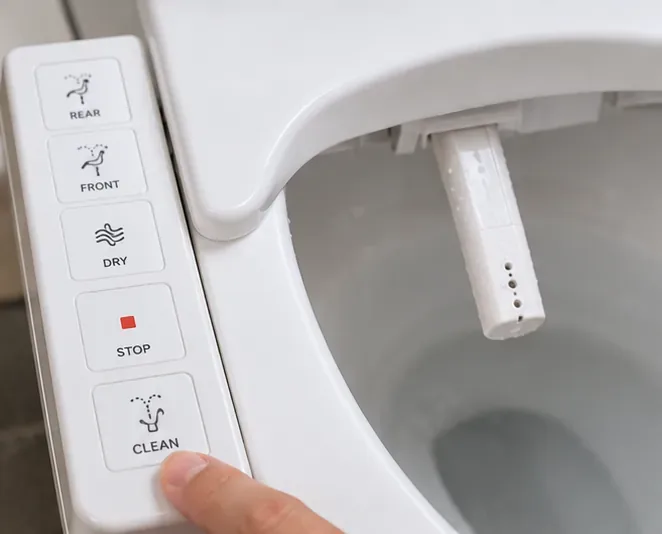
Start with an unoccupied seat. Many electric bidets will not extend the wash wand for maintenance while the seat sensor is activated. Use the control sequence described in your manual to move the nozzle into its cleaning position.
Do not simply grab a retracted nozzle and pull it out. TOTO warns against pushing or pulling the wand with excessive force, and Kohler manuals describe using the unit's cleaning controls to extend the wand.
Use your model’s maintenance or nozzle-cleaning control to extend the wand without forcing it; button names and sequences vary by bidet.
A common misunderstanding is that every electric bidet should be unplugged before any cleaning. The safer statement is more specific: follow the electrical safety instructions for your model. The TOTO K300 manual says to unplug before maintenance except when using its wand-cleaning function, because the powered mechanism is needed to extend the wand.
Action: use the official cleaning mode first, then follow the manual's power instructions rather than applying one rule to every bidet.
2. Wipe the Wand With a Soft, Damp Cloth
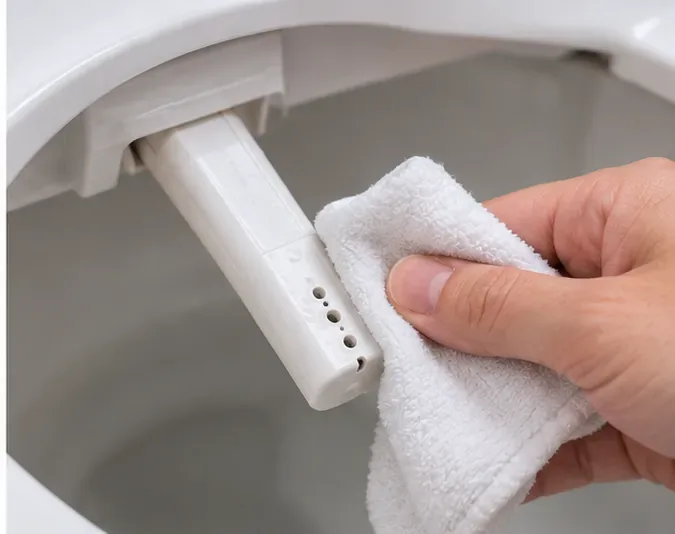
For ordinary residue, begin with the gentlest method. Wipe the exposed wand and nozzle tip with a clean, soft cloth dampened with water. Support the area lightly and clean around the spray openings without twisting the wand.
TOTO's current K300 instructions call for a soft wet cloth and specifically warn against excessive pulling, pushing, or pressing. This is a good default because many wand assemblies are made from plastic parts with small moving components and seals.
Wipe the extended wand gently with a soft, damp cloth. Do not pull, twist, or press hard on the nozzle mechanism.
If plain water does not remove visible soil, check your manual before adding a cleaner. TOTO allows diluted neutral kitchen detergent for heavy dirt on certain plastic surfaces, while Brondell advises a soft wet cloth and gentle cleaner for many of its bidet products. Strong chemicals are not a universal upgrade.
Action: start with water. Escalate only to the mild cleaner explicitly allowed by your manufacturer, then remove any cleaner residue with clean water if the instructions call for it.
3. Deal With Mineral Buildup Carefully
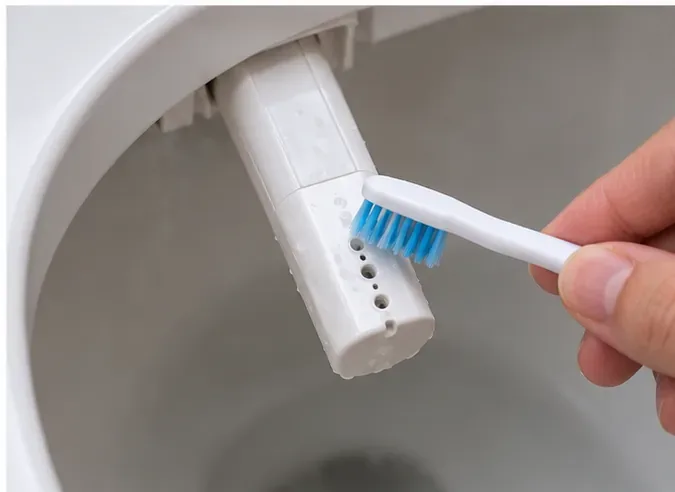
Small white deposits around the spray holes are often associated with mineral buildup from the water supply. Kohler's guidance says the spray wand can be cleaned with a soft-bristled brush and hot water, and some Kohler manuals allow the nozzle tip to be removed for more thorough cleaning.
Some manufacturer instructions, including Kohler guidance for certain models, allow a soft-bristled brush and hot water for the nozzle. Use this method only when your own manual permits it.
This is where generic internet advice can become risky. One common claim is that every bidet nozzle should be soaked in vinegar. That is not verified as a universal recommendation across the manufacturers reviewed here. Some models have removable tips and some do not; plastics, coatings, seals, and approved cleaners differ.
Alcohol is similarly model-specific. Brondell troubleshooting for certain non-electric Ecoseat products suggests a 50/50 water-and-rubbing-alcohol mixture or particular mild cleaners for grime, but that is product-specific support advice, not a blanket rule for all electric bidet seats.
Action: if a soft damp cloth is not enough, use only the descaling or cleaning method stated for your exact model. Do not soak a nozzle tip in vinegar, alcohol, bleach, toilet bowl cleaner, or another chemical merely because another brand permits a similar product.
4. Retract, Rinse, and Check the Spray
Once the nozzle is clean, use the normal control to retract it or complete the manufacturer's cleaning cycle. Do not push the wand back into the housing by hand unless the manual specifically instructs you to do so.
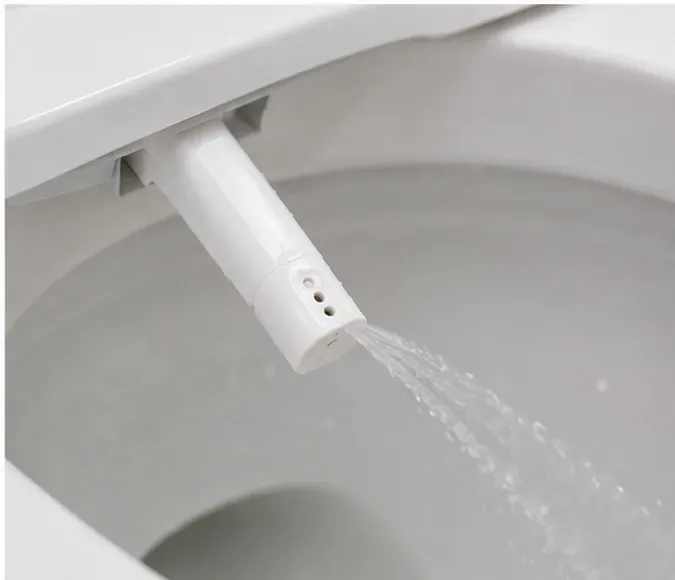
After cleaning, retract the wand or run the model’s cleaning cycle, then confirm the spray openings are clear and the nozzle moves normally.
Then check the result. Depending on the model, you may be able to run a nozzle-cleaning rinse while the seat is unoccupied, or you may need to follow the normal operating conditions for a wash test. You are looking for smooth extension and retraction, unobstructed spray holes, and a spray pattern that is no longer obviously weak or uneven.
Action: stop if the wand binds, remains stuck, leaks from an unusual location, or still has poor flow after the approved cleaning method. At that point, the problem may involve the water filter, inlet screen, water pressure, or an internal component rather than dirt on the nozzle.
Common Myths That Can Lead to Bad Cleaning Decisions
Claim
What the manufacturer guidance supports
What to do
“A self-cleaning nozzle never needs manual cleaning.”
False as a general rule. TOTO explicitly says automatic wand cleaning does not eliminate the need for cleaning.
Inspect the nozzle and manually clean it when dirty or when the spray changes.
“Vinegar is always the best descaler.”
Not universally verified. Approved chemicals and removable parts vary by model.
Use vinegar only when your exact manual or manufacturer support says it is compatible.
“A stronger disinfectant is safer.”
Not supported. Manufacturers commonly warn against harsh or abrasive chemicals that can damage plastic finishes or components.
Start with water and a soft cloth; use only approved mild cleaners.
“If the spray is weak, the nozzle must be dirty.”
Not necessarily. A clogged filter screen, restricted water supply, or other faults can also reduce flow.
Clean the nozzle first, then follow the model's troubleshooting steps if pressure remains low.
How Often Should You Clean a Bidet Nozzle?
There is no single evidence-based interval that fits every bidet. TOTO's K300 manual gives an approximate monthly wand-maintenance interval, while Kohler ties spray-tip cleaning to visible mineral buildup and reduced performance. Water hardness, frequency of use, bathroom conditions, and the bidet's automatic rinse design all change how quickly residue appears.
Action: use your manufacturer's schedule when it provides one. Otherwise, inspect the nozzle regularly and clean it when you see soil, scale, or a change in spray quality rather than waiting for a universal calendar date.
What Should You Avoid?
Do not force the nozzle outward, inward, sideways, or rotationally.
Do not use abrasive pads, scouring powders, metal tools, or stiff brushes on plastic nozzle parts.
Do not spray cleaner directly into an electric bidet housing unless the manual specifically allows it.
Do not assume toilet bowl cleaner is safe for the nozzle or bidet seat.
Do not remove a nozzle cap or spray tip unless the manufacturer describes it as removable.
Do not mix household cleaning chemicals.
How to Tell Whether the Cleaning Worked
A successful cleaning should leave the wand visibly free of residue, able to extend and retract without sticking, and capable of delivering a normal spray pattern. If the nozzle holes still look blocked after the approved cleaning method, or if water flow remains weak, the next step is not automatically a stronger chemical.
Check the manual for inlet-filter or screen maintenance. Kohler recommends cleaning the filter screen when water pressure to the wand drops, and Brondell troubleshooting pages likewise identify clogged mesh filters as a possible cause of weak or failed wash performance on multiple models.
Action: if cleaning the nozzle does not restore normal operation, move to the manufacturer's filter and troubleshooting instructions or contact support. That prevents a simple maintenance task from turning into damage caused by unnecessary disassembly.
Manufacturer Guidance Used for This Guide
TOTO K300 WASHLET instruction manual: manual wand cleaning, soft wet cloth, automatic cleaning limitations, and warnings against excessive force.
Kohler bidet seat cleaning guidance: wand extension for cleaning, soft-bristled brush and hot water on applicable models, mineral-deposit guidance, and filter-screen maintenance.
Brondell SpaSuite bidet attachment FAQ: distinction between nozzle-cleaning features and manual cleaning, plus general advice to avoid strong chemicals.
The key is simple: clean gently, let the model's maintenance mode do the positioning, and treat chemicals and removable parts as model-specific choices. If the manual and generic advice conflict, the manual for your exact bidet wins.