Home
» How To
»
How to Clean a BUNN Coffee Maker With Vinegar: A Model-Safe Descaling Guide
How to Clean a BUNN Coffee Maker With Vinegar: A Model-Safe Descaling Guide
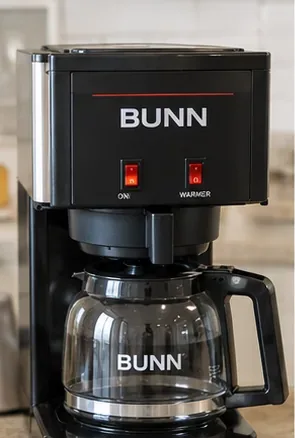
If you have a BUNN home coffee maker and want to descale it with vinegar, the first question is not “How much vinegar should I pour in?” It is “Which BUNN model do I own?” BUNN’s current home-support pages separate Speed Brew, Heat N’ Brew, and My Café into different product lines, and their cleaning instructions are not interchangeable. This guide follows the official vinegar routine for BUNN Speed Brew models, then explains what changes if you own a Heat N’ Brew or another BUNN brewer.
For Speed Brew, BUNN specifies 1 quart (32 ounces) of white vinegar, a minimum two-hour soak, sprayhead cleaning, and three or more fresh-water flushes until the vinegar odor is gone. BUNN describes this as routine cleaning that removes mineral deposits from the internal hot-water tank. The manufacturer recommends doing it about every three months, with more frequent cleaning when your water has higher mineral content.
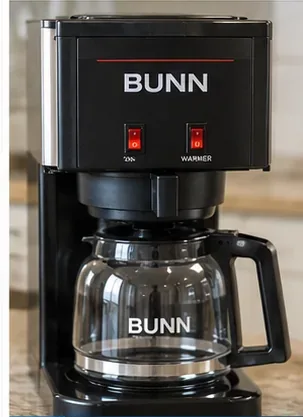
Start by identifying your brewer model. The vinegar quantities and cleaning sequence in this guide are for BUNN Speed Brew models.
Can You Use the Same Vinegar Method on Every BUNN Coffee Maker?
No. BUNN’s current support structure is model-specific, and the vinegar procedure differs between product families. Before cleaning, check the model label and compare it with BUNN’s official home product support page.
Product family
What the official instructions say
What to do
Speed Brew
Use 32 oz of white vinegar, let it sit in the brewer at least 2 hours, then flush with fresh cold water 3 or more times.
Follow the full procedure below.
Heat N’ Brew HB
The manual uses equal parts water and white vinegar, 25 oz each, followed by a brew cycle and 3 or more water cycles. It also gives a separate stronger-clean option using 50 oz of white vinegar.
Do not substitute the Speed Brew sequence; use the Heat N’ Brew procedure.
My Café
It has its own brewer-cleaning, sprayhead, seal, and water-probe maintenance instructions.
Use the model manual rather than assuming the 32-oz Speed Brew method applies.
If you have a Speed Brew, BUNN’s current Speed Brew support page lists models including CSB1, CSB2G, CSB2B, CSB3T, GRB, GRW, SB, NHS, BX, and BT. The detailed cleaning sequence is in the manufacturer’s Speed Brew owner’s manual.
What Do You Need Before You Start?
For the official Speed Brew routine, gather the following:
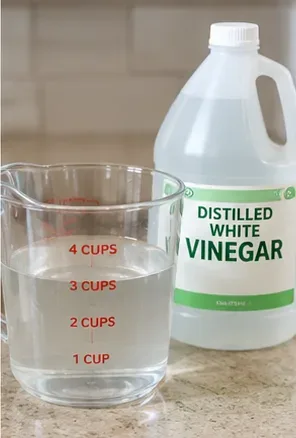
1 quart (32 oz) of plain white vinegar
A toothpick for clearing mineral deposits from sprayhead holes
Mild dish soap
A soft cloth
Fresh cold water for at least three rinse cycles
Your normal brew funnel and carafe
Use white vinegar because that is what BUNN specifies. There is no need to improvise with apple cider vinegar, baking soda, bleach, or an unverified descaler for this procedure.
For a Speed Brew routine cleaning, BUNN specifies 32 ounces of white vinegar. Do not dilute it into a 1:1 solution unless your model’s own manual specifically calls for that.
How Do You Clean a BUNN Speed Brew With Vinegar?
1. Confirm the brewer is assembled for a normal brew
Slide the empty brew funnel into the funnel rails and place the empty carafe beneath it. You do not need coffee grounds or a paper filter for this cleaning cycle.
Because a Speed Brew normally keeps an internal tank of hot water ready, do not remove internal-facing parts while the brewer is hot. BUNN warns that the internal tank contains hot water and says the machine should be switched off, unplugged, and allowed to cool before parts are removed.
2. Pour 32 ounces of white vinegar into the brewer
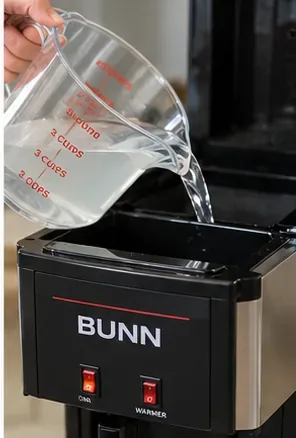
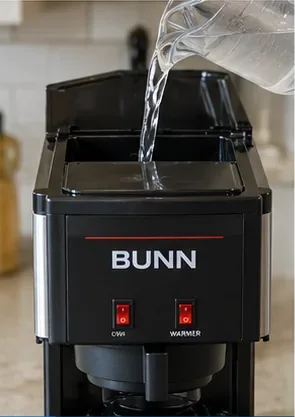
Open the pour-in lid and add the full quart of white vinegar. Close the lid. On a Speed Brew, adding liquid at the top displaces liquid from the internal tank, so liquid will begin moving through the system and into the carafe.
Pour the measured white vinegar into the top of a Speed Brew. The official Speed Brew routine uses straight white vinegar rather than a half-vinegar, half-water mixture.
3. Let the initial flow finish, then empty the carafe
Wait until liquid stops flowing into the carafe, then empty the carafe. This is not the end of the cleaning process; the important descaling soak happens next inside the brewer.
Keep the carafe under the funnel until flow stops. Empty it before beginning the two-hour vinegar soak.
4. Turn off the tank, unplug the brewer, and wait at least two hours
Move the tank power switch to OFF and unplug the coffee maker. BUNN instructs you to leave the vinegar in the machine for at least two hours. This gives the acid time to work on mineral deposits in the internal hot-water tank while the brewer cools enough for the sprayhead to be handled safely.
Do not shorten this into a quick 10- or 20-minute soak just because another drip coffee maker uses that timing. The two-hour soak is part of the Speed Brew procedure.
5. Remove and clean the sprayhead
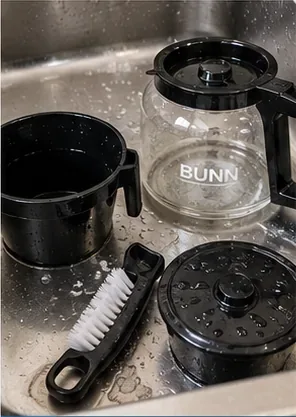
After the brewer has been off, unplugged, and allowed to cool through the soak period, remove the brew funnel and unscrew the sprayhead with your fingertips. Check each sprayhead opening. If you see mineral deposits or white flakes, gently clear the holes with a toothpick.
Wash the sprayhead with a cloth and mild dish soap, then rinse it thoroughly with clean water. Avoid abrasive tools that can damage surfaces.
Wash removable parts with mild soap and rinse thoroughly. For Speed Brew maintenance, also unscrew the sprayhead and clear mineral deposits from its holes with a toothpick.
6. Flush the vinegar out with fresh cold water
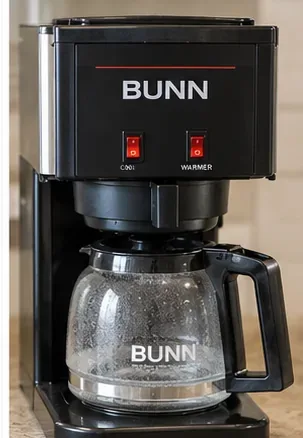
Reinsert the brew funnel as directed, place the empty carafe beneath it, and pour one full carafe of fresh water into the coffee maker. Close the lid so the fresh water begins flushing vinegar from the internal hot-water tank. When the flow stops, empty the carafe.
After the vinegar soak and sprayhead cleaning, use fresh cold water to flush vinegar from the internal hot-water tank.
7. Repeat the rinse cycle three or more times
BUNN says to repeat the fresh-water cycle three or more times, or until you can no longer smell vinegar. Treat “three” as the minimum, not a guaranteed stopping point. If the carafe or brew path still smells acidic, run another full fresh-water cycle.
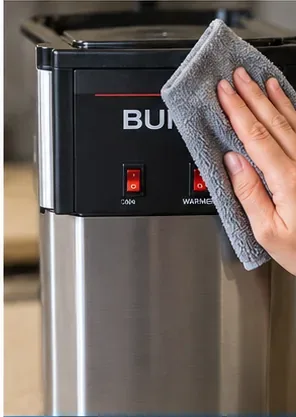
While the removable surfaces are cool, you can also wipe the exterior with a soft damp cloth. Keep water away from electrical parts and never immerse the brewer, cord, or plug.
Wipe the cool exterior with a soft damp cloth while keeping moisture away from electrical components. Exterior wiping complements, but does not replace, the internal vinegar rinse cycles.
8. Reattach the sprayhead and return the brewer to service
Remove the brew funnel, reinstall the clean sprayhead, and replace the funnel. Put the carafe back in position. Plug the brewer in and switch the tank power back to ON. BUNN says to allow about 15 minutes for the water in the tank to return to brewing temperature before making coffee.
Once the sprayhead is reinstalled and the brewer is plugged in, turn the tank power on and allow about 15 minutes for a Speed Brew to return to brewing temperature.
How Often Should You Descale a BUNN With Vinegar?
For Speed Brew routine cleaning, BUNN gives a general interval of every three months. The company also says the schedule may need to be more frequent depending on the mineral content of your water. That distinction matters: scale buildup depends heavily on water hardness, so a fixed calendar interval cannot fit every household.
Useful signs that mineral buildup may be developing include slower-than-usual flow, visible white deposits around the sprayhead, or water remaining in the pour-in area when it should have moved through. BUNN’s Speed Brew support information notes that a clogged sprayhead or sprayhead tube can interfere with normal flow.
What If You Have a Heat N’ Brew Instead?
Do not use the Speed Brew 32-ounce, two-hour-soak procedure by default. BUNN’s Heat N’ Brew instructions call for an equal-parts solution of 25 oz water and 25 oz white vinegar, then a brew cycle followed by at least three full water cycles. The Heat N’ Brew manual also describes a stronger option using 50 oz of white vinegar with a timed pause during the brew process.
You can confirm your HB model and troubleshooting information on BUNN’s Heat N’ Brew support page. This is a good example of why a generic “one cup vinegar plus one cup water” recipe found online should not override the manufacturer’s model-specific procedure.
Does Vinegar “Sanitize” the Coffee Maker?
That is not the claim BUNN makes for this routine. The Speed Brew manual describes vinegar cleaning as a way to remove mineral deposits from the internal hot-water tank and help prolong the brewer’s life. It is more accurate to call this descaling or mineral-deposit removal than to promise disinfection.
Routine hygiene still includes washing the brew funnel and glass carafe after use. For applicable Speed Brew models, BUNN says the glass carafe and brew funnel can be cleaned with mild, non-abrasive dish soap; its manual also gives dishwasher guidance for certain parts and separate instructions for thermal carafes.
What Should You Avoid?
Do not guess the vinegar ratio. Speed Brew and Heat N’ Brew use different official procedures.
Do not remove the sprayhead while the brewer is hot. Follow the power-off, unplug, and cooling instructions.
Do not stop after one water rinse. Speed Brew calls for three or more rinses, continuing until the vinegar smell is gone.
Do not immerse the brewer, cord, or plug. The unit contains electrical components.
Do not use abrasive cleaners on the carafe or brewer surfaces. Follow the material-specific care instructions in your manual.
Do not assume vinegar will fix every slow-flow problem. Persistent blockage can require sprayhead or sprayhead-tube maintenance.
How Do You Know the Cleaning Worked?
Before brewing coffee again, use a simple check: the sprayhead is clean and securely reinstalled, at least three fresh-water cycles have been completed, there is no obvious vinegar odor, and the brewer has reheated for the time specified in its manual. If the machine still has weak or abnormal flow, visible mineral blockage, leaks, or another fault after cleaning, stop troubleshooting by trial and error and use BUNN’s official manual finder or contact BUNN Home Products support for the exact model.
For a typical Speed Brew, the practical takeaway is straightforward: use the manufacturer-specified 32 ounces of white vinegar, give it the full two-hour soak, clean the sprayhead, and rinse with fresh water at least three times. The method is simple, but the model check at the beginning is what keeps a useful cleaning routine from becoming the wrong procedure for your machine.