Home
» How To
»
How to Clean a GE Dishwasher Filter Without Damaging It
How to Clean a GE Dishwasher Filter Without Damaging It
GE dishwasher filters are not all built the same, so the first step is to identify which filtration system your machine actually uses. GE Appliances says most newer models have removable Fine and Ultra Fine Filters that need periodic cleaning, while older models and some current models use self-cleaning filtration with no removable filter for routine cleaning. This guide was checked against GE Appliances support guidance available on September 13, 2026.
If your dishwasher has the removable filter style, cleaning it is usually a simple sink-side job: remove the lower rack, unlock the cylindrical Ultra Fine Filter, clean it with warm soapy water and a sponge, clean the flat Fine Filter if your model has one, then reinstall everything securely. If you cannot confirm that a part is meant to be removed, stop and check the model-specific manual rather than prying on it.
Quick answer: how do you clean a GE dishwasher filter?
For a GE dishwasher with removable Fine and Ultra Fine Filters, remove the bottom rack, turn the Ultra Fine Filter counterclockwise, lift it out, and rinse it with warm soapy water. Use a sponge for stubborn residue. GE warns against scouring pads and abrasive scrubbing on the filter because they can damage the filtering surface. If your model also has a removable Fine Filter, remove it according to the retaining-post instructions for that model, wash it with warm soapy water, and reinstall both filters securely.
What to use
What to avoid
Warm water
Scouring pads
Mild dish soap
Abrasive cleaners
Soft sponge
Forcing or prying a stuck filter
Soft brush only when appropriate for the Fine Filter
Stiff brushing on the Ultra Fine Filter
Before you start: make sure your GE dishwasher has a removable filter
Do not assume that every round or mesh-looking part in the bottom of the tub should come out. GE specifically notes that some dishwashers use self-cleaning filtration. Those machines generally do not have a removable filter that the owner is expected to clean.
If you do not know your exact model, find the model/serial tag first. GE lists common dishwasher tag locations along the left or right front inside edge or the right side edge of the door. The official GE dishwasher model and serial number locator can help.
How to clean a GE dishwasher filter step by step
1. Stop the dishwasher and pull out the lower rack
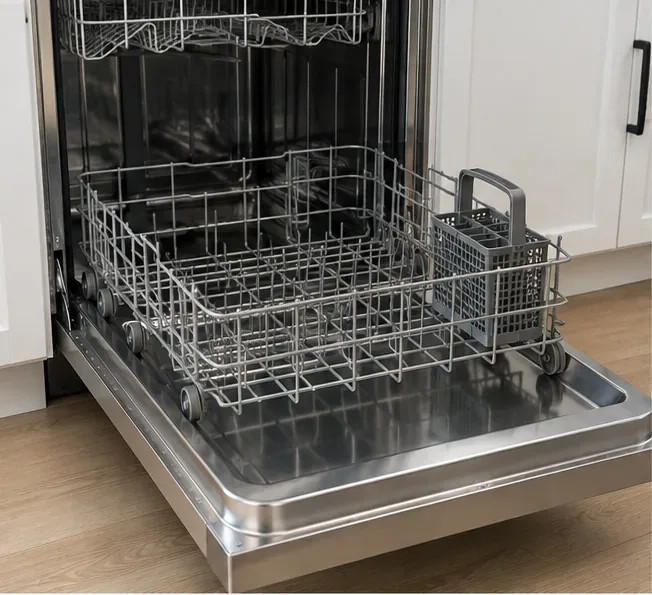
Make sure the dishwasher is not running and the interior has cooled if it recently completed a hot cycle. Open the door and pull the lower rack forward. On many models, you can slide the rack completely out for easier access to the tub floor. Keep the rack level so it does not catch on the door or rails.
Pulling the lower rack forward creates clear access to the filter area at the bottom of the dishwasher.
2. Locate the removable filter assembly
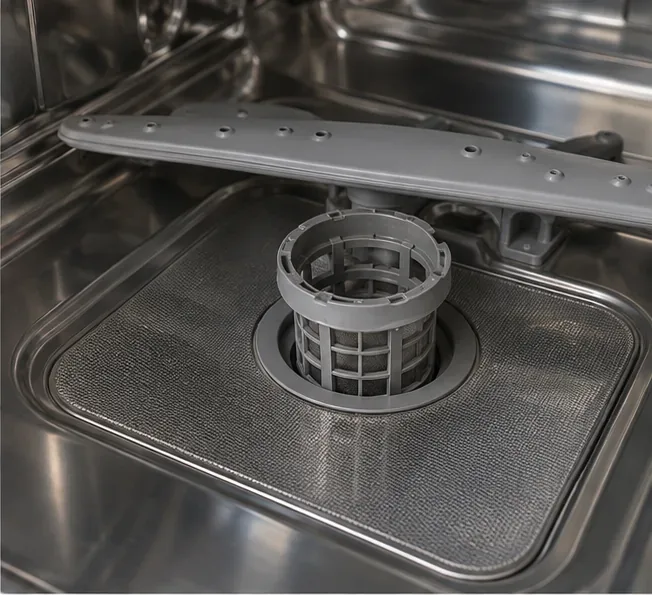
Look at the bottom of the tub, usually near the lower spray arm. A removable-filter design commonly has a cylindrical Ultra Fine Filter seated in or above a flatter Fine Filter area. The exact shape varies by model, which is why the owner's manual is the final authority if your layout does not match this general description.
Before removing anything, note how the filter sits and where its lock position is. A quick phone photo can make reassembly easier.
A removable cylindrical filter is shown at the tub floor; the exact filter shape and retainer layout can vary by GE model.
3. Unlock the Ultra Fine Filter
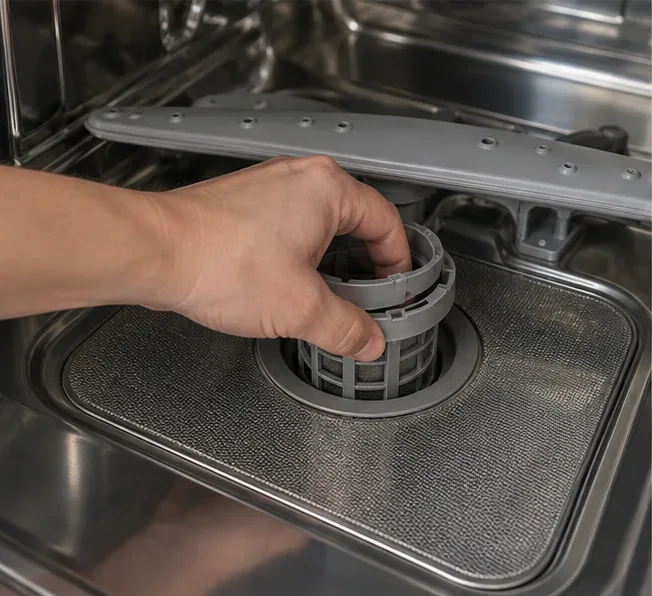
GE's generic removable-filter instructions say to twist the Ultra Fine Filter counterclockwise to release it. Use your hand, not pliers or another gripping tool. If it does not move with moderate hand pressure, check the manual for your model before applying more force.
Turn the removable Ultra Fine Filter counterclockwise by hand to unlock it on models that use GE's standard removable-filter arrangement.
4. Lift the Ultra Fine Filter straight out
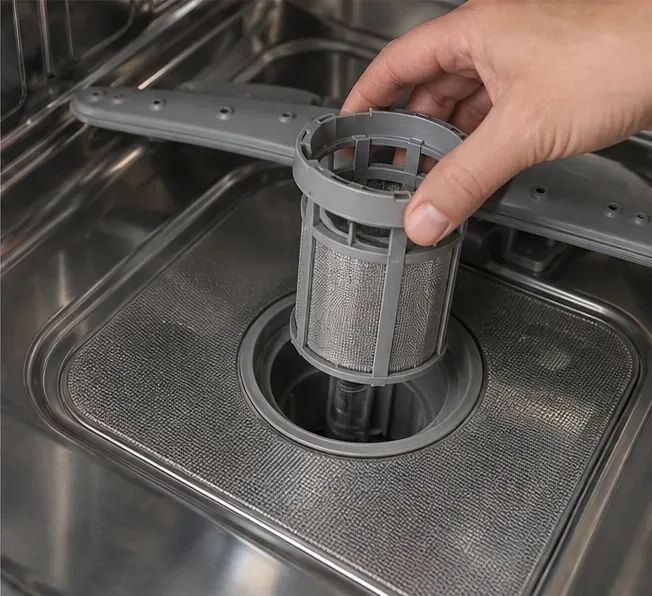
Once it is unlocked, lift the cylindrical filter out of the opening. Check the filter and the exposed sump area for large pieces of food, paper labels, plastic, bones, or other debris that can interfere with water flow. Remove only loose, reachable debris; do not disassemble pump components unless your model's service instructions explicitly tell you to do so.
After unlocking it, lift the Ultra Fine Filter out so the screen can be washed and the surrounding area checked for loose debris.
5. Wash the Ultra Fine Filter with warm soapy water
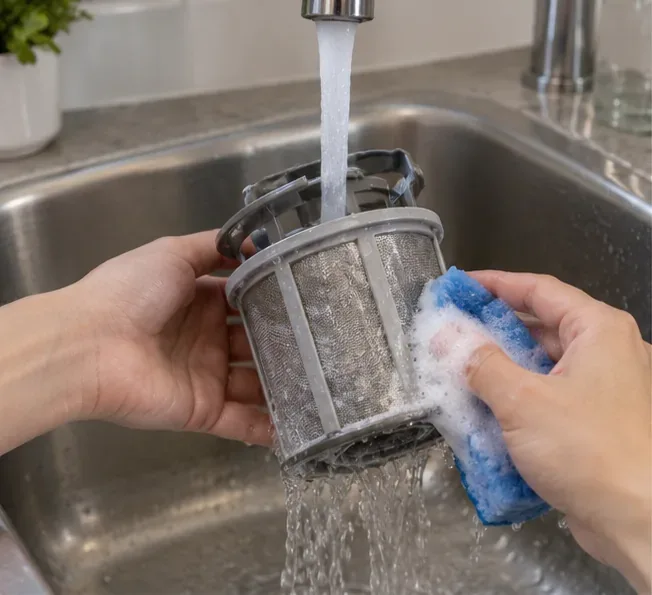
Rinse the cylindrical filter under warm water with a small amount of dish soap. Use a soft sponge to loosen food film and particles from the screen. GE's dedicated guidance cautions that scouring pads or brushes can damage the Ultra Fine Filter, so gentle cleaning is the safer choice here.
Pay attention to the mesh rather than trying to make the plastic frame look cosmetically new. The goal is to restore clear water flow through the screen without scratching or deforming it.
Rinse the Ultra Fine Filter with warm soapy water and use a soft sponge for residue instead of an abrasive pad.
6. Remove and clean the Fine Filter if your model uses one
On GE designs covered by the generic support procedure, the flat Fine Filter is removed after the Ultra Fine Filter. GE describes two retaining posts toward the back of the tub that turn counterclockwise before the Fine Filter can be lifted out. Your dishwasher may use a different retaining arrangement, so follow the owner's manual if the parts do not match that description.
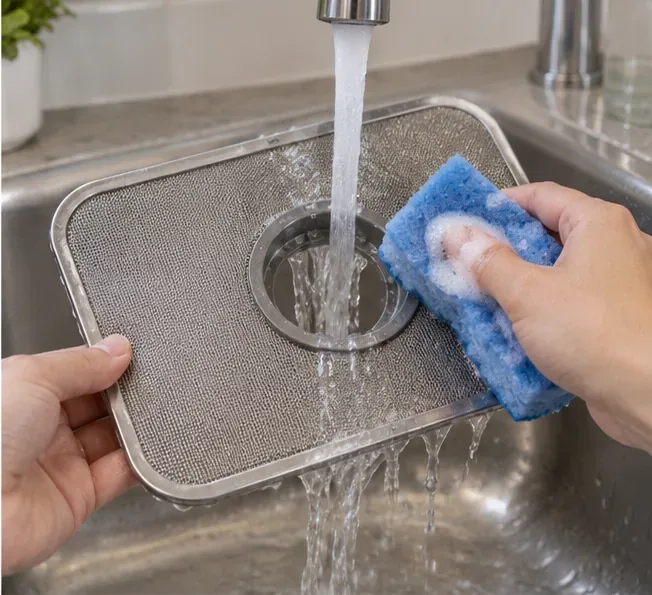
Wash the Fine Filter with warm soapy water. GE says a soft brush or sponge may be used when needed for stubborn soil or hard-water calcium deposits, but scouring pads or harsh brushing can scratch the filter surface.
Clean the Fine Filter with warm soapy water; a sponge is suitable for the mesh, while retaining hardware varies by model.
7. Inspect both filters before reinstalling them
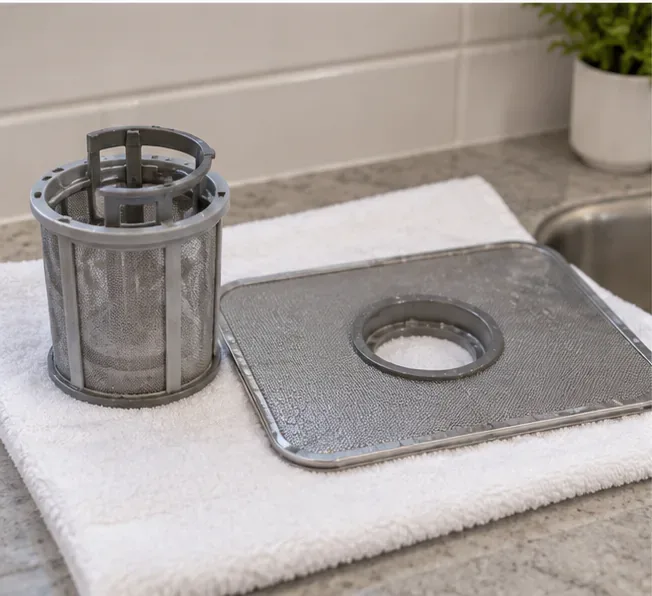
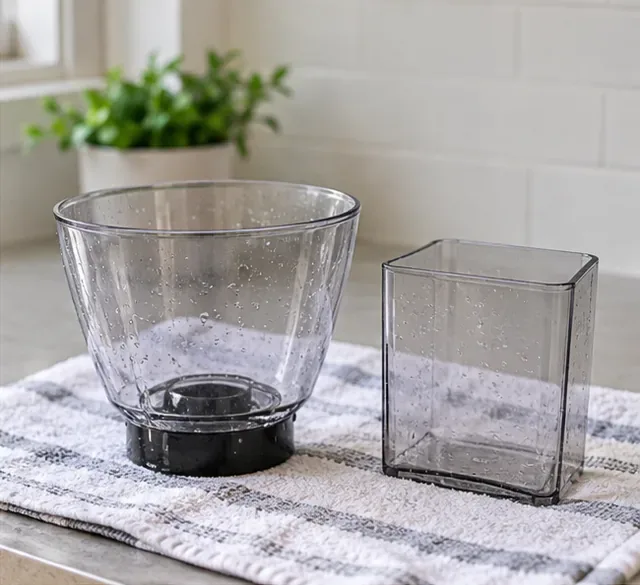
Rinse away remaining soap and inspect the screens under good light. Look for trapped particles, torn mesh, warped plastic, or damage that could prevent the filter from seating correctly. Let excess water drain off. The filters do not need a lengthy drying period before going back into the dishwasher, but laying them on a clean towel makes it easier to inspect the surfaces and confirm that no debris remains.
If the mesh is torn or the locking parts are broken, use the model number to identify the correct replacement rather than operating with a damaged or improvised filter.
Inspect the cleaned filter screens and locking parts for trapped debris or damage before reinstalling them.
8. Reinstall the filters and lock them securely
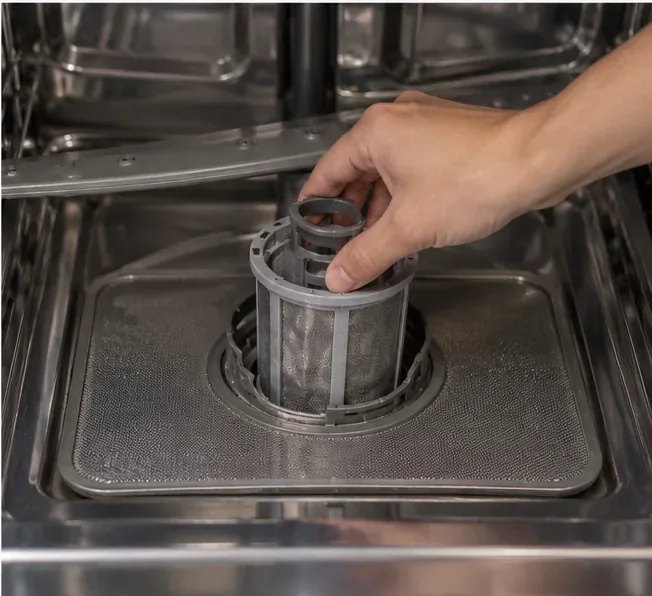
Put the Fine Filter back first if you removed it, then secure its retaining posts as directed for your model. Reinsert the Ultra Fine Filter and turn it clockwise to lock it. GE's generic instructions note that an embossed arrow in the Fine Filter can be used as an alignment guide on applicable models.
After reassembly, make sure the filter sits flat and does not wobble. Return the lower rack, confirm that the lower spray arm can rotate freely, and run your next normal wash cycle. If dishes still come out gritty or wash performance remains poor, the filter may not be the only cause.
Reinstall the filter in its opening and turn it into the locked position so it sits securely before the next wash cycle.
How often should you clean a GE dishwasher filter?
GE's dedicated filter-cleaning page recommends inspecting and cleaning Fine and Ultra Fine Filters periodically, stating every other month or more often depending on use. A separate GE troubleshooting page for poor wash performance recommends cleaning removable Fine and Ultra Fine Filters once a month for optimum wash performance.
Those statements are not necessarily contradictory: one is general maintenance guidance and the other is troubleshooting-oriented. A practical routine is to inspect the filter monthly and clean it whenever residue is visible, with every other month as a reasonable baseline for normal use. Clean it sooner if you run the dishwasher frequently, wash heavily soiled loads, notice gritty dishes, or see a decline in cleaning performance. Your model-specific manual takes priority if it gives a different schedule.
Situation
What to do
Normal household use
Inspect monthly and clean periodically; GE's dedicated guidance says every other month or more often depending on use.
Heavy use or lots of food residue
Check and clean more frequently.
Gritty dishes or reduced wash performance
Clean the removable filters now and check spray-arm openings.
Self-cleaning filtration
Do not pry out non-removable parts; follow the model manual.
Common mistakes that can damage the filter
Using an abrasive pad. The fine screen is functional, not just cosmetic. Scratching or deforming it can reduce how well it works.
Scrubbing the Ultra Fine Filter with a stiff brush. GE specifically warns that brushes can damage this filter; use a sponge instead.
Forcing a part that will not release. A self-cleaning system or a different retainer design may look similar to a removable filter.
Reinstalling the filter loosely. A filter that is not fully locked may not stay correctly positioned during operation.
Ignoring the model manual. GE has produced many dishwasher platforms over the years, and the generic procedure does not replace model-specific instructions.
What if the dishwasher still smells, drains poorly, or leaves grit?
A dirty filter can contribute to poor wash results, but it is not the only possible cause. GE's troubleshooting guidance also points to blocked spray-arm jets, excess food debris, loading problems, and drainage-related issues. If excessive water remains in the bottom of the tub, inspect the removable filters and surrounding area for blockage, but remember that some water in the sump/filter area can be normal on models with an Ultra Fine Filter.
If the dishwasher continues to leave grit after the filters are clean and correctly installed, check that the spray arms rotate freely, their openings are clear, and the racks are not blocking water movement. For persistent drainage problems, leaks, unusual noises, or a filter that will not lock in place, use the model-specific troubleshooting section or arrange qualified service instead of disassembling the pump area.
Final check
A correctly cleaned GE removable filter should have open-looking mesh, no obvious food film, and a secure fit when reinstalled. The most important detail is model awareness: some GE dishwashers need this manual filter-cleaning routine, while others use self-cleaning filtration and should not be treated the same way.
When in doubt, identify the model number and compare your dishwasher with GE's official manual before removing parts. That one step prevents most avoidable mistakes and keeps the cleaning process simple.