Home
» How To
»
How to Clean a Grill Pan Without Damaging Cast Iron, Enamel, or Nonstick
How to Clean a Grill Pan Without Damaging Cast Iron, Enamel, or Nonstick
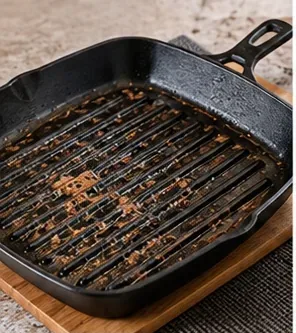
A grill pan can be frustrating to clean because grease and browned food collect in the channels between the ridges. The obvious instinct is to soak it, scrape harder, or reach for baking soda. Before doing any of those things, answer one question: what is the cooking surface made of?
That decision changes the safe cleaning method. A traditional seasoned cast-iron grill pan needs to be washed, dried promptly, and lightly oiled; Lodge specifically says not to soak seasoned cast iron. An enameled cast-iron grill pan can usually tolerate a warm soapy soak and does not need traditional seasoning. A nonstick grill pan needs soft tools because steel wool and harsh abrasives can damage the coating. Stainless steel can tolerate a different set of stuck-food methods again.
The manufacturer guidance in this article was checked on September 12, 2026. The goal is not to declare one cleaning trick best for every pan, but to match the method to the material and the severity of the mess.
What kind of grill pan do you have?
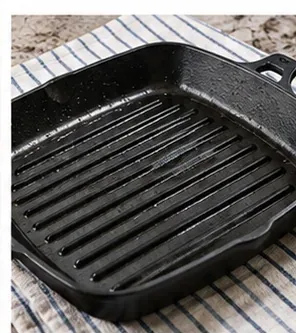
Look at the product listing, underside markings, packaging, or manufacturer manual if you still have it. Color alone is not reliable: black cookware can be bare cast iron, black enamel, or nonstick.
Pan type
Typical care direction
Main thing to avoid
Seasoned bare cast iron
Hand wash, dry completely, apply a very thin coat of oil
Long soaking and dishwasher use
Enameled cast iron
Cool first, wash with warm soapy water and a soft non-abrasive tool
Metal scouring pads and thermal shock
Traditional nonstick
Cool, hand wash with warm soapy water and a soft sponge or nylon tool
Steel wool, harsh abrasives, overheating
Stainless steel
Wash normally; use material-approved methods for burned residue
Oven cleaner, steel wool, chlorine/peroxide bleach on All-Clad guidance
Before choosing a cleaner, identify the pan material. Burned food can look the same on bare cast iron, enamel, nonstick, and stainless steel even though the safe cleanup methods differ.
Should you clean a grill pan while it is still hot?
No. Let it cool enough to handle safely and, for enameled or nonstick cookware, avoid a sudden temperature shock. Le Creuset says enameled cast iron should cool to room temperature before cleaning and warns against putting cold water into a hot pan because rapid temperature change can damage the enamel. All-Clad likewise warns against putting a hot pan under cold water because it can warp.
You do not need to wait until grease hardens completely. Once the pan has cooled to a safe warm or room temperature, scrape or wipe out loose food and excess grease with an appropriate non-damaging tool.
Can you soak a grill pan in soapy water?
It depends on the material.
For seasoned bare cast iron: do not leave it soaking. Lodge's current cast-iron care guidance says soaking cast iron in water is a recipe for rust. Instead, wash it by hand with warm soapy water, a stiff-bristled brush or suitable scrubbing pad, and use a scraper for food lodged between the grill ridges.
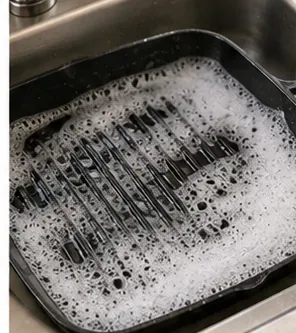
For enameled cast iron: a soak can be useful. Le Creuset says stubborn residue can be softened by filling the cooled cookware with warm soapy water and letting it soak. Staub also recommends warm water, liquid dish soap, and a soft sponge or brush, with longer soaking when necessary for stuck-on food.
For nonstick: follow the coating manufacturer's directions. All-Clad recommends hand washing its nonstick cookware in warm soapy water using a soft sponge or nylon scrubbing pad.
Warm soapy water is a common starting point for enameled and nonstick grill pans. Do not leave traditional seasoned cast iron soaking in water; Lodge advises against soaking because it can promote rust.
How do you clean between the grill ridges without damaging the pan?
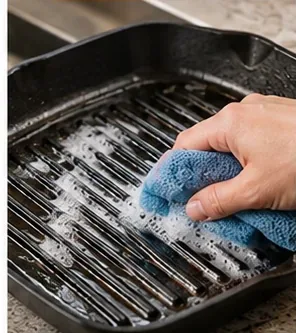
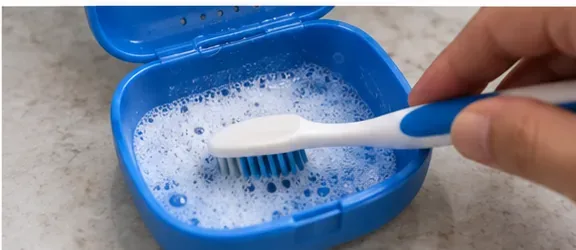
Start with the least aggressive tool that reaches the grooves. A soft or nylon brush works well because the bristles can follow the channels. A shaped pan scraper can also help on materials whose manufacturer permits one.
Lodge specifically sells and recommends grill-pan scrapers and stiff-bristled cleaning brushes for seasoned cast iron. For enameled cast iron, Le Creuset calls for a soft, non-abrasive sponge or brush, while Staub warns against metal scouring pads. For nonstick, All-Clad recommends soft sponges or nylon scrubbers and advises against steel wool and steel scouring pads.
Work with the ridges, not against them. A soft brush, sponge, or non-scratch tool reaches the grooves without unnecessarily attacking a coating or enamel surface.
Scrub in the direction of the ridges, then change angle to reach the corners where the raised ribs meet the pan floor. The objective is to lift food, not polish the surface down to a different color. This distinction matters on black enamel: Le Creuset notes that its black satin enamel develops a natural patina over time and says that patina should not be scrubbed away.
What should you do when food is burned onto the ridges?
Escalate the cleaning method according to the pan material rather than simply scrubbing harder.
Seasoned bare cast iron
Use a pan scraper or nylon brush first. Lodge's cast-iron guidance says tough stuck-on food can be handled by simmering a little water in the pan for 3–5 minutes, letting the pan cool, and then using a scraper. Afterward, wash, dry completely, and oil the surface. If food is still carbonized onto the pan and normal cleaning will not remove it, Lodge treats that as a case where restoration or reseasoning may be more appropriate than endless aggressive scrubbing.
Enameled cast iron
Start with a warm soapy soak. For more stubborn residue, Le Creuset says you can add one or two tablespoons of baking soda to warm water, bring it to a simmer for about 8–10 minutes, cool it, then clean with a soft sponge and dish soap. Staub's current care booklet gives a similar escalation path: warm soapy water first, then boiling water with two or three spoonfuls of baking soda for a few minutes if residue remains.
Baking soda is a conditional step, not a universal one. Le Creuset and Staub provide baking-soda methods for stubborn residue on compatible enameled cast iron, while other materials should follow their own care instructions.
Do not assume that every powdered cleaner is safe. Lodge's enameled-care page specifically advises avoiding citrus-based cleaners because they can dull the exterior gloss, while Le Creuset says never to use harsh abrasive agents or metal pads on enameled cast iron.
Nonstick grill pan
Stay gentle. All-Clad's nonstick guidance recommends warm soapy water, a soft sponge or nylon scrubbing pad, and no steel wool, steel scouring pads, oven cleaner, or harsh detergents. If burned grease has become severe, check the exact product's care instructions before trying an acid or alkaline treatment because nonstick formulations vary.
Stainless-steel grill pan
Stainless steel has more freedom than coated cookware, but still follow the brand's care instructions. All-Clad says burned food on stainless steel can be treated by adding baking soda and water, bringing the mixture to a boil, and using a wooden spoon to loosen the food. That method should not be copied onto a nonstick surface simply because the pan shape looks similar.
Do you need to rinse a grill pan after using baking soda or soap?
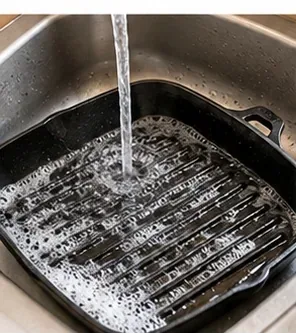
Yes. Rinse thoroughly so no soap, dissolved grease, or cleaning compound remains between the ridges. Check the corners and pour spouts, where foamy water can linger.
Rinse away loosened food and cleaner thoroughly, paying attention to the channels between the raised grill ridges.
For enameled cookware, Le Creuset says to rinse thoroughly and dry completely. Staub also instructs owners to dry thoroughly before storage. For seasoned cast iron, rinse after washing and move directly to prompt drying rather than letting the pan sit wet in the sink.
How dry does a grill pan need to be before storage?
Completely dry. Water trapped in the grooves can leave spots on many materials and can cause rust on exposed iron.
Use a lint-free towel or paper towel to dry the top, underside, handle, corners, and channels. With seasoned cast iron, many cooks also place the pan briefly over low heat after towel-drying to drive off hidden moisture, provided the manufacturer allows normal stovetop heating. The important point is the result, not a fixed heating time: the pan should be dry before oiling or storage.
Dry the grill pan completely after cleaning. Prompt drying is especially important for seasoned cast iron because retained moisture can lead to rust.
Should you oil the pan after cleaning?
Only if the material calls for it.
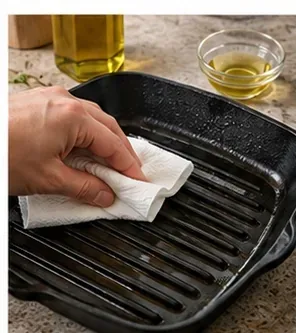
Seasoned bare cast iron: yes. Lodge's current instruction is simple: after washing and drying, add a thin layer of oil and distribute it over the surface. The layer should be very light rather than visibly wet or sticky.
Enameled cast iron: no traditional cast-iron seasoning is required. Le Creuset's Signature Square Skillet Grill uses black satin enamel and specifically says it does not need the seasoning required by raw cast iron. Staub does suggest occasionally brushing its enameled cast iron interior with cooking oil and warming it gently to improve nonstick properties, but that is brand-specific maintenance—not proof that all enameled grill pans need seasoning.
Nonstick: do not apply a cast-iron seasoning routine unless the manufacturer explicitly tells you to. High-temperature seasoning can be inappropriate for a coated surface.
Only traditional seasoned cast iron needs this finishing step: wipe on a very light coat of cooking oil after drying. Enameled and nonstick grill pans do not need cast-iron seasoning.
What if the pan is rusty?
First confirm that it is actually bare or exposed cast iron. Orange-brown rust on traditional cast iron is repairable. Lodge says steel wool can be used when the purpose is specifically to remove rust, followed by washing, complete drying, a very thin oil coat, and—in more serious cases—oven reseasoning.
If an enameled pan is chipped and exposed iron is rusting, that is a different issue. Le Creuset's current care instructions say not to use enameled cast iron when the interior enamel has chipped, because loose enamel could be ingested. Cleaning cannot repair a missing enamel layer.
Is the dishwasher ever a good choice?
For bare seasoned cast iron, no: Lodge says its traditional cast iron should be hand washed and that dishwasher use can strip seasoning and encourage rust.
For enameled cast iron, some manufacturers technically allow dishwasher use. Le Creuset and Lodge both say their enameled cast iron is dishwasher-safe, but both prefer hand washing to preserve the appearance. Staub also says most of its enameled cast iron can go in the dishwasher, with exceptions such as wooden handles, while noting that repeated dishwasher detergent exposure can affect the product over time.
For nonstick, All-Clad says some lines are dishwasher-safe but recommends hand washing to keep cookware looking its best. The tradeoff is convenience versus preserving the finish and coating as long as possible.
How do you know the grill pan is actually clean?
Do not use “looks brand new” as the only standard. A correctly cleaned grill pan should meet these practical checks:
No loose or sticky food remains between the ridges.
No soap, baking-soda slurry, or cleaner residue is left in the channels.
The pan no longer smells strongly of old grease when dry.
The surface is intact: no new scratches, chips, peeling coating, or exposed enamel damage appeared during cleaning.
Seasoned cast iron is dry and carries only a very thin oil film rather than a tacky layer.
Enameled or nonstick cookware is dry and does not have oil applied as though it were raw cast iron.
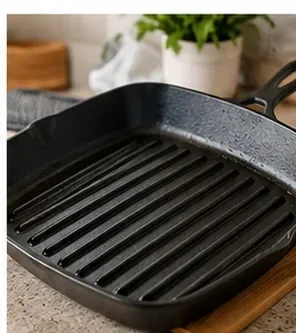
The useful result is a pan with clear ridges, no loose food residue, no cleaner left behind, and an intact cooking surface ready for the next use.
If burnt material remains after the strongest method your manufacturer permits, stop escalating to harsher tools. A scarred nonstick coating, chipped enamel, or deeply rusted cast-iron surface is a different problem from ordinary food residue. At that point, restoration or replacement may be safer than stronger chemistry.
What cleaning approach makes the most sense for your pan?
For a Lodge-style seasoned cast-iron grill pan, the shortest reliable routine is hand wash, scrub the grooves, dry promptly, and apply a very light oil layer. For Le Creuset or Staub enameled cast iron, use warm soapy water and a soft non-abrasive tool, then escalate to the manufacturer's soak or baking-soda method if needed. For nonstick, use the softest method and protect the coating. For stainless steel, you have more options for burned residue, but still follow the product-specific instructions.
The ridges make grill pans more tedious to clean, but they do not change the basic rule: material comes before method. Once you know the surface, you can choose enough cleaning power to remove the food without removing the finish you were trying to protect.