Home
» How To
»
How to Clean a lululemon Yoga Mat Without Damaging Its Grip
How to Clean a lululemon Yoga Mat Without Damaging Its Grip
The safest answer is simple: for current lululemon yoga mats, start with a clean damp cloth. If ordinary wiping is not enough, lululemon's current product pages also say to wipe the mat after practice with a natural cleanser, then keep it out of direct sunlight and make sure it is fully dry before rolling it up. Do not treat a yoga mat like a washable towel or machine-washable exercise accessory.
That conservative method matters because lululemon mats are layered products rather than a single slab of generic foam. For example, the current The Mat 5mm product page lists natural and synthetic rubber, polyurethane, polyester, and nylon. The current lululemon Align Yoga Mat 5mm page gives the same core care direction: wipe clean with a damp cloth, ensure the mat is dry before rolling, and store it out of direct sunlight. Those pages were checked on September 11, 2026.
The short method that fits most current lululemon mats
If you finished a normal yoga session and the mat mainly has sweat, skin oils, or light dust on it, you usually do not need a deep-cleaning project. Use this five-step approach:
Confirm the care instructions for your exact mat model.
Wipe the whole practice surface with a clean damp cloth.
If residue remains, use a small amount of a compatible natural cleanser rather than soaking the mat.
Make a second damp-cloth pass to remove loosened soil or leftover cleaner.
Lay the mat open to dry completely, out of direct sunlight, before rolling and storing it.
The reason to start this way is not that stronger cleaners never work. It is that stronger chemistry, heavier scrubbing, excess water, and heat create more variables. If your goal is to clean the mat while preserving its surface feel and layered construction, the manufacturer's own care instructions are the best baseline.
Step 1: Check which lululemon mat you have
Before cleaning, look at the product name, old order record, label, or current product page if you can identify it. This is especially useful if your mat is older, discontinued, or made from a different material than today's rubber-and-polyurethane models.
As a reference, current versions of The Mat 5mm and Align Yoga Mat 5mm list a body composition of 55% natural rubber, 23% synthetic rubber, 15% polyurethane, 5% polyester, and 2% nylon. The current 3mm version uses a somewhat different percentage mix, but lululemon still lists the same basic care pattern: damp-cloth cleaning, complete drying before rolling, and storage away from direct sun. The company also directs customers to the specific product page for material and care details in its Product Wash and Care help page.
If your mat's own label or product page differs from this guide, follow the instructions for that mat.
Step 2: Wipe the mat with a clean damp cloth
Start with a clean, lightly damp cloth and gentle passes across the mat rather than saturating the surface.
Lay the mat flat. Dampen a soft, clean cloth with water, then wring it out so it is moist rather than dripping. Wipe the surface in overlapping passes from one end to the other. Pay extra attention to hand and foot zones, where sweat and skin oils tend to collect.
For a lightly used mat, this may be all you need. A successful result at this stage is not necessarily a mat that looks brand new. lululemon notes that color may change over time, so mild color variation should not automatically be treated as dirt that needs aggressive scrubbing.
Example: if you did a 30-minute low-sweat practice and the surface simply feels slightly damp, a thorough damp-cloth wipe followed by complete drying is the lowest-intervention option.
Step 3: Use a natural cleanser only when plain water is not enough
lululemon's current product pages say to wipe the mat after practice with a natural cleanser, but the cited pages do not define a specific formula or publish a universal DIY recipe. That is an important limitation. It means you should not assume that vinegar, alcohol, essential oils, bleach, dish detergent, or any other household mixture is automatically equivalent to the manufacturer's wording.
If you already have a cleanser that is specifically intended for yoga mats and is compatible with your exact mat material, use it sparingly and according to its label. A cautious technique is to put a small amount on the cloth rather than flooding the mat. Wipe a limited area first and check for unwanted changes in color, tackiness, gloss, or texture before continuing.
For routine cleaning, more liquid is not necessarily better. The goal is to lift sweat film and visible soil, not to saturate the layered mat.
Step 4: Make a clean damp-cloth pass and spot-treat only where needed
For a second pass, use a clean damp section of cloth to lift remaining sweat, dust, or cleanser residue.
After using a cleanser, switch to a clean damp cloth and wipe the mat again. This second pass helps remove loosened grime and excess cleaner from the surface.
For a small dirty area, repeated gentle passes are usually a better first choice than forceful scrubbing. If a mark does not change after several careful wipes, stop and reassess rather than increasing pressure indefinitely. Surface damage, dye transfer, abrasion, or permanent discoloration will not necessarily respond to cleaning.
Example: suppose one corner has a gray shoe mark but the rest of the mat is clean. Work on that corner instead of repeatedly wetting the entire mat. If the mark remains but the surface is otherwise clean, dry, and unchanged in texture, it may be cosmetic rather than removable residue.
Step 5: Air-dry completely before you roll the mat
Leave the mat open in a ventilated indoor area until every surface is fully dry, away from direct sunlight.
Drying is part of the cleaning process, not an optional last detail. lululemon specifically instructs users to ensure the mat is dry before rolling it and to store it out of direct sunlight. Some current product listings also specify laying the mat flat to dry and state that it should not be washed, bleached, ironed, or dry-cleaned.
Leave the mat flat or sufficiently open in a ventilated indoor area. Do not put it in direct sun to speed things up. Do not roll it while one side still feels cool or damp. Depending on room humidity and how much moisture you used, drying time can vary, so use the mat itself rather than a fixed timer as your guide.
Roll the mat only after it is completely dry so trapped moisture is not sealed inside.
Once both sides are fully dry, roll it for storage. If the instructions for your particular printed mat say to roll it with the graphics facing outward, follow that model-specific direction.
How to tell whether the cleaning worked
Judge the result by practical signs rather than by expecting a factory-new appearance:
No visible loose soil or sweat film: the areas you wiped should look reasonably even and free of surface debris.
No cleaner residue: the mat should not feel unusually slick, soapy, or coated after drying.
Normal surface feel: the grip and texture should feel consistent with the rest of the mat.
Fully dry before storage: there should be no damp or cool-feeling patches when you roll it.
No new damage: cleaning should not leave peeling, bubbling, gouges, or obvious surface abrasion.
If those conditions are met, the cleaning was successful even if an old cosmetic stain or gradual color change remains.
When should you change methods?
What you see
Best next move
Why
Light sweat or dust
Damp-cloth wipe
This is directly consistent with current lululemon care instructions.
Visible film that water does not remove
Use a small amount of a compatible natural cleanser, then wipe again with a damp cloth
lululemon mentions a natural cleanser, but does not publish one universal DIY formula on the cited pages.
One stubborn mark
Spot-clean gently and reassess
Repeated whole-mat cleaning adds moisture without necessarily helping a localized cosmetic mark.
Mat is saturated from a spill
Blot excess moisture and air-dry fully; do not machine wash
Current care pages emphasize damp-cloth cleaning and complete drying, and some listings explicitly state “Do Not Wash.”
Peeling, bubbling, sticky deterioration, or structural damage
Stop escalating home cleaning and contact lululemon support or consider replacement
Cleaning can remove surface soil; it cannot reliably repair material breakdown.
What should you avoid?
For current rubber-based lululemon mats, the manufacturer's care information gives several clear boundaries. Do not machine wash the mat, bleach it, iron it, dry-clean it, roll it while wet, or store it in direct sunlight when the product-specific page lists those restrictions. The Mat 5mm product page also notes that its natural-rubber construction may contain latex, which is relevant for anyone with a rubber or latex allergy.
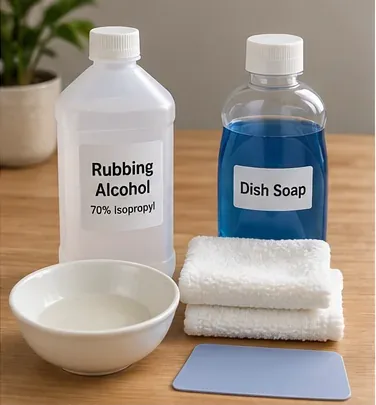
Be especially cautious with internet recipes that call for concentrated vinegar, alcohol, essential oils, disinfectants, or strong detergents. The issue is not that every such product will definitely damage every lululemon mat. The issue is that the current manufacturer pages cited here do not establish those mixtures as a universal cleaning method. If preserving the mat's material and grip is the priority, the documented damp-cloth and natural-cleanser guidance is the better-supported starting point.
Does the antimicrobial treatment mean you can skip cleaning?
No. Current product pages state that an antimicrobial additive helps prevent mold and mildew on several lululemon mats, but that feature does not replace routine surface cleaning or drying. Sweat, body oils, dust, and visible dirt still need to be physically wiped away, and the manufacturer still tells users to clean the mat after practice and dry it before rolling.
What if the mat still smells?
A new natural-rubber mat can have a noticeable odor. lululemon says this smell should fade over time and suggests unrolling and airing the mat out before use. If the mat is clean but still smells like rubber, ventilation may be more appropriate than repeatedly applying more cleanser.
If an older mat develops a persistent musty odor, visible growth, or a sticky or degraded surface that remains after careful cleaning and complete drying, home wiping may have reached its limit. At that point, ask lululemon about the specific model or replace a mat that can no longer be kept clean and structurally sound.
Bottom line
For most current lululemon yoga mats, the best-supported cleaning routine is intentionally simple: wipe with a damp cloth, use a compatible natural cleanser only when needed, remove any residue with another damp wipe, let the mat dry completely out of direct sunlight, and roll it only when dry. Check your exact model before using stronger cleaners or a more aggressive process. That approach gives you a clear result to aim for—a clean, dry surface with normal grip—without turning routine care into a chemistry experiment.