Home
» How To
»
How to Clean a Nespresso Vertuo Machine: A Safe, Model-Aware Routine
How to Clean a Nespresso Vertuo Machine: A Safe, Model-Aware Routine
Nespresso’s newer guidance adds one useful caution that changes how often some owners should reach for the rinse cycle. In the June 13, 2025 Vertuo Pop quick-start guide, Nespresso warns that frequent hot-water rinsing may accelerate wear and recommends a rinsing cycle after 100 coffees for that model. That interval is model-specific, not a universal rule for every Vertuo machine, so the safest approach is to use the cleaning cycle when your model’s manual calls for it rather than running it after every few cups.
The most important distinction is simple: routine cleaning and descaling are not the same job. Routine cleaning removes coffee residue and rinses the internal coffee path with fresh water. Descaling removes mineral buildup and uses a dedicated descaling procedure. Mixing those two maintenance tasks is one of the easiest ways to over-clean a Vertuo or use the wrong product.
What do you need before cleaning a Vertuo?
For a normal cleaning session, you usually need only a few basic items:
Fresh potable water
A soft, clean cloth
Mild, odorless dish detergent for removable parts
A clean towel or drying rack
A container large enough for the rinse cycle: generally at least 1 liter for Vertuo Next and Vertuo Pop, or at least 0.8 liter for VertuoPlus
Do not pour dish soap, vinegar, or other household cleaners into the water tank for the normal cleaning cycle. Nespresso’s cleaning instructions use fresh water in the tank. Descaling solution belongs only in the separate descaling procedure.
Stage 1: Eject the capsule, power down, and empty the wet parts
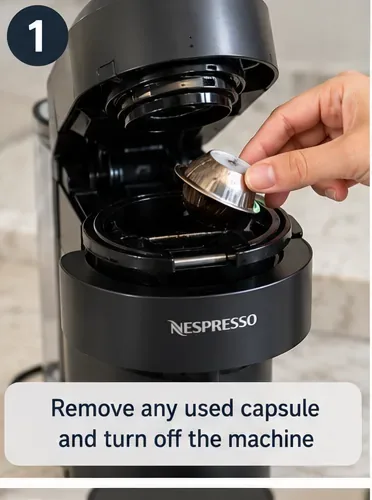
Open the machine so the used capsule is released into the capsule container. Then turn the machine off and unplug it before you begin manual wiping or washing. This is the right time to remove the capsule container, drip tray, cup support, and water tank.
Remove the used capsule first, then turn the machine off before handling removable parts or wiping the appliance.
Empty any standing water or coffee from the drip tray and discard used capsules. If coffee residue has dried around the capsule container or drip area, do not scrape aggressively. A warm-water wash is safer for plastic parts than abrasive pads or sharp tools.
Nespresso’s safety material also warns against reaching carelessly into the Vertuo head because sharp points can be present. If a capsule is genuinely stuck, do not force your fingers into the mechanism. Turn the machine off, unplug it, and follow the troubleshooting instructions for your exact model.
Stage 2: Hand-wash removable parts and wipe the machine
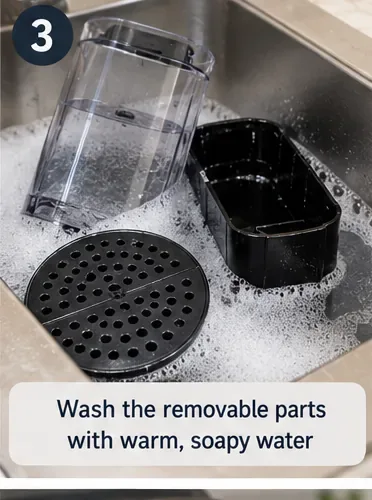
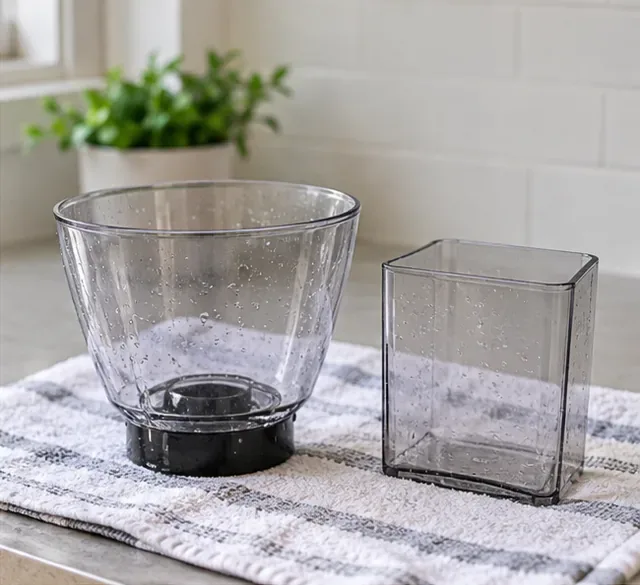
Wash the removable components with warm water and a small amount of mild, odorless detergent, then rinse thoroughly. Standard Vertuo guidance favors hand washing; do not assume removable parts are dishwasher-safe unless the manual for your exact model explicitly says so.
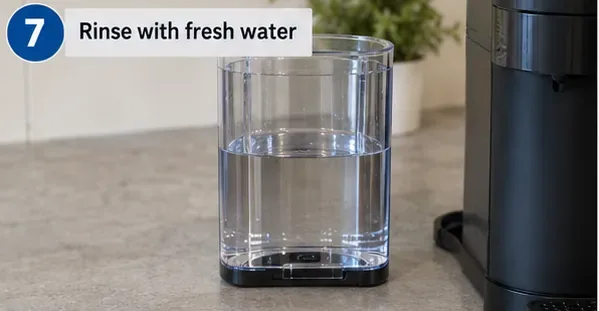
Hand-wash removable parts with warm water and mild, odorless detergent, then rinse away all soap residue.
Use a damp cloth on the exterior and around the coffee outlet. The official Vertuo Next support page specifically warns against strong or abrasive cleaners, solvent cleaners, immersion in water, and placing the machine in a dishwasher. The same page recommends cleaning the coffee outlet regularly with a clean, damp cloth.
Do not flood the brewing head with water, spray cleaner into openings, or use steam or pressure-cleaning equipment. If you are cleaning the exterior, the cloth should be damp rather than dripping wet.
Stage 3: Run the built-in cleaning cycle with fresh water
Once the manual cleaning is done, refill the water tank with fresh potable water and put it back in position. Reinstall the capsule container and cup support, place a large empty container under the coffee outlet, and make sure there is no capsule in the machine.
Use fresh potable water for the routine cleaning cycle; descaling solution is not needed for this rinse.
Plug the machine back in and follow the cleaning command for your specific Vertuo model. The controls are similar across several machines, but cycle duration and minimum container size are not identical.
Vertuo model
How to start routine cleaning
Container
Typical cycle
Vertuo Next / Vertuo Pop
Close and lock with no capsule, wait until ready, then press the coffee button 3 times within 2 seconds
At least 1 L / 34 fl oz
Up to about 7 minutes
VertuoPlus
Close the head with no capsule, then press the coffee button 3 times within 2 seconds
At least 0.8 L
About 5 minutes
Vertuo Lattissima
With no capsule inserted, press the coffee button 3 times within 2 seconds
On Vertuo Next and Vertuo Pop, water may take some time to begin flowing after the three quick button presses. Nespresso says the process can take up to about 7 minutes. On VertuoPlus, the automatic procedure is shorter, around 5 minutes. Do not open the machine while the cleaning cycle is actively running.
Stage 4: Dry, reassemble, and check whether you actually need descaling
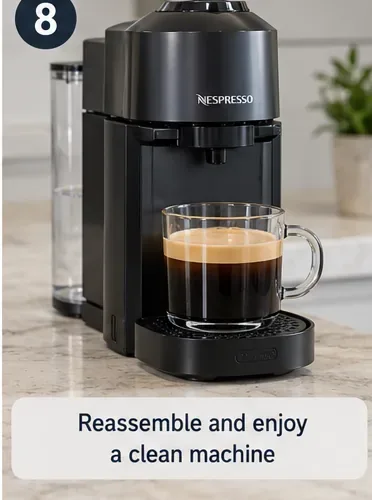
When the rinse cycle is complete, empty the catch container. Dry the washed removable parts completely with a clean towel or let them air-dry, then reinstall them. Wipe away any visible splashes around the outlet and drip area.
After the parts are fully dry, reinstall them and return the machine to normal use.
If the machine now flows normally and the coffee outlet is clean, routine cleaning is finished. Do not automatically follow every cleaning session with a descale.
When should you descale instead of just clean?
Descaling is appropriate when the machine shows its descaling alert, when your model’s maintenance schedule calls for it, or when mineral buildup is suspected after normal cleaning does not solve flow or temperature problems. Nespresso’s current FAQ commonly uses a guideline of about every three months or 300 capsules, while also noting that actual need depends on water hardness and use.
For descaling, use the procedure written for your exact Vertuo model and the amount of water specified for that model. Nespresso recommends its descaling solution for this maintenance task. Do not improvise the sequence, because Vertuo models use different combinations of buttons, levers, locks, and timing to enter and exit descaling mode.
How often should you do the routine cleaning cycle?
There is no single interval that should be copied blindly across every Vertuo generation. Nespresso’s 2025 Vertuo Pop quick-start guide is unusually explicit: it recommends a rinse after 100 coffees and says excessive hot-water rinsing can accelerate wear. Other model support pages describe cleaning as a procedure that can be performed when needed, such as after a long period of non-use, when coffee grounds appear in the cup, or when flow becomes unusual.
A practical routine is to empty the used-capsule container and drip tray frequently, wash removable parts whenever residue or odor develops, wipe the outlet regularly, and run the internal cleaning cycle according to your model’s instructions rather than by habit after every small number of drinks.
Quick troubleshooting after cleaning
No water comes out: confirm the tank is full and seated correctly, the head is properly closed or locked, and there is no capsule inside during the cleaning cycle.
Coffee grounds still appear: Nespresso support for some Vertuo models recommends repeating the cleaning procedure and then checking whether descaling is due.
Flow is still unusually slow: verify the tank position, clean the outlet, and check the model’s descale alert or maintenance instructions.
The machine leaks: empty and clean the drip tray and capsule container, reseat the water tank, and stop using the machine if leakage continues.
A capsule is stuck: switch off and unplug the machine before troubleshooting; avoid reaching into sharp internal areas.
Bottom line
To clean a Nespresso Vertuo correctly, separate the job into manual cleaning and the machine’s fresh-water rinse cycle. Remove the used capsule, hand-wash the removable parts, wipe the appliance with a damp cloth, then run the built-in cycle using the button sequence and container size specified for your model. Save descaling solution for an actual descale. That model-aware approach keeps the process simple, avoids unnecessary chemical cleaning, and follows the maintenance logic Nespresso documents for the Vertuo range.