Home
» How To
»
How to Season Gas Grill Grates: Cast Iron vs. Stainless Steel vs. Porcelain
How to Season Gas Grill Grates: Cast Iron vs. Stainless Steel vs. Porcelain
If food is sticking to your gas grill grates, or you are trying to protect a new set from rust, “season the grates” sounds like an obvious answer. The catch is that it is not the right answer for every grate. Bare cast iron, stainless steel, porcelain-enameled cast iron, and porcelain-coated steel can require different care—and grill manufacturers do not all give the same instructions.
The safest rule is simple: identify the grate material and follow the owner’s manual for your exact grill before applying oil and heat. Generic seasoning advice is useful only after that check. For example, Weber says its porcelain-enameled cast-iron grates do not need seasoning, while current guidance from Napoleon and Broil King includes seasoning procedures for some porcelainized or porcelain-enameled cast-iron grids. Char-Broil says its stainless-steel and cast-iron grates should be seasoned, while its porcelain grates do not require it. Those differences are why material alone is not always enough.
Quick Answer: Should You Season Your Gas Grill Grates?
Grate type
General direction
Main tradeoff
Best next step
Bare cast iron
Usually yes
Excellent heat retention, but vulnerable to rust if left unprotected
Season after cleaning and whenever the protective layer is lost
Porcelain-enameled cast iron
Depends on the manufacturer
Enamel reduces direct exposure of the iron, but care instructions vary by brand and model
Check the manual before adding a baked-on oil layer
Stainless steel
Optional or manufacturer-specific
More corrosion-resistant, but oiling may help food release and cleanup
Follow the grill maker’s care instructions
Porcelain-coated steel
Often no seasoning
The coating provides the protective surface; abrasive care can damage it
Clean gently and follow the manual
Weber’s official care guidance is especially clear for its own porcelain-enameled cast-iron grates: the baked-on coating means they do not need seasoning. By contrast, Napoleon’s current guidance explains how to season stainless-steel and cast-iron cooking grids, and Broil King’s gas-grill manuals instruct owners to season some porcelain-enamel cast-iron grids after washing. Char-Broil’s grate-seasoning guidance similarly distinguishes stainless/cast iron from porcelain.
A thin oil layer is appropriate only when the grate manufacturer recommends seasoning; identify the grate material and check the manual first.
What Seasoning Actually Does
Seasoning is not the same thing as simply greasing a grate before cooking. The goal is to leave an extremely thin oil film and heat it according to the manufacturer’s procedure so that it forms a more durable protective layer on the cooking surface. On bare cast iron, that layer helps reduce direct exposure to moisture and can improve food release. On stainless steel, some manufacturers recommend oiling mainly for release and easier maintenance rather than because the steel needs the same rust protection as raw cast iron.
The tradeoff is that more oil is not better. A heavy layer can become sticky, smoke excessively, or collect residue. If a grate is porcelain coated and the manufacturer says not to season it, adding repeated baked-on oil layers can create unnecessary buildup without improving the factory coating.
Choose the Method by Your Grate, Not by a Universal Rule
If you have bare cast iron
This is the strongest case for traditional seasoning. Bare cast iron has high heat capacity and sears well, but it needs protection from moisture. A thin film of a manufacturer-approved high-temperature cooking oil or shortening is generally the practical choice.
Best for: owners who value strong searing and do not mind regular maintenance.
Tradeoff: more upkeep than stainless steel or intact porcelain coatings. After washing, it should be dried promptly rather than left wet.
If you have porcelain-enameled cast iron
Do not assume that “cast iron” automatically means “season it.” Weber explicitly says its porcelain-enameled cast-iron grates never need seasoning. Broil King, however, publishes manuals that describe its cast-iron grids as porcelain enamel coated and still instruct users to season them. Napoleon also sells porcelainized cast-iron grids and publishes seasoning directions for cast iron.
Best recommendation: the model-specific manual wins. The coating system and intended maintenance routine are part of the product design.
Tradeoff: following generic cast-iron advice can be unnecessary for one grill and correct for another.
If you have stainless steel
Stainless steel is more corrosion-resistant and generally less dependent on a polymerized protective coating. Still, some manufacturers recommend seasoning stainless grids. Napoleon, for example, includes stainless steel in its seasoning guidance, and Char-Broil recommends seasoning stainless-steel and cast-iron grates.
Best for: owners who want lower-maintenance grates and do not want to treat every cleaning as a re-seasoning job.
Tradeoff: stainless may not build or hold the same dark seasoned appearance as raw cast iron, and a light oil film is more about cooking performance and maintenance than “saving” the metal from ordinary use.
Which Oil Should You Use?
There is no single oil that every grill manufacturer names as the best. Napoleon lists high-temperature options such as canola oil, flaxseed oil, and shortening in its care guidance. Char-Broil generally recommends cooking oil and emphasizes leaving only a thin layer. The practical choice is therefore an oil or fat that your grill manufacturer approves and that can tolerate the prescribed seasoning temperature.
Choice
Practical advantage
Tradeoff
Who it suits
Canola or neutral vegetable oil
Widely available, easy to brush into a thin layer
Can become gummy if applied too heavily
Most owners following a general high-temperature-oil instruction
Vegetable shortening
Easy to control as a very thin solid coating; specified in some cast-iron instructions
Messier to spread into corners if overapplied
Owners whose manual specifically calls for shortening
Other high-temperature cooking oils
May tolerate the heat range specified by the manufacturer
Price and formulation vary; not every oil is named in every manual
Owners who already have an approved oil on hand
Avoid using salted butter or margarine as a substitute for seasoning oil. Manufacturer manuals that discuss cast-iron seasoning commonly direct users toward cooking oil or shortening instead.
A 5-Step Method for Grates That Are Supposed to Be Seasoned
This is a conservative procedure synthesized from current manufacturer guidance. If your manual specifies different temperatures, timing, cleaning tools, or coating frequency, use the manual instead.
Step 1: Start with a cold grill and clean the grates
Turn the grill off and let it cool completely before removing or washing grates. For first use or a full re-seasoning, manufacturer guidance commonly calls for mild soap and water, followed by thorough rinsing. Remove food residue and loose corrosion without gouging or chipping a coated surface.
For ordinary between-cook maintenance, a full soap-and-water wash may not be necessary every time. Weber, for example, directs owners of its porcelain-enameled grates to preheat and brush them clean rather than season them.
Step 2: Dry completely and deal with rust before oiling
Moisture trapped under a coating works against the purpose of seasoning. Dry washed grates completely. On bare or manufacturer-approved cast iron, remove light surface rust using the method allowed in the manual before applying oil. If a porcelain coating is chipped, flaking, or badly damaged, seasoning does not restore the enamel; inspect the grate and consult the manufacturer about replacement.
Step 3: Apply the thinnest practical film of oil
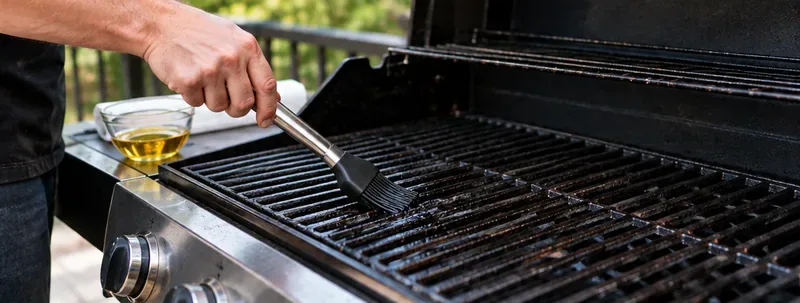
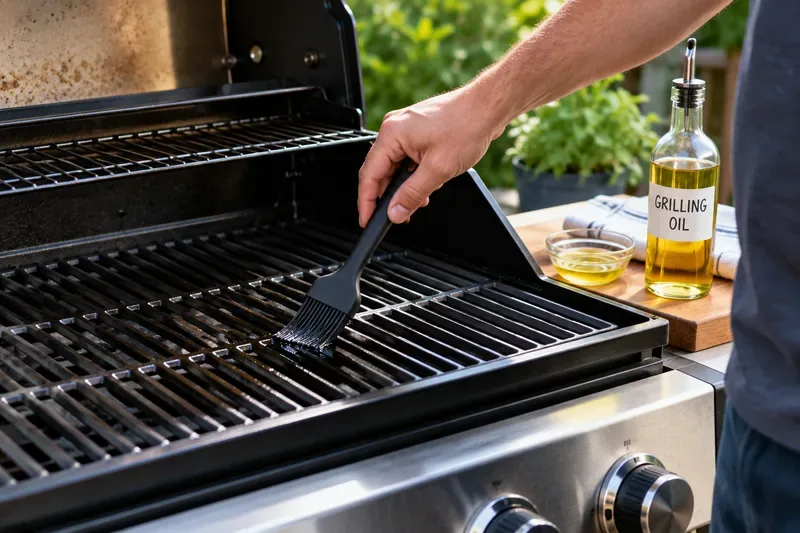
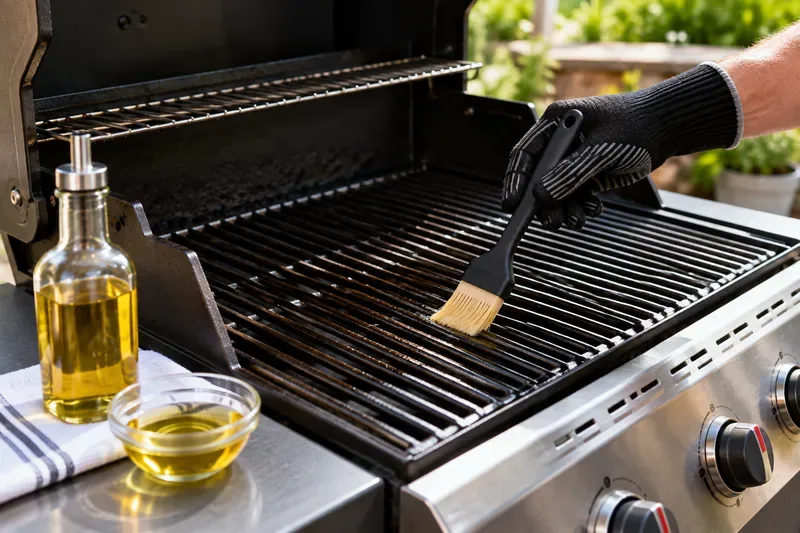
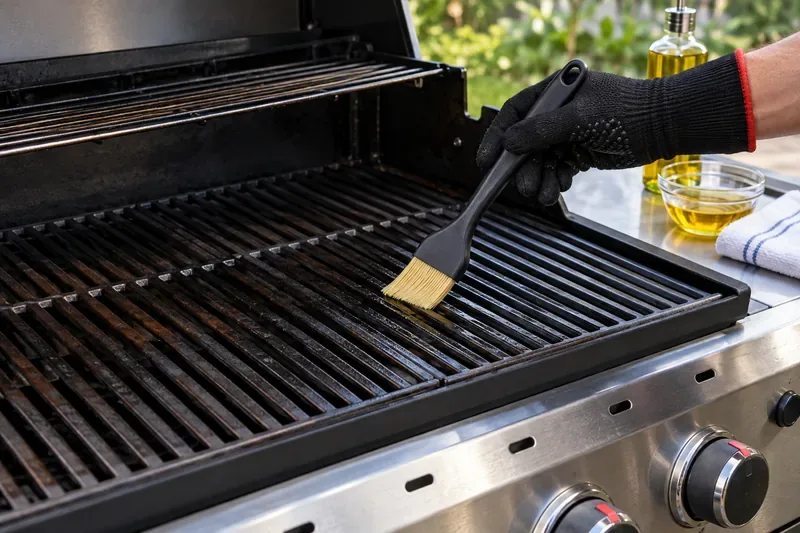
With the burners off, use a silicone basting brush or another manufacturer-approved applicator to spread a very thin layer over the cooking surface. If the instructions say to coat both sides, remove the grate or handle it only when cool and safe to do so.
Napoleon specifically recommends a silicone basting brush in its current care guidance and cautions that paper towel fibers can catch on rough cast-iron grids. Char-Broil also emphasizes wiping away excess oil so that only a thin, even film remains.
Use only enough oil to leave a light sheen. A thick wet layer is more likely to smoke heavily or become tacky.
Step 4: Heat the grates for the time and temperature your manufacturer specifies
This is where brand-specific instructions matter most. Napoleon’s cast-iron procedure calls for heating the grill to about 350–400°F (176–204°C) and heating the oiled grids for roughly 30 minutes, with another thin coat and another heating period in some current manuals. Char-Broil’s general grill-seasoning procedure uses a shorter heating cycle. Other products may specify different timing entirely.
Do not automatically turn every grill to maximum heat just because “hotter sounds better.” The correct target is the temperature range in the care instructions for your grate and grill.
Before the heating stage, the grate should look lightly coated rather than wet. Heat it only within the range specified for the grill and grate.
Step 5: Cool, inspect, and decide whether another coat is actually needed
Turn off the burners and gas supply as directed by the grill manual and let the grates cool. A properly maintained cast-iron surface should look evenly protected rather than sticky or pooled with oil. If the manufacturer calls for a second coat, repeat the same thin-film process rather than adding a thick layer.
For routine maintenance, frequency again depends on the product. Napoleon’s current materials include schedules ranging from every few uses in some manuals to periodic re-seasoning in its general care article. Char-Broil recommends very frequent oiling for some grate types. That variation is another reason not to copy someone else’s maintenance interval without checking your manual.
A maintenance coat should remain thin and even. Re-season only as often as the manufacturer and the grate’s condition justify.
Should You Season Before Every Cook?
Not necessarily. There are three different practices that often get called “seasoning”:
Initial seasoning: preparing a new seasoning-approved grate before first use.
Periodic re-seasoning: rebuilding protection after deep cleaning, rust removal, storage, or visible loss of the coating.
Light pre-cook oiling: adding a small amount of oil to reduce sticking before food goes on.
These are related but not identical. A stainless-steel grate may benefit from light oiling without needing a cast-iron-style seasoning routine. A Weber porcelain-enameled cast-iron grate can be cleaned and used according to Weber’s care instructions without creating a new oil-seasoned coating. A Broil King cast-iron grate may be porcelain enameled yet still have manufacturer instructions that include seasoning.
Seasoning vs. Oiling the Food: Which Is Better for Sticking?
If your main goal is preventing delicate food from sticking, grate seasoning is only one variable. For a grill with a grate that does not require seasoning, lightly oiling the food itself may be simpler than trying to build a permanent coating on the grate. It also avoids adding unnecessary residue to a factory-finished surface.
If your main goal is corrosion protection on bare cast iron, however, oiling the food is not a substitute for protecting the metal after cleaning and storage.
Choose based on the problem:
Food sticking on stainless or porcelain: focus first on clean grates, proper preheating, and food preparation.
Rust on bare cast iron: focus on drying and the manufacturer’s seasoning routine.
Rust appearing where porcelain is chipped: inspect the coating and consider replacement guidance instead of trying to “season over” structural damage.
Common Mistakes and Their Tradeoffs
Using too much oil
More oil feels protective, but it can leave a sticky layer and collect debris. Thin coats are easier to control and are consistent with manufacturer instructions.
Assuming every black grate is raw cast iron
Many grates are dark because they are porcelain enameled or coated. Treating an enameled grate like raw iron can add unnecessary maintenance.
Using one brand’s instructions on another brand
The Weber-versus-Napoleon/Broil King difference shows why this matters. Similar-looking porcelain-enameled cast-iron grates can come with different care instructions.
Seasoning over rust or residue
Oil does not make loose rust, burnt debris, or damaged coating disappear. Clean the surface first using tools appropriate for the grate.
Skipping complete drying
For cast iron, drying is not a cosmetic step. Leaving washed iron wet increases the chance of corrosion before the protective oil layer is established.
How to Tell If Your Grates Are Ready
Before cooking, run through this quick check:
The grates are clean and dry.
There is no pooled oil or sticky residue.
Any visible rust was addressed before seasoning.
The oil layer, if used, was thin and even.
The grill completed the manufacturer-specified heating cycle.
Porcelain-coated grates show no loose or flaking coating.
You know whether future maintenance means brushing, light oiling, or full re-seasoning for your specific model.
If food still sticks after a correct seasoning or cleaning routine, do not automatically add more oil. Review preheat time, cooking temperature, food moisture, and whether the food is being moved before it naturally releases from the hot grate.
Bottom Line
For bare cast iron, seasoning is usually essential maintenance. For stainless steel, it can be useful but is often less critical and more manufacturer-specific. For porcelain-coated or porcelain-enameled grates, do not guess: some manufacturers say no seasoning is necessary, while others include seasoning as part of normal care for their coated cast iron.
The best method is therefore not the hottest burn, the most expensive oil, or the thickest coating. It is the method that matches the grate construction and the grill maker’s instructions: clean surface, complete drying, an extremely thin approved oil film when called for, controlled heating, and only as much maintenance as the grate actually needs.