Home
» How To
»
How to Wash a Sunbeam Electric Blanket Safely: What the Manual Actually Says
How to Wash a Sunbeam Electric Blanket Safely: What the Manual Actually Says
Imagine this hypothetical example: Jordan takes a Sunbeam heated blanket out of storage before the first cold week of the season. The fabric looks fine, but it smells a little stale and could use a wash. The obvious question is also the important one: can an electric blanket really go in a washing machine?
For many current Sunbeam heated-bedding products, the answer is yes—but only after the controller is disconnected and only with the care method specified by Sunbeam. This example is purely illustrative, not a report of a product test. The safest starting point for your own blanket is its sewn-in care label and the manual for its exact model.
The short answer: how Sunbeam says to wash heated bedding
As checked on September 12, 2026, Sunbeam's official heated-bedding instructions say to unplug the power cord from the wall, detach the controller cord, inspect the blanket for wiring that has worn through the fabric, then machine wash in cold water on a gentle cycle or hand wash. The same instructions call for low, delicate tumble drying, removing the blanket while it is still damp, gently stretching it back to its original size, and finishing the drying process over a clothesline or shower rod without clothespins. The blanket must be completely dry before the power or control plug is reconnected. See the official Sunbeam heated-bedding instruction manual.
Sunbeam also says not to dry clean the blanket, use bleach, put it through a wringer, iron it, immerse the controller or cord in water, or reconnect the heated product while it is damp. Action: before you carry the blanket to the laundry room, locate the care label and confirm that these directions match your model.
Question
Verified Sunbeam guidance
What to do
Can it go in a washer?
Current Sunbeam heated-bedding guidance allows cold, gentle machine washing or hand washing.
Detach the controller first and follow your model's label.
Can it go in a dryer?
Sunbeam specifies low heat on a delicate cycle, then removal while still damp.
Finish drying naturally and do not use a commercial laundromat dryer.
Can it be dry cleaned?
No. Sunbeam warns that cleaning solvents can damage heating-element insulation.
Use the approved wash method instead.
Can you reconnect it while slightly damp?
No. Sunbeam says the heated product must be completely dry.
Wait until every part of the blanket and connector area is dry.
Step 1: Inspect the blanket, then disconnect it in the right order
Back to Jordan's hypothetical blanket: before washing, Jordan checks the fabric, cord, connector area, and controller rather than treating laundering as a fix for electrical damage. Sunbeam instructs owners to examine heated bedding for wear or damage and to stop using it if damage or improper operation is observed. The wash instructions specifically say to make sure no wires have worn through the fabric.
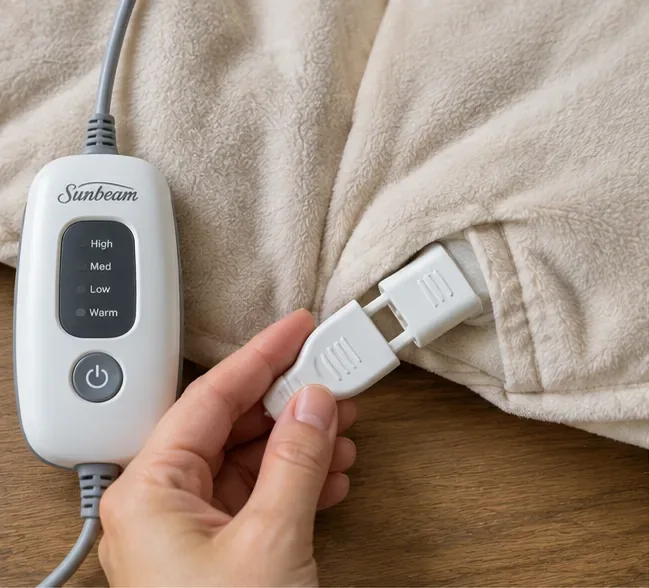
Then disconnect in the order Sunbeam specifies: unplug the power cord from the wall before detaching the controller from the blanket. Do not put the controller or attached power cord in the washer. The controller is not waterproof and should not be immersed.
A detachable heated-blanket controller being unplugged from the blanket connector before washing. Connector and controller designs vary by Sunbeam model.
Action: if you see exposed wire, a damaged cord, scorch marks, a cracked connector, or other obvious electrical damage, stop there. Cleaning is not a repair. Use Sunbeam's official support page to locate product help rather than plugging a damaged blanket back in.
Step 2: Machine wash cold on gentle—or hand wash
With every detachable electrical component removed, Sunbeam's generic heated-bedding instructions allow two cleaning paths: a cold-water gentle machine cycle or hand washing. That directly corrects a common misconception that every electric blanket must stay out of a washing machine. Sunbeam's current FAQ likewise says its heated bedding is washing-machine and dryer safe because the controller is detachable, while also telling owners to follow the product's use-and-care instructions. See the Sunbeam heated-bedding FAQ.
What Sunbeam's generic instructions reviewed here do not specify is a universal detergent brand, detergent dose, presoak time, or stain-remover formula. Those details can depend on the blanket's fabric, care label, and the washer. That means it is better not to invent a stronger cleaning recipe just because the blanket is heavily soiled. Bleach is explicitly prohibited in Sunbeam's instructions.
The blanket goes into the washer only after detachable electrical controls have been removed. Sunbeam's general guidance specifies cold water and a gentle cycle.
For Jordan's illustrative blanket, the practical choice is therefore simple: use the cold, gentle setting that matches the sewn-in label. Avoid a wringer. If the blanket is too bulky to move freely in the home washer, do not automatically switch to a laundromat dryer later; Sunbeam specifically warns against commercial dryers because they can become hot enough to damage the wiring.
Action: use only laundry products permitted by the care label, skip bleach, and do not add an unverified sanitizer, solvent, or aggressive stain treatment to the heated blanket.
Step 3: Dry on low only as directed, then finish air-drying
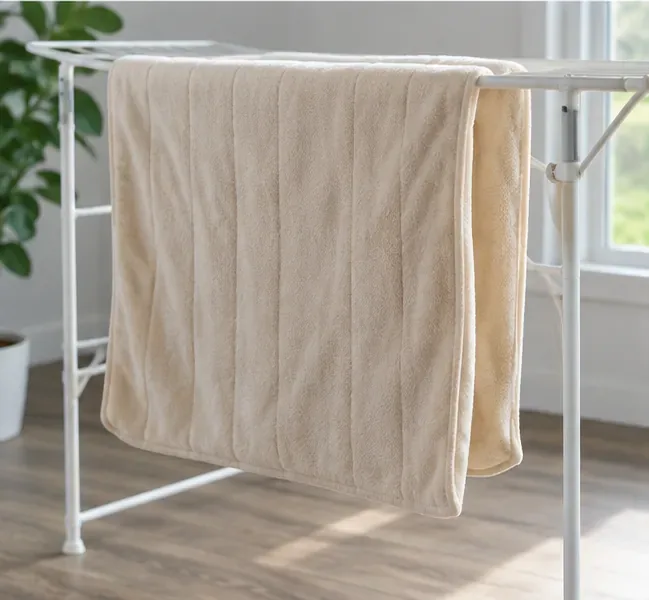
Another easy misunderstanding is that “dryer safe” means a Sunbeam blanket can simply stay in a hot dryer until bone dry. That is not what the cited Sunbeam manual says. It calls for a low, delicate tumble cycle and then instructs the user to remove the blanket while it is still damp. At that point, gently stretch the blanket back toward its original dimensions and finish drying it over a clothesline or shower rod. Sunbeam says not to use clothespins.
The reason to treat heat conservatively is built into the manufacturer's warning: improper laundering can damage the heating-wire system, and commercial dryers can be too hot for the product. A current Sunbeam product page may describe a blanket as machine washable and dryer safe, but the detailed manual still controls how drying should be done. For an example of current product language, see Sunbeam's heated blanket product page.
A washed heated blanket draped loosely so air can circulate while it finishes drying. Follow your model's label for the approved hanging arrangement; Sunbeam's general manual specifies a clothesline or shower rod without clothespins.
If you prefer to avoid the dryer altogether, Sunbeam's FAQ also describes line drying as an option after washing. What matters is that the blanket is supported without sharp pinching or hardware that could stress the wired fabric.
Action: if you use a household dryer, choose the low/delicate method your model allows, remove the blanket while damp, reshape gently, and let it finish drying naturally.
Step 4: Do not reconnect the controller until the blanket is completely dry
This is the step that should not be rushed. A surface can feel dry while thicker seams, connector areas, or folded sections retain moisture. Sunbeam's instruction is unambiguous: do not reconnect the power or control plug until the heated product is completely dry.
In the hypothetical example, Jordan leaves the blanket spread out until there is no dampness at the connector area, seams, or fabric layers. Only then does Jordan inspect the blanket again and prepare it for normal setup. This is also a good time to check that laundering did not reveal loose stitching, damaged fabric, or wiring that feels unusually prominent.
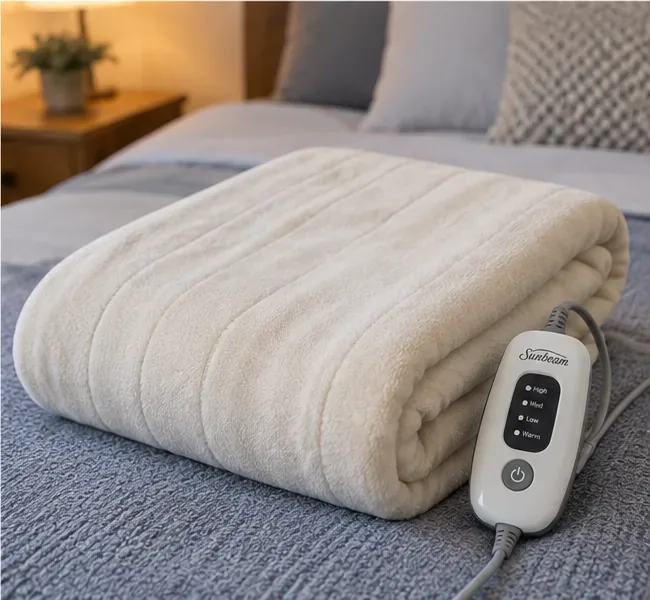
A clean, fully dried heated blanket beside its detachable controller. Reconnect only after the blanket and connector area are completely dry; controller appearance varies by model.
Action: when in doubt about residual moisture, wait longer. Do not plug the blanket in as a way to “test” or speed the drying process.
Four common misconceptions worth clearing up
“Electric blankets can never be machine washed.”
That is not true for the Sunbeam heated bedding covered by the current guidance above. The controller detaches, and Sunbeam permits cold, gentle machine washing. The important limitation is that this does not automatically apply to every electric blanket from every brand or every older Sunbeam model.
Action: treat the sewn-in label and exact model manual as the deciding source.
“Dry cleaning is gentler, so it must be safer.”
Sunbeam says the opposite for its heated bedding: do not dry clean it. The manufacturer warns that cleaning solvents may damage the insulation around the heating element.
Action: if ordinary washing is not appropriate because the product is damaged, contact the manufacturer rather than substituting dry cleaning.
“If the blanket says dryer safe, high heat is faster and fine.”
The current manual does not support that shortcut. It specifies low, delicate tumble drying, removal while damp, and natural finishing. It also warns against commercial dryers and laundromat dryers because of their heat.
Action: use low/delicate only when your model permits tumble drying, and finish drying outside the dryer.
“A little dampness is okay if the connector looks dry.”
Sunbeam instructs users not to reconnect until the heated product is completely dry. There is no verified shortcut in the cited guidance for judging electrical safety from the connector surface alone.
Action: allow additional drying time if any part of the blanket is cool, damp, or questionable.
What depends on your exact Sunbeam model?
The basic care sequence is consistent across the Sunbeam heated-bedding guidance reviewed here, but the physical connector, controller style, fabric construction, size, and exact label wording can vary. Older products may also have different manuals. The images in this guide show a representative detachable-controller setup rather than a promise that every Sunbeam controller looks the same.
There is also no universal answer here for unusual situations such as a blanket with a torn connector pocket, a controller that has been accidentally washed, a product with an unreadable label, or a blanket whose model number cannot be identified. Those cases need model-specific guidance rather than a generic cleaning recipe.
Action: find the model information on the product label and consult Sunbeam's manual/support resources before washing if anything about your blanket differs from the standard detachable-controller setup.
A quick pre-wash checklist
Read the sewn-in care label and locate the exact model manual if possible.
Unplug the blanket from the wall before detaching the controller.
Remove every detachable cord and controller that the instructions tell you to remove.
Inspect the fabric, wiring area, connector, and cord for visible damage.
Use cold water and a gentle cycle or hand wash when your model instructions allow it.
Do not use bleach, dry cleaning, a wringer, or an iron.
If tumble drying is allowed, use low/delicate and remove the blanket while still damp.
Finish drying naturally, following the model's directions.
Do not reconnect or power the blanket until it is completely dry.
Bottom line
For a typical detachable-controller Sunbeam electric blanket, washing is not a forbidden operation; it is a controlled one. The verified Sunbeam method is to disconnect the electrical controls, wash cold on gentle or hand wash, use only the permitted low/delicate drying process, finish drying naturally, and reconnect nothing until the blanket is completely dry. The care label for your exact blanket remains the final authority when it differs from generic guidance.
Jordan's example ends with a clean blanket only because every step follows the manufacturer's limits rather than treating the blanket like ordinary bedding. That is the useful rule to carry over to your own Sunbeam heated blanket: clean the fabric, but protect the wiring and connector system first.