Home
» How To
»
How to Wash a Weighted Blanket With Glass Beads: A Practical Care Guide
How to Wash a Weighted Blanket With Glass Beads: A Practical Care Guide
A weighted blanket filled with glass beads is not automatically safe for the washing machine just because the beads are glass. The care label on your exact blanket, the blanket’s total weight, its fabric and batting, the condition of its seams, and the capacity of your washer all matter. Start with those checks before adding detergent or water.
Some glass-bead blankets are designed for full machine washing. For example, Baloo’s current weighted blanket uses lead-free glass beads and is labeled machine washable: the company instructs owners to wash the blanket by itself in cold water on a gentle cycle, use gentle detergent, and dry on low heat. Baloo also warns that the blanket becomes heavier when wet and says to check the washer’s weight capacity; it recommends a commercial machine for its King size. That is a useful real-world example, but it is not a universal care rule for every brand. See Baloo Living’s current weighted blanket care instructions.
Fast decision table: wash the whole blanket, the cover, or only the stain?
Your situation
Best starting option
Why
Removable cover is dirty but the inner blanket is clean
Wash the cover separately
It avoids putting the heavy bead-filled insert through an unnecessary wash cycle.
Small food, drink, or body-oil spot
Spot clean first
Local cleaning reduces stress on stitching and saves a full wash.
Care label says machine washable and your washer can handle the load
Machine wash as labeled
This is the most convenient full-clean method when the manufacturer approves it.
Care label allows washing, but the blanket is too heavy or bulky for your home washer
Use a suitable commercial machine or professional laundry service
A larger drum gives the blanket room to move and reduces overload risk.
Care label says spot clean only, dry clean only, or gives another restricted method
Follow the label
The shell, batting, coatings, stitching, or trim may be the limiting factor, not the glass beads.
Seams are opening or beads are escaping
Repair or retire the blanket before washing
Agitation can turn a small leak into a major failure.
Before-you-wash checklist
Read the sewn-in care label and any manufacturer instructions for your exact model.
Remove and wash a duvet-style cover separately if the blanket has one.
Check the blanket’s dry weight and your washer’s rated capacity.
Inspect every edge, quilted pocket, tie, zipper, and seam for damage.
Confirm whether the label permits machine washing, hand washing, tumble drying, or air drying.
Use a mild laundry detergent unless the manufacturer specifies something else.
Do not use bleach unless the care label explicitly allows it.
Plan the drying method before you start; a wet weighted blanket is substantially harder to move and support.
Large bedding needs enough drum space to move. Whirlpool’s current bedding guidance says a bulky comforter cannot clean properly if it is packed tightly into a washer and recommends a large-capacity or commercial machine when a home machine is too small. A weighted blanket adds another concern: its concentrated mass. Whirlpool’s guidance is not written specifically for bead-filled blankets, so use it as an appliance-loading principle and still follow the blanket maker’s weight limits. See Whirlpool’s bulky-bedding washing guide.
How to machine wash a glass-bead weighted blanket when the label allows it
Step 1: Read the care label before choosing settings
Do this even if you have washed another glass-bead blanket successfully. Two blankets can use the same type of weighting material but different shell fabrics, batting, thread, edge binding, or internal pocket construction. The label is the shortest route to the correct water temperature, cycle, detergent limits, and drying method.
Step 1: Read the care label on your own blanket first; glass-bead fill does not make every weighted blanket follow the same wash instructions.
Step 2: Check machine capacity and give the blanket room
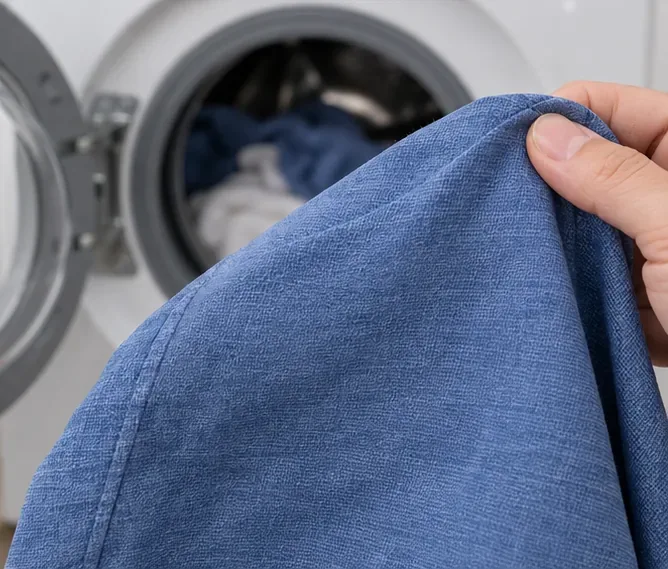
Wash the blanket by itself unless its manufacturer explicitly says otherwise. A heavy blanket sharing the drum with towels or clothing makes balancing and rinsing harder. If the blanket barely fits when dry, that is a strong sign that the machine is too small for a safe full wash.
A commercial front-loader can be the better choice for a large or heavy blanket. Baloo specifically recommends a commercial washer for its King weighted blanket and tells users to check the machine’s weight capacity because the blanket is heavier when wet.
A large laundry mesh bag is optional, not universal. It can contain loose ties or a removable cover, but it should not be used if it prevents the blanket from moving freely or if the manufacturer does not recommend it.
Step 2: Use a washer with enough capacity for the blanket to move; a mesh bag is optional and should not crowd the drum.
Step 3: Use a small amount of mild detergent
Use the detergent type specified by the blanket maker. When the label simply calls for a gentle detergent, a mild liquid laundry detergent is a practical choice because it disperses readily in cool water. More detergent does not mean a cleaner weighted blanket. Excess suds can be difficult to rinse from thick quilted layers.
Avoid bleach when the manufacturer prohibits it. Baloo, for example, tells owners not to bleach its glass-bead weighted blankets. Fabric softener is also best skipped unless the label permits it; bulky bedding can hold onto residues, and softener may affect some fabric finishes.
Step 3: Measure mild detergent rather than overfilling the dispenser; thick quilted layers need thorough rinsing.
Step 4: Choose the cycle and water temperature from the label
If your blanket’s label matches the common cold-and-gentle approach, select cold water and a gentle or delicate cycle. Do not raise the temperature simply because the blanket is heavily soiled. Hot water can affect dyes, fabric finishes, batting, and stitching even when the glass beads themselves are not the weak point.
An extra rinse can be useful for a thick blanket if your washer offers it and the care label does not prohibit it. Whirlpool recommends extra rinsing for bulky bedding to help remove detergent and soil. The tradeoff is more water and a longer cycle, so it is most useful when the blanket feels soapy after a normal rinse or when you are sensitive to detergent residue.
Step 4: Match the washer settings to the care label; cold water and a gentle cycle are common, but the exact blanket instructions take priority.
Step 5: Dry on low heat only if the care label permits tumble drying
Some glass-bead weighted blankets can go into a dryer. Baloo currently directs owners to tumble dry its weighted blankets on low heat, while its product page also describes medium or low heat for some versions. Use the instruction attached to your exact product rather than selecting high heat to save time.
If the label permits a dryer, use a drum large enough for the blanket to tumble instead of remaining in a tight mass. Clean wool dryer balls or tennis balls are optional for some bulky bedding because they can help separate folds, but they are not a substitute for adequate dryer capacity and should be omitted if the blanket maker advises against them.
Step 5: If tumble drying is allowed, use the manufacturer’s low-heat setting and a dryer large enough for the blanket to move freely.
Step 6: Air dry or finish drying with the blanket fully supported
If the care label says air dry, or if the dryer cycle ends while the inner layers still feel damp, support the blanket across a broad drying rack or clean flat surface in a well-ventilated room. Avoid suspending a saturated heavy blanket from a narrow clothesline unless the manufacturer explicitly recommends that method; concentrated wet weight can pull on seams and fabric.
Turn or reposition the blanket periodically so both sides are exposed to air. Drying can take much longer than ordinary bedding because there are many quilted layers and pockets to check.
Step 6: Support the blanket across a broad surface while air drying so its wet weight is not concentrated on a small section of fabric.
Step 7: Redistribute the weight and check every pocket
When the blanket is nearly dry, lay it flat and run your hands across the quilted sections. The glass beads should remain contained in their stitched pockets rather than collecting in a new bulge caused by a damaged seam. Gently smooth the blanket instead of aggressively shaking a heavy wet insert.
Use this inspection to find problems that may have appeared during washing: loose stitching, a torn pocket, beads outside their normal compartment, or a stiff area that is still wet. Do not put a leaking blanket back on the bed until it is repaired or replaced.
Step 7: Smooth the quilted pockets and check for bead migration, loose stitching, or sections that still feel damp.
Step 8: Do not store or cover it until it is completely dry
Check more than the surface. Press several of the thickest sections, corners, and center pockets. The blanket should feel dry throughout and should not have cool, clammy, or noticeably heavy patches. Whirlpool’s bulky-bedding guidance also stresses complete drying before use or storage to reduce the risk of mold and mildew.
Once fully dry, reattach a clean removable cover if you use one. Store the blanket folded on a sturdy shelf or spread on the bed rather than hanging its full weight from a small hook.
Step 8: Fold or recover the blanket only after the inner quilted sections are fully dry.
If the blanket cannot go in your home washer
Option 1: Wash only the removable cover
This is the lowest-stress routine when the inner blanket is not actually dirty. A washable cover catches skin oils, pet hair, crumbs, and many everyday spills before they reach the weighted insert. Wash the cover according to its own care label; do not assume the cover and inner blanket use the same temperature or dryer setting.
Option 2: Spot clean
For a small stain, blot rather than saturate the entire weighted pocket. Use a diluted mild detergent if permitted, work from the outside of the stain inward, then blot with clean water and towels. Allow the spot to dry completely before putting a cover back on.
Option 3: Hand wash only when the label permits it
A bathtub can provide enough physical space, but hand-washing a 15- or 20-pound blanket becomes significantly more difficult once it is saturated. The main challenge is not the glass beads; it is moving, rinsing, and supporting the wet blanket without twisting the seams. If hand washing is allowed, press and squeeze gently rather than wringing. If you cannot safely lift and support the wet blanket, use a commercial laundry facility instead.
Option 4: Use a commercial washer
A commercial machine is often the most practical answer for a large blanket that is labeled machine washable but exceeds your home appliance’s weight or space limits. Choose a machine with a drum that still has room after the dry blanket is loaded. Do not confuse “it fits through the door” with “the washer can safely handle it.”
What not to do
Do not guess from the filler alone. Glass beads are only one part of the construction.
Do not wash a blanket with open seams. Repair damage before agitation begins.
Do not overload a residential washer. The wet blanket can be far harder for the machine to move than the dry blanket suggests.
Do not automatically use hot water. Follow the label’s temperature limit.
Do not use bleach when the maker prohibits it. Bleach can damage fabrics, dyes, and stitching.
Do not wring a wet weighted blanket. Twisting concentrates force on the stitched bead pockets.
Do not use high dryer heat to speed things up. Use only the drying temperature specified on the care label.
Do not put a still-damp blanket back into a duvet cover or closet. Thick internal sections can remain damp after the surface feels dry.
Quick reference: the safest default when instructions are unclear
Question
Conservative answer
No care label?
Do not assume machine washing; contact the manufacturer or use cautious spot cleaning until the construction is confirmed.
Blanket barely fits in the washer?
Use a larger commercial machine.
Removable cover is the only dirty part?
Wash the cover separately.
Small localized stain?
Spot clean first.
Machine washable but no dryer guidance?
Do not improvise with high heat; check the manufacturer before tumble drying.
Blanket has loose stitching or bead leakage?
Repair or replace it before washing.
Final check before using the blanket again
A successfully washed glass-bead weighted blanket should be clean, fully dry, evenly supported by intact quilting, and free of bead leakage. Run your hands over the full surface, inspect the seams and edge binding, and make sure there are no unusually dense pockets or damp areas. If a section stays lumpy after gentle redistribution, or beads have crossed through a failed seam, stop using the blanket until the damage is addressed.
The most useful rule is simple: treat the care label as the authority, the washer’s capacity as a hard limit, and the wet blanket’s weight as something to plan for before you start. Glass beads do not require one universal cleaning ritual. A well-made, machine-washable model can be straightforward to launder, while another blanket may be better protected by cover washing, spot cleaning, or a commercial machine.