Home
» How To
»
How to Wash a Wool Coat Safely: A Care-Label-First Guide
How to Wash a Wool Coat Safely: A Care-Label-First Guide
The safest answer is simple: wash a wool coat at home only when its care label explicitly allows washing. If the label says “Dry Clean Only,” stop there and use the labeled cleaning method. A wool coat is more than wool fiber: its lining, interfacing, shoulder structure, buttons, adhesives, and dyes can react differently to water. The U.S. Federal Trade Commission’s care-label guidance makes the same practical point: instructions are meant to apply to the garment as a whole, and a “Dry Clean Only” warning means washing is expected to damage it. See the FTC explanation of garment care labels.
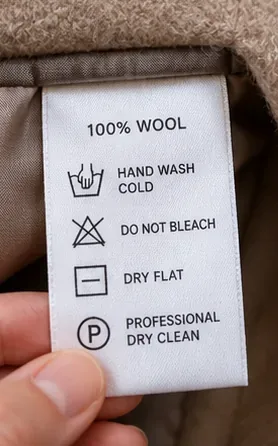
To make the process concrete, this guide uses a hypothetical example: Elena owns a camel-colored wool coat whose sewn-in label says “hand wash cold,” “do not bleach,” and “dry flat.” She wore it through a rainy commute, the cuffs have light road grime, and there is one small food spot near the pocket. This is only an example for applying the method; it is not a real test result or customer experience.
Quick decision: should you wash the coat at home?
What the label says
What to do
Dry Clean Only
Do not hand wash or machine wash. Use the specified professional method.
Hand Wash
Use the labeled water temperature and a mild wool detergent; minimize agitation.
Machine Wash / Wool Cycle
Use the labeled temperature and a wool or delicate cycle with mild detergent.
Do Not Wash
Do not immerse the garment. Follow the remaining care instructions.
Label is missing or unreadable
For a structured coat, the conservative choice is professional assessment rather than experimenting with full immersion.
Woolmark likewise advises checking the care claim first. Its current care guidance, reviewed for this article in September 2026, notes that many wool garments can be washed, but the approved method depends on the label. See Woolmark’s wool care hub.
How to wash a wool coat by hand when the label allows it
1. Read the entire care label before getting the coat wet
Elena’s hypothetical coat is suitable for hand washing, so she can continue. Before you do the same, read every instruction, not just the fiber content. “100% wool” does not automatically mean “hand washable.” Look for the cleaning method, water temperature, bleach warning, drying method, and ironing or steaming guidance. Detachable belts, faux-fur trim, leather pieces, or removable liners may have separate care requirements.
Start with the real care label. The hypothetical coat in this guide is washable; a coat marked “Dry Clean Only” should not be washed at home.
2. Empty, fasten, and brush the coat
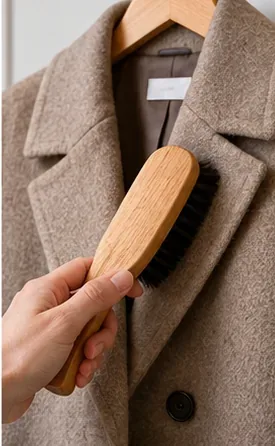
Remove everything from the pockets and take off any detachable accessories that the label tells you to remove. Close buttons or zippers if the construction is less likely to snag that way. Then use a clean, soft garment brush on woven wool, working with the surface rather than aggressively against it. Woolmark specifically recommends brushing woven garments lengthwise to remove surface soil. That matters in Elena’s example because loose grit at the cuffs can often be removed before any water is needed.
Brush the coat before washing so loose dust, lint, and surface soil do not become harder to remove once wet.
3. Treat small stains gently before the full wash
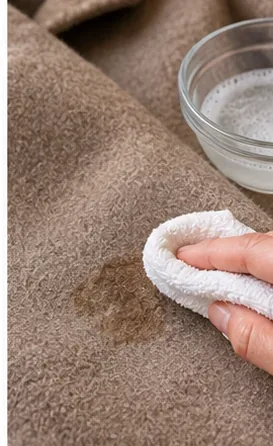
For Elena’s small pocket-area spot, the goal is to lift the mark without spreading it. Blot with a clean cloth and a small amount of appropriately diluted mild wool detergent. Do not scrub. Woolmark’s stain-care guidance for wool emphasizes gentle blotting rather than rubbing, and its general detergent guidance recommends a mild or neutral wool detergent. Avoid heavy-duty detergents, bleach-containing products, and enzyme-heavy “bio” detergents unless the garment manufacturer explicitly says otherwise. See Woolmark’s detergent guidance.
Blot a localized stain rather than scrubbing it. Friction can roughen the wool surface and spread the mark.
4. Hand wash with minimal movement
Fill a clean basin with water at the temperature on the label. In Elena’s example, that means cold water. For garments labeled for hand washing without a more restrictive temperature, Woolmark commonly describes clean lukewarm water of about 86°F (30°C), so the coat’s own label should always win when there is a difference.
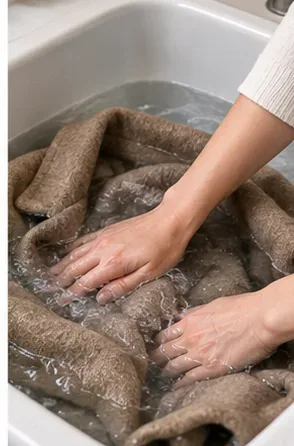
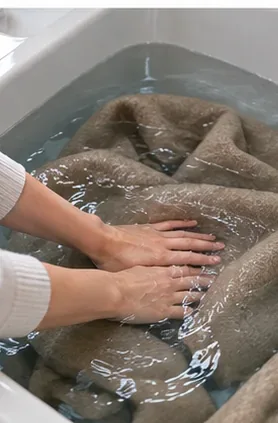
Add a small amount of mild wool detergent and distribute it through the water before adding the coat. Lower the coat into the basin and support its weight. Gently press the water through the fabric. Do not twist, scrub, or repeatedly lift a heavy, waterlogged coat by one shoulder. Wool fibers can felt and shrink when moisture, heat, and mechanical agitation are combined, while a structured coat can also distort under its own wet weight.
For a hand-washable coat, support the garment in the water and use gentle pressing motions instead of rubbing, twisting, or wringing.
5. Rinse without temperature shock or rough handling
Drain the wash water while supporting the coat, then refill with clean water at a compatible temperature. Press gently to move rinse water through the fabric. Repeat as needed until detergent residue is gone. Woolmark’s hand-washing guidance recommends thorough rinsing and low mechanical action; the important practical rule is that rinsing should stay gentle, not become a second wash cycle.
Rinse gently until detergent is removed, keeping the coat supported so the wet fabric is not stretched.
6. Remove water with towels, never by wringing
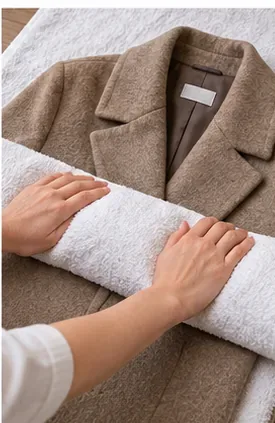
Once rinsed, let excess water drain naturally. Transfer the coat onto a clean, colorfast towel while supporting the entire garment. Lay it flat, roll the towel with the coat inside, and press the roll to absorb moisture. Unroll and repeat with a dry towel if necessary. Do not twist the coat like a towel: that can distort the shell, lining, seams, and internal shaping.
Use a towel to absorb water after rinsing. Press the roll; do not wring the coat.
7. Dry according to the label, then finish only if permitted
Elena’s hypothetical label says “dry flat,” so she reshapes the coat on a dry towel or ventilated drying surface, smooths the lapels and seams into their normal position, and keeps it away from radiators and direct sunlight. Woolmark recommends air drying wool away from direct heat and sunlight; its drying guidance also notes that the correct position depends on the garment type and care claim. See Woolmark’s wool-drying guidance.
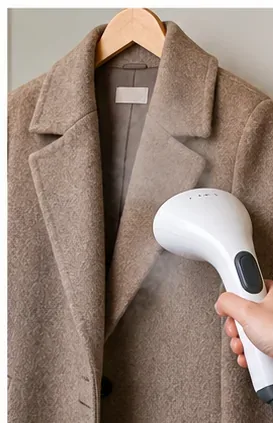
Do not judge the coat while it is still damp. Thick wool and linings can take substantial time to dry. Once it is completely dry, you may use light steam to relax wrinkles only if the care label and garment construction permit it. Keep the steamer moving and avoid soaking one area with condensation. If the label warns against steam or you are unsure about bonded interfacing, skip this step.
After the coat is fully dry, light steaming can relax wrinkles only when the care label and construction allow it; otherwise skip this finishing step.
8. Brush lightly and store only when fully dry
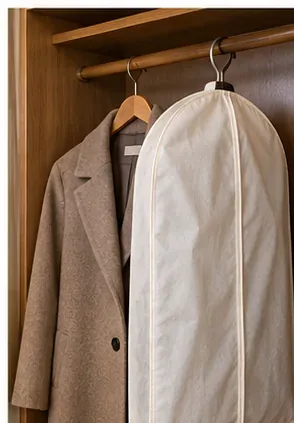
When Elena’s example coat is dry, she gives the woven surface a light brush and returns it to storage. Use a hanger that supports the shoulders without creating sharp bumps, unless the care label specifies flat storage. Never put a damp coat into a closed garment bag. For longer storage, make sure stains and body oils have been removed because residues can attract textile pests. A breathable cover can help protect against dust while avoiding trapped moisture.
Store the coat clean and fully dry on appropriate support, with enough space for air circulation and no trapped moisture.
What if the label says machine washable?
If your wool coat explicitly says it can be machine washed, you do not need to default to hand washing. Follow the label’s temperature and cycle. Woolmark advises using a wool setting when available, or a cold/delicate cycle where appropriate, together with a mild wool detergent. A large mesh laundry bag can reduce snagging, but it does not override a restrictive care label. Keep the load light enough that the coat is not compressed against heavy items.
Skip the dryer unless the coat’s label specifically permits tumble drying. Even if the outer wool is technically machine washable, a coat’s lining and structure may have different limits. This is why the care label is more important than generic fiber advice.
Common mistakes that cause shrinkage, distortion, or a rough surface
Washing a “Dry Clean Only” coat because the shell is wool. The whole garment construction determines safe care.
Using hot water or changing temperatures abruptly. Follow the labeled temperature rather than guessing.
Scrubbing stains. Blotting is safer for the wool surface than aggressive friction.
Using standard heavy-duty or enzyme-rich detergent without checking compatibility. Choose a mild wool detergent unless the manufacturer says otherwise.
Wringing the coat. Press water out with towels instead.
Hanging a heavy wet coat when the label says dry flat. Wet weight can pull the garment out of shape.
Drying next to a radiator or in strong direct sun. Use natural air drying away from concentrated heat.
Putting the coat away slightly damp. Wait until the shell, seams, pockets, and lining are fully dry.
When home washing is not the right choice
Choose professional cleaning when the care label requires it, when the coat contains leather or suede trim, when the lining or interfacing is damaged, when colors appear unstable, or when the stain is oily, unknown, or extensive. The same applies to tailored coats with complex internal structure if the label is missing. Home washing is most suitable when the manufacturer has already told you the garment can be washed and you can follow that process closely.
Bottom line
In the hypothetical example, Elena can safely proceed because her coat’s label explicitly allows a cold hand wash and flat drying. Your coat may require a different process. Read the label first, use mild detergent and low agitation only when washing is permitted, remove water by pressing rather than wringing, and dry exactly as directed. The goal is not to make every wool coat washable at home; it is to apply the safest method the manufacturer has approved for that specific garment.