Home
» iOS
»
iPhone 18 Pro Camera Review: Is the New Sensor Actually a Game Changer?
iPhone 18 Pro Camera Review: Is the New Sensor Actually a Game Changer?
As of September 14, 2026, Apple has announced the iPhone 18 Pro and iPhone 18 Pro Max, not a standard model called iPhone 18. The Pro models are available for preorder and are scheduled to reach customers on September 18. That timing matters: this is a practical, pre-release camera assessment based on Apple’s published specifications and claims, not a hands-on lab review. Apple’s announcement is available in its September 9 iPhone 18 Pro press release.
The short version is that the most important camera change is not a jump in megapixels. The iPhone 18 Pro keeps a 48MP Fusion Main camera, but adds a new sensor, a four-position variable aperture, and manual Pro controls for aperture, shutter speed, white balance, and histogram viewing. Apple says the new Main sensor improves image quality, but it has not published a sensor-size figure in inches or square millimeters. That means it is too early to claim that the sensor alone is a game changer.
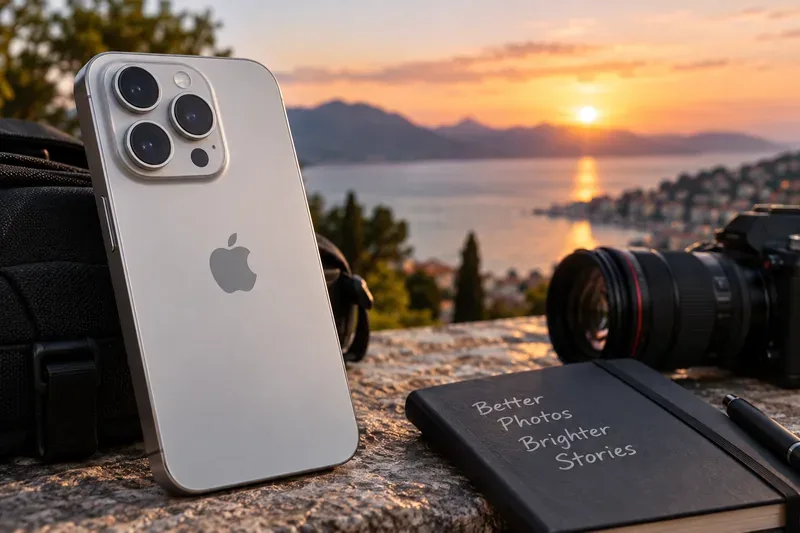
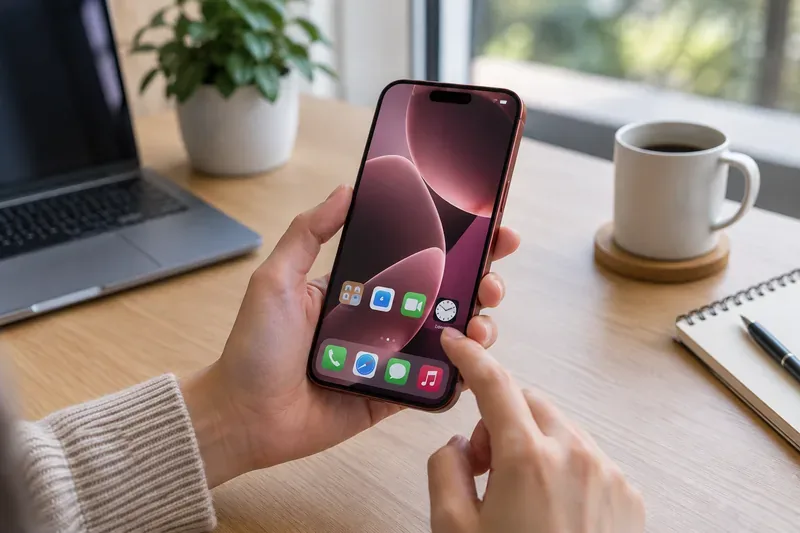
A triple-camera iPhone beside photography gear at sunset, illustrating the kind of high-contrast scene where aperture control, dynamic range, and low-light performance matter.
What is actually new about the Main camera sensor?
Apple describes the 48MP Fusion Main camera as using a “new sensor” and says it improves image quality. The company also publishes a 2.44 µm quad-pixel figure, with 1.22 µm individual pixels. Those pixel figures match the published iPhone 17 Pro Main camera specification. In other words, the public numbers do not support a simple story that the iPhone 18 Pro wins because it suddenly has much larger pixels.
The meaningful hardware story is the combination of that new sensor with a physical variable-aperture mechanism. Apple says six laser-cut blades can move between aperture settings, allowing the camera to alter both light intake and depth of field. The iPhone 17 Pro Main camera, by comparison, used a fixed ƒ/1.78 aperture. Apple’s older model specifications remain available on the iPhone 17 Pro technical specifications page.
Practical takeaway: do not buy the iPhone 18 Pro because of the phrase “new sensor” alone. The stronger reason is the camera system’s ability to combine that sensor with real aperture control and a more flexible shooting interface.
Why variable aperture matters more than the 48MP headline
Aperture affects two things photographers care about immediately: how much light reaches the sensor and how much of the scene can remain acceptably sharp from front to back. Apple lists four selectable aperture positions on the Main camera: ƒ/1.48, ƒ/1.8, ƒ/2.8, and ƒ/4.0.
For low-light photos: ƒ/1.48 is the important setting
Apple says the camera can open to ƒ/1.48 in darker conditions. A wider aperture allows more light to reach the sensor, which can reduce the need for very long exposures or aggressive computational brightening. That should be useful for indoor scenes, restaurants, nighttime streets, and moving people in dim environments.
What remains unknown is how much cleaner the files are compared with the iPhone 17 Pro when both cameras are tested under identical lighting. Noise reduction, motion handling, color, highlight recovery, and sharpening all depend on more than aperture alone.
For portraits: ƒ/1.8 is Apple’s highlighted balance
Apple specifically presents ƒ/1.8 as a portrait-friendly setting that balances light gathering with depth of field. For photographers who want a subject separated from the background without relying entirely on software-simulated blur, this is one of the most interesting uses of the new hardware.
It does not eliminate computational portrait processing. Smartphone sensors and lenses still behave differently from large-sensor interchangeable-lens cameras. The practical benefit is additional optical control before software processing begins.
For groups and layered scenes: ƒ/4 can be more valuable than a wider aperture
A common smartphone-camera problem is not lack of blur but too little usable depth of field when people stand at different distances from the lens. Apple says the Main camera can narrow to ƒ/4 to keep more of a group or scene in focus. That is potentially more useful than it sounds for family photos, events, food tables, architecture, and travel scenes with foreground and background subjects.
Quick action: if you eventually use an iPhone 18 Pro, compare the same group composition at the automatic setting and at ƒ/4. Look at faces in the back row, not just the center subject.
Lets the camera choose, while ƒ/2.8 gives a useful comparison point
Corner detail, highlight clipping, sharpening
Group photo
ƒ/4
Increases depth of field
Sharpness of people behind the front row
Intentional motion effect
Use Pro shutter-speed control
Controls motion rendering rather than relying only on aperture
Subject sharpness, hand shake, highlight exposure
How much of the camera system is actually new?
The Main camera is the headline change, but the rest of the rear system is important when judging whether an upgrade is worthwhile. Apple lists a 48MP Fusion Ultra Wide at 13mm and ƒ/2.2, plus a 48MP Fusion Telephoto at 100mm 4x and an optical-quality 200mm 8x option. Those focal lengths, apertures, and published quad-pixel figures closely resemble the iPhone 17 Pro’s camera specifications.
That does not mean the results will be identical. Apple also mentions a new computational imaging pipeline, updated Photographic Styles with texture and grain controls, smart focus tracking, and other software changes. But the published hardware table does not show the same kind of obvious generational shift for Ultra Wide or Telephoto that the Main camera gets from variable aperture.
Upgrade implication: if you mostly shoot at 4x or 8x, wait for side-by-side real-world samples before assuming a dramatic improvement. If you shoot mostly at 1x, the iPhone 18 Pro has a clearer hardware reason to be interesting.
Pro controls may matter as much as the sensor
Apple is adding manual control over aperture, shutter speed, and white balance, plus a histogram in the Camera app. For experienced photographers, this changes how the phone can fit into a deliberate workflow. A histogram can help catch clipped highlights before capture. Manual white balance can improve consistency across a series. Shutter-speed control opens the door to intentional motion blur or more predictable motion freezing when conditions allow.
These controls are not automatically better for every user. Automatic exposure and computational photography remain the fastest choice for spontaneous photos. Manual settings become valuable when consistency or creative intent matters more than speed.
What should be tested before calling the new sensor a game changer?
The iPhone 18 Pro is scheduled to become available on September 18, 2026. Until repeatable testing is possible on shipping hardware, several important questions remain unanswered. A proper camera review should check the following:
Low-light noise: compare fine texture in hair, fabric, foliage, and shadow areas at the same scene brightness.
Motion in dim light: photograph walking people or pets and compare subject blur, not just static-scene brightness.
Dynamic range: shoot a bright window, sunset, or backlit face and inspect highlight recovery and shadow noise.
Depth-of-field behavior: compare ƒ/1.48, ƒ/1.8, ƒ/2.8, and ƒ/4 at the same focus distance.
Group sharpness: place people in multiple rows and see whether ƒ/4 materially improves the back row.
ProRAW quality: inspect how much real recoverable detail exists before aggressive sharpening and noise reduction.
Lens flare and ghosting: put bright lights near the frame edge at night.
Video consistency: check exposure transitions, focus tracking, noise, rolling motion, and color across lenses.
A simple buyer checklist
If you shoot mostly at 1x, the variable-aperture Main camera is a substantial new capability worth testing.
If you frequently photograph groups, ƒ/4 may be one of the most practically useful additions.
If you shoot night scenes or indoor events, ƒ/1.48 is promising, but wait for motion and noise comparisons.
If you are upgrading from an iPhone 17 Pro mainly for telephoto, the published specifications do not yet show an equally dramatic hardware jump.
If you use manual camera apps or ProRAW, the new first-party Pro controls could reduce friction and make the stock Camera app more useful.
If image quality is your only reason to upgrade, wait for independent comparisons from shipping hardware rather than relying on launch samples alone.
So, is the new iPhone 18 Pro sensor a game changer?
Not by itself—not yet. Apple has confirmed a new Main sensor, but it has not published enough sensor-specific data or real-world comparative measurements to prove that the sensor alone is a generational breakthrough. The 48MP resolution and 2.44 µm quad-pixel specification are not new versus the iPhone 17 Pro.
The more convincing innovation is the complete Main-camera package: a new sensor paired with a true variable aperture, automatic aperture behavior, four manual aperture settings, and broader Pro controls. That combination can change how an iPhone handles low light, depth of field, group photography, and deliberate creative shooting in ways that are easy to understand and test.
For most buyers, the smart conclusion on September 14 is therefore conditional. The iPhone 18 Pro camera looks like a meaningful evolution, especially at 1x, but the word “game changer” should wait until shipping units can be tested against the iPhone 17 Pro in the same scenes. For Apple’s own current overview, see the iPhone 18 Pro product page.